

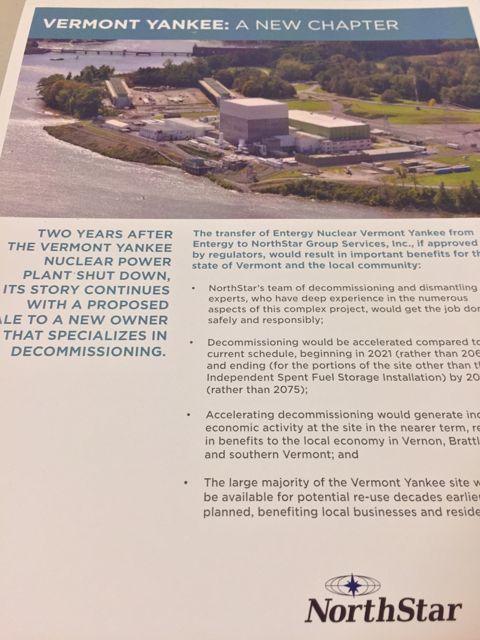
[N]orthStar’s top administrator says his company will “get moving quickly” on decommissioning Vermont Yankee now that state regulators have approved the sale of the Vernon nuclear plant.
Speaking a day after the Vermont Public Utility commission OK’d the transfer of the plant from Entergy to NorthStar, Scott State also said the goal of completing decommissioning by 2026 is “attainable” if things proceed as planned. That’s four years earlier than the project’s 2030 deadline.
That optimism stems in part from the fact that NorthStar already has performed about $27 million worth of “pre-closing” work at Vermont Yankee under a separate contract with Entergy.
“We were really happy with what we were able to get done ahead of closing,” State said. “At the end of the day, a year of pre-closing work saves a year off the back end of the schedule.”

The state utility commission’s ruling capped more than two years of planning, discussion, debate and negotiation surrounding NorthStar’s plan to undertake an accelerated decommissioning project in Vernon.
Entergy shut down the plant at the end of 2014 and has been preparing the site for a long-term decommissioning project that could have taken 60 years. In contrast, NorthStar is moving ahead with a massive, nearly $524 million decommissioning and restoration effort that may be done in less than a decade.
The federal Nuclear Regulatory Commission ruled in October that NorthStar could assume Vermont Yankee’s nuclear license. So the state’s decision clears the way for the sale to close, and Entergy has said that will happen early in 2019.
The utility commission’s review was marked by sometimes-contentious debate about NorthStar’s wherewithal and credentials. But a memorandum of understanding signed in March of this year included new financial and environmental commitments from the company and brought many – though not all – critics into the fold.
In an interview Friday, State said he believes NorthStar benefitted from the “vetting that occurred in Vermont.”
“There were times when it was frustrating and difficult, and it was very expensive,” State said. “But, at the end of the day, the process worked. And we couldn’t be more thankful for the engagement we had with all of the people involved.”
“I think everybody combined on this made this a better project, and we think that’s going to pay great dividends for us,” State added.
NorthStar wasn’t just waiting around while the regulatory process played out. The company has had personnel in Vernon since 2017 overseeing preliminary work for decommissioning under a contract with Entergy.
Much of that work involved preparations for removing Vermont Yankee’s reactor. That included engineering and analysis to determine how best to dismantle the reactor for disposal, as well as “procurement of special tooling to do that kind of work, which has long lead times to get it developed and available,” State said.
The pre-closing work also included improving a rail line into the plant site, since much of the project’s waste will leave via railcar.
Once NorthStar has ownership of the site, decommissioning work will be “almost immediate,” State said.
The first priority will be removing the plant’s reactor. That will happen via a contract with Orano USA, which was formerly called AREVA and has international expertise in reactor work.
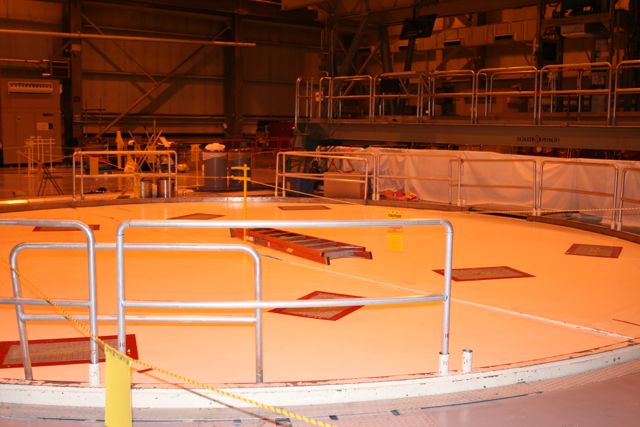
The reactor and the plant’s spent fuel together constitute more than 99 percent of the site’s radioactive materials, State said. So “it’s a risk reduction (and) it’s a safety improvement to get that piece of work done first,” he said.
After the reactor job is finished, State said, NorthStar will have a better handle on the time required to complete the rest of the work.
“We know where we should be on production rate, getting various pieces of work done,” State said. “And if we can stay on target with that, we’ll be closer to 2026 than 2030 – we’re certain of that.”
While this will be NorthStar’s largest nuclear project to date, State noted that the company has extensive experience in decommissioning industrial sites.
“It’s largely work that we do every day, somewhere. It’s removal of steel and concrete,” he said. “It happens to be radiological (in Vernon), which impacts the health and safety program that you have, and it impacts your productivity.”
NorthStar’s decommissioning work is subject to both federal and state oversight. NorthStar also has pledged to work with the community, including giving regular updates to the Vermont Nuclear Decommissioning Citizens Advisory Panel.
“Our preference is to do as much as we can in a public forum so that there’s complete transparency as to what we’re doing,” State said. “It’s our plan to make sure that we’re actively engaged with all the various stakeholders.”
Those stakeholders include Vernon officials, and State said “that relationship has gone very well.” The town has its own agreement with NorthStar, including provisions for tax payments, expense reimbursements and road repairs.
Town officials also have discussed redevelopment issues with NorthStar, though the Vermont Yankee property’s future is not yet clear. The timing of the NorthStar sale approval is “pretty amazing” because officials are finalizing their town plan and reviewing a plan for a village center near the plant, said Bob Spencer, chair of Vernon’s Planning and Economic Development Commission.
“From a town planning perspective, this really opens up some opportunities,” Spencer said.
NorthStar also is engaging with the Elnu Abenaki, a Native American tribe that has submitted testimony to the state regarding the tribe’s long history in the area of the Vermont Yankee plant. NorthStar has agreed to hire a cultural adviser to help on the Yankee decommissioning project.

Rich Holschuh, a Native American activist representing the Elnu Abenaki tribe in Vermont Yankee proceedings, said NorthStar has been “conscious and proactive” in dealing with the tribe’s concerns thus far.
“Now we get into the nitty-gritty, and I want to be sure that what comes out of this is meaningful – that it accomplishes some of the obligations that haven’t been met in the past,” Holschuh said.
That’s one of many obligations that NorthStar is bound to now that the Vermont Yankee sale is moving forward.
“Now it’s up to us to go do the project the way we’ve described that we would, and be good partners and good citizens, and at the end of the day return the site to a use that’s beneficial for the local community,” State said.

