


[L]awmakers prepared for adjournment — possibly Friday — despite failing to resolve a dispute with Gov. Phil Scott over health care benefits for teachers.
The Statehouse held its breath Thursday to see if the Republican governor and leaders in the Democrat-controlled House and Senate could make headway on a deal that could send lawmakers home. Late in the afternoon, a united Democratic leadership made a pitch that the governor said he would use to frame a counterproposal. However, the two sides appeared far apart after another day of back and forth.
House and Senate leaders said their latest proposal will save property taxpayers money and protect collective bargaining for teachers. Scott said it falls short of his plan, which lawmakers had already rejected.
Unless the disagreement is resolved at the last minute, the impasse will likely result in a budget veto, setting the stage for a special session in June.
Scott’s insistence that lawmakers find education savings has been the major sticking point holding up adjournment. Lawmakers had hoped to leave last Saturday.
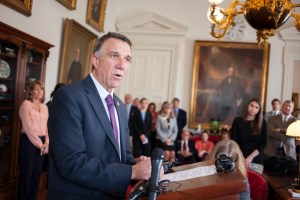
The governor has said he wants to capture significant savings by taking over state health insurance negotiations with teachers and bargaining for a uniform package statewide. Democrats and union leaders say that would disrupt the way contracts are negotiated with the local districts.
The new Democratic plan would use the same math as the governor’s while leaving it to school boards to achieve the savings in negotiations. Boards that don’t reach their targeted share of the mandated statewide savings — a total of $13 million — would have to make it up elsewhere, such as through cuts to staff or programs.
Scott has said his plan yields up to $26 million a year, but the new contracts would kick in at midyear, giving $13 million during the first year.
House Speaker Mitzi Johnson said the Democrats’ proposal guaranteed property tax relief. She said it was very similar to a plan she presented the governor on Wednesday afternoon, which was quickly rejected.
“This is the only plan on the table that guarantees a 3-cent reduction in property taxes this year, right now,” the speaker said during a press briefing outside the caucus meeting room.
“Every other plan nibbles around the edges,” Johnson said.
The state’s largest teachers union hailed the Democratic proposal and urged lawmakers to pass it.
“It certainly, from our perspective, preserves collective bargaining, which was a foundation principle that we felt was incredibly important,” said Jeff Fannon, the executive director of the Vermont-NEA. “We think it’s important that that remains a principle that we continue on and carry forward with.”
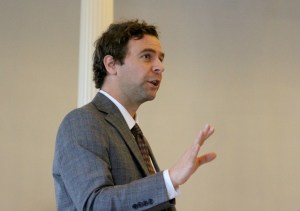
Senate President Pro Tem Tim Ashe, who worked on the proposal, said the Democratic leadership agreed that “we do not want to interfere in collective bargaining.”
Speaking in the late afternoon on the Senate floor, Ashe told senators the path for a deal with the governor had significantly narrowed, but said he would remain hopeful “a miracle” could happen. He said that “there’s not much further to go unless the goalposts get moved again.”
If no last-minute deal is reached, Senators will vote on the Democratic plan Friday and adjourn, according to Ashe.
Ashe and Johnson are putting their plan to a vote knowing it might draw a Scott veto. That threat, lawmakers said, has hung over the entire session.
Benefits and bargaining
The opportunity for savings is the result of changes under the Affordable Care Act. All teachers in the state will move to lower-value health insurance on Jan. 1. The new plans have less expensive premiums and higher out-of-pocket costs.
The state estimates that $75 million can be saved. Scott proposed giving the teachers back $49 million to cover out-of-pocket costs, with the remaining $26 million to be split between property tax relief, the general fund and teacher retirement. The Beck amendment, a version of Scott’s proposal, would have given all the money back to taxpayers. The Beck amendment failed last week in the House.
The Democratic leaders’ one-year proposal would take $13 million out of the education fund. School boards would be responsible for achieving savings in an amount equal to their share of the $13 million.
Boards would report savings to the Agency of Education, which would reduce the amount it sends to each school district by the amount saved.
The legislative proposal says “these savings can be achieved” with an 80/20 premium split and $2,400 for out of pocket costs incurred by teachers.
The governor says he can build on that plan by changing the word “can” to “shall,” requiring local school boards to negotiate an 80/20 split.
Scott also wants to see a plan that reduces education spending on an ongoing basis. “These are ongoing savings we have to realize … year after year,” Scott said.
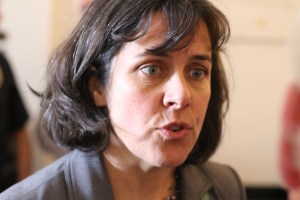
House Speaker Mitzi Johnson, D-South Hero, speaks to reporters Thursday about a Democratic plan to lower property taxes. Photo by Erin Mansfield/VTDigger
Johnson said Democratic leaders tried to address the governor’s concerns but that he kept moving the goalposts. Thursday morning, Johnson said Scott told Democratic leaders that in addition to a statewide health insurance contract, he wanted local school districts to agree to limit salary increases so they wouldn’t gobble up the health care savings.
“That was put on the table this morning,” Johnson said. The governor’s new proposals have been “a little bit of a game of whack-a-mole.”
She said it had been difficult to pin down the governor on whether he wanted property tax relief or something else.
Ashe charged that Scott intends to break the collective bargaining process.
Ashe told fellow senators in a late Thursday afternoon session that he never thought “the budget would be held up over collective bargaining.” He said the two issues were unrelated and that Scott’s efforts were “equivalent to holding up the budget over marijuana legislation.”
Lawmakers ambivalent about Democratic leadership’s plan
But some challenged the notion that the Democrats weren’t interfering with local bargaining, because districts would be punished if they can’t get prescribed concessions.
“The whole reason you are proposing this is because you don’t want to shift negotiations to the statewide level where the administration thinks it is fundamental to get to a sustainable level of spending,” said Rep. Kurt Wright, R-Burlington. “Talk about local control — you’re inserting yourselves into the negotiation and forcing them to potentially cut programs for kids.”
Fannon, from the Vermont-NEA, said he didn’t think it would come to that. “I think that there’s only so much money that they always get anyway, and I think they’ll manage to that,” Fannon said. “Notwithstanding what others have said in the past, they’ve been prudent managers in the past and I think they will do so going forward.”
Rep. Heidi Scheuermann, R-Stowe, said she was really concerned for school boards. “School boards will have a difficult time. The challenge with negotiating with the teachers union, it is happening right here, right now — the Statehouse can’t even do it.”
“This is like way worse,” said Rep. Anne Donahue, R-Northfield, after seeing a draft of the Democratic leadership’s new plan. “This totally dumps on the school boards a mandate to come up with these reductions.”
Nine local contracts around the state have already been decided for the next fiscal year, and none of the eight that have been made public so far have hit the numbers assumed in the savings plans. Under the Democrats’ proposal, those school boards would have to make other cuts.
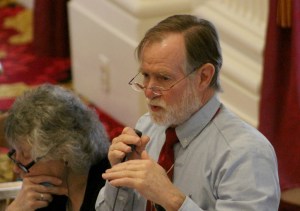
Rep. David Sharpe, D-Bristol, chair of the Education Committee, said the governor pushed this idea late in the session and some lawmakers didn’t like the savings going to the education fund or the general fund. “He put us in a very difficult situation,” Sharpe said.
But Sharpe said the opportunity for savings is real since every school district is negotiating contracts this year.
“We have this opportunity, and if all the school districts in the state bargain in a way that saves taxpayer dollars, it will reduce education spending by $13 million,” Sharpe said. “We put it all on the bottom line. We thought it was important to return that money to taxpayers, and that is what we did.”
After the first year, savings are dependent upon teachers changing the way they use health care. But the savings will reset the education fund, and the governor expects annual windfalls from his proposal.
Getting to adjournment
The health insurance dispute has held up votes on the property tax rate and the budget.
Sen. Jane Kitchel, D-Caledonia, chair of Senate Appropriations, said a conference committee negotiating differences between the House and Senate budgets likely will not meet again until Friday.
“The budget is the last ship to leave the port,” Kitchel said.
Sources said Ashe was willing to stay in session until the issues were resolved while Johnson was not. The speaker acknowledged that she and Ashe had not always been on the same page during the week. Some lawmakers said there was clearly friction between the two and differences in style. An earlier plan put forward to the governor Wednesday came from Ashe, not from both chambers’ leaders, as has been typically done in the past.
“No, we haven’t always been in lockstep, and I don’t think it’s our jobs to be in exact lockstep,” Johnson said. “The House has different dynamics and concerns than the Senate, so that’s expected in our relationship, but we’ve been trying to work together on something that can get us out of here” and address high property taxes.
When a senator asked if the session might bleed into Saturday, Ashe said, “I don’t take any delight” in staying longer. Ashe said it was out of his hands and up to the House whether to suspend its rules.
The Senate leader, who along with the speaker and governor are all newly installed in leadership positions, warned against making poor decisions just to save one day’s worth of legislative cost.

Sen. Anthony Pollina, P/D-Washington, said Scott had been “out of the picture” during the legislative session until the end.
“I think the governor has latched onto an idea and he’s become very inflexible and unwilling to look at any alternatives, and I think it’s unfortunate because we have the potential to save money for property taxes, but it doesn’t have to necessarily be the way the governor sees it. I think the governor should be more open and more cooperative.”
“I think what he’s trying to do is embarrass the Legislature, in a political way that he can gain points whether or not what he’s doing is sensible or practical,” the longtime Progressive said.
“I think he’s more political than people would imagine, quite honestly,” Pollina said. “For a guy who’s always had an image of being very open and a regular guy you’d go get a beer with, I don’t think too many people have been having beers with him lately because he’s really not around.”
Rep. Johannah Leddy Donovan, D-Burlington, was asked what would be different if the governor vetoed the budget and the Legislature returned for a special session.
“I think we’ve been here all session, everything we have done has faced a veto of the governor. We have no power over that. We have to do what we think is right, and he’ll have to make decisions for himself,” she said.
/
