


School officials are urging lawmakers not to act with haste as they mull sweeping reforms to the way Vermont pays for its preK-12 system.
Since the release of a major education funding study from the University of Vermont last month, Senate lawmakers have been contemplating how to overhaul the state’s education tax system. But even as they urge them to act on the report’s findings – which recommend substantial changes to the way factors like poverty are accounted for in the state’s formula – school officials are cautioning legislators not to move too quickly.
Among the complicating factors, they say: a bottleneck of school reform efforts, an understaffed Agency of Education, and the enormity of the tax implications of the study’s recommendations.
Testifying before the Senate Education Committee earlier this week, Vermont Superintendents Association executive director Jeff Francis called the study “a call to action.” But he also ticked off a list of major concerns already in play: newly merged districts learning to get along together, a special education system in transition, and growing infrastructure needs.
“The reference to those things is not intended to be a barrier or an excuse that you don’t act. Quite the contrary,” he told lawmakers.
Senate Education Chair Phil Baruth, D/P-Chittenden, has already said any changes would need to be phased in over several years. Francis and Jay Nichols, the executive director of the Vermont Principals’ Association, recommended going a step further and convening a commission to outline an implementation plan for the General Assembly.
Legislators also took a first look this week at a tax simulation created by the Joint Fiscal Office using current spending, as well as one set of recommendations presented by researchers. JFO’s modeling is only a first pass by lawmakers at what a new system could look like, and is highly likely to change. But it makes clear who would win or lose under a reformed system, and illustrates just how profound the tax consequences would be.
A large number of districts – 77 – would see a tax rate decrease of an average of 18 cents in JFO’s model. Another 39 would see their taxes go up an average of 16 cents. But individual districts could see their taxes swing by far more. On one end of the spectrum, the southern Vermont school district of Searsburg would see its tax rate plummet 53 cents. Norwich, meanwhile, in the Upper Valley, would see its rate skyrocket 52 cents.
Lawmakers must also consider how changing the overall formula will interact with Act 173, the special education overhaul passed in 2018. Jeff Fannon, the executive director of the Vermont-NEA, called the changes coming to Vermont school districts under the special education law “seismic.” The combination of district mergers, a dramatic reform to education taxes, and the special education law “could be toxic,” he said.
“We are concerned about the erosion of public support for the public school system,” Fannon said. “That’s a legitimate concern on our part.”
The union is advocating for an outright repeal of Act 173, Fannon added, because it believes educators haven’t received the necessary training to implement the law as intended. Such a reversal is unlikely from the General Assembly, and Baruth replied immediately that revoking the overhaul was a non-starter for him. But a delay in the law’s implementation, he said, was a possibility.
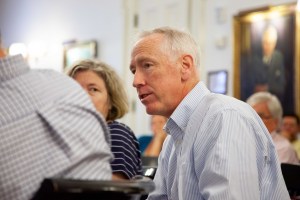
“We might have to mess with the timeline. We’ll hang that on the wall as something to be thinking about,” Baruth said.
Lawmakers last session already delayed by a year the rollout of Act 173, which switches Vermont from a reimbursement to a block-grant model for funding special education, at the request of an advisory group tasked with overseeing the reform’s multi-year implementation.
At the time, the advisory group cited concerns about a lack of capacity at the Agency of Education, inadequate professional development, and disagreements over draft regulations.
Meagan Roy, the group’s chair, said this week that while repealing the measure wasn’t something the group supported, it remained concerned about whether staff in schools were receiving the proper training. And it has also recently come to light, she said, that there was a one-year disconnect between the switch to a block-grant model and when independent schools would come under the act.
It’s possible that the group might ultimately ask legislators once again to delay the law’s effective date, Roy said. But its members might be hesitant to do so.
“The advisory group recognizes that we can’t delay, delay, delay because this is a difficult thing,” she said.
