

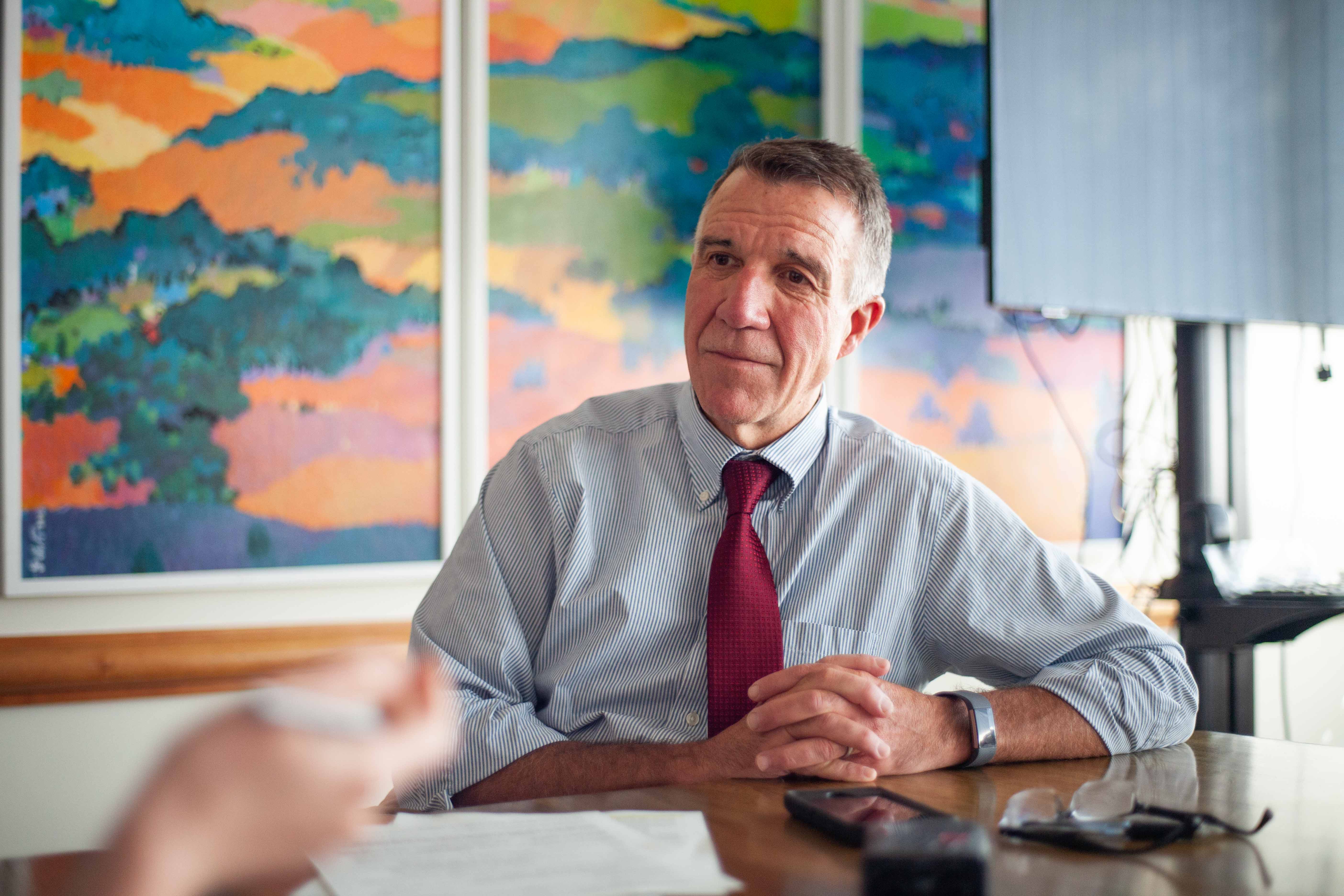
On Sept. 27, days after thousands of Vermonters descended on the Statehouse and downtowns across the state to demand immediate action on climate change, Gov. Phil Scott did not share the sense of urgency.
In an interview at his office that day, the popular Republican governor said that when it comes his climate initiatives in 2020, he’s “not looking to reinvent the wheel” and “not looking to come out with something dramatic.”
Since taking office in 2017, Scott has avoided taking drastic action on climate change. And until earlier this year, so had Democrats in Vermont’s Legislature.
Now, as an election year coincides with a groundswell of public support for climate action — 76% of Vermonters said they are worried about global warming in a recent poll — Democrats are poised to pass sweeping bills aimed at cutting carbon emissions.
But it appears that pressure coming this year from Democrats in the Legislature, and voters across the state, may not be enough to sway Scott. And even if Scott blocks the bills, there remains deep skepticism that his opponents will be able to make him pay on election day.
Democrats and Progressives in the Statehouse have united behind two major climate initiatives they plan to move forward next year.
One, the “Transportation Climate Initiative,” would authorize Vermont to take part in a regional push to charge companies for bringing fossil fuels into the state. Governments would then use the funds to invest in carbon-cutting measures.
The other legislation known as the “Global Warming Solutions Act,” would require Vermont to reduce its carbon emissions by about 25% by 2025. Unlike the state’s current emissions targets, which are only goals, the bill would hold state agencies legally liable for cutting emissions.
Scott, who has opposed policies that increase the cost of living for Vermonters and raise government spending, is already signaling concerns about both measures, and those close to him are doubtful he will come around on either.
But in 2020, the governor, who is likely running for reelection, will also have to weigh whether thwarting climate action could cost him votes.
“The climate change advocates will say that we’re facing a climate crisis, it’s necessary to do something right way,” Eric Davis, an emeritus professor of political science at Middlebury College said of climate change policies in 2020.
“The governor will use his mantra of affordability once again, and he will say that Vermont shouldn’t do anything that increases the cost of living in this state.”

Some Republicans have raised concerns about the 12-state Transportation Climate Initiative, and called its system of fuel pricing a “carbon tax.” Under the agreement, which would include Northeastern and Mid-Atlantic states, fuel prices could rise by as much as 17 cents per gallon.
New Hampshire Gov. Chris Sununu, a Republican, said Thursday the state would not be participating in the accord because it would lead to higher gas prices. However, Gov. Charlie Baker, the Republican governor of Massachusetts, is backing the measure.
For the last year, the Scott administration has helped negotiate the terms of the 12-state agreement, and the governor says he still needs time to review the proposal before making a final decision. But he has already expressed skepticism of the agreement, and said if it ends up as only carbon tax, he won’t support it.
Sen. Joe Benning, R-Caledonia, the Senate minority leader and a close ally of the governor’s, said he doesn’t believe Scott will support the regional climate initiative. Benning said higher fuel prices will place a burden on rural Vermonters, and if the proposal comes out “smelling like a carbon tax” it will be roundly rejected by the governor.
“Phil Scott is very anxious to try to preserve peoples’ pocketbooks,” Benning said. “All of us want to have a clean environment, and I think Phil Scott does too.” he added. “But bankrupting a substantial portion of the state at the same time…that doesn’t make common sense.”
A source in the Scott administration said that while the governor hasn’t made up his mind about the regional initiative, he has “nothing but suspicion” for it.
“We do want to help get to our emissions goals or our carbon footprint goals, but I think the governor is very suspicious of doing that through price mechanism,” the source said.
While the governor has been leery of carbon pricing proposals, he has been a proponent of expanding access to electric vehicles through incentive programs.
Rebecca Kelley, the governor’s spokesperson, said when it comes to proposals to address climate change in 2020, the governor’s budget will include “a continued focus on vehicle electrification and expediting transition to/adoption of these technologies.”
The governor declined to be interviewed for this story, and referred to a September interview on climate change with VTDigger. In that interview, and in other discussions about climate change with the press, Scott has said he believes electric vehicles will be central in the state’s fight against the warming climate.

He has repeatedly said now that popular vehicle manufacturers including Harley Davidson, Ford, Bugatti, and Lamborghini are coming out with electric models, others will follow suit, and they will soon become widely adopted by consumers.
“[As] soon as there’s this proof, that people see that something works, that is efficient and effective, and affordable, then they’ll migrate towards that,” he said in the September interview.
At the time, the governor said he was “open-minded” about the Democrats’ Global Warming Solutions Act, the measure that would require Vermont to reduce emissions 26% below 2005 levels by 2025 — or roughly a quarter from present levels. This would align with the goals set out in the Paris Climate Agreement, which President Donald Trump withdrew from in 2017.
But Scott also expressed reservations about how under the measure, the state could be held accountable in the courts if it didn’t reach carbon emissions goals.
“Trying to use a regulatory method and punishment as a means to drive change typically doesn’t work that well,” Scott said at the time.
Rep. Jim Harrison, R-North Chittenden, who is close with the governor, said he could support putting stricter emissions reductions goals into state statute. But opening the state up to court challenges could make it harder for him and other Republicans to support the legislation.
“I think for anybody that’s concerned about fiscal responsibility, it’s going to raise some flags,” Harrison said. “We just have to be very, very careful that we don’t end up in a situation where we create some real liabilities.”
House Speaker Mitzi Johnson, D-South Hero, said Thursday that her action on climate change in 2020 would not be “limited” by the governor’s thinking.
“I think it’s our responsibility to put forward the best piece of legislation that we can that acknowledges that while we’re not going to solve the whole problem, we have a role to play,” she said.
“[We] have a very short time to curb our emissions, change our practices, to make sure that we have a decent world to leave to our kids and grandkids,” she added. “That is much more important to me than what somebody else thinks right now.”
Senate Majority Leader Becca Balint, D-Windham, said that with rising public support for climate change measures, lawmakers will move forward with them, despite headwinds from Scott.
“I understand that the governor seems to be making those signals that he’s lukewarm on this, but we have to answer to our constituents,” she said. “What we’re hearing is that we want more movement on this.”
Balint said that Scott’s position on climate change could be a hurdle for him in an election year, when Democrats are expected to be energized, and turning out en masse to vote against President Donald Trump.
“You’ve got so many people activated on this issue and 2020’s going to be a big election for Democrats nationally, there’s a lot of frustration,” she said. “You’ve got quite a bit of people in Vermont who did not pull the lever for the presidential candidate.”
Rebecca Holcombe, a former Vermont education secretary, and the only Democrat who has announced she is running for governor next year, has frequently criticized Scott for failing to address climate change during his governorship.
She said the Transportation Climate Initiative is an important step to raise revenue to cut emissions, and that Scott isn’t taking a strong position on the issue because it backs him into a corner.
“The problem is I think politically, what he’s struggling with is that he wants to look like Charlie Baker and support it, or appear to be supporting it, because he knows Vermonters want climate action. But he’s also trying to be Gov. Sununu and reject it because of the carbon pricing,” she said. “And you really can’t have it both ways.”
But some are not convinced Scott’s positions on climate change will be enough to make a difference in the upcoming election. The governor is widely popular, with 64% approval rating, according to the latest poll from Morning Consult, and has historically opposed legislation that raises the cost of living in the state.
Sen. Anthony Pollina, P/D-Washington, the chair of Vermont’s Progressive Party, said even if the governor stands in the way of the legislation, he’s not sure it would harm Scott in an election.
He noted that the governor, who was elected on a pledge to hold down the cost of living in the state, has been reelected despite his vetoes of bills to raise the minimum wage and create statewide paid family leave program, which also have widespread support among voters.
“He’s able to weather this stuff in the past, so we’ll see,” Pollina said.
Lt. Gov. David Zuckerman, a Progressive Democrat who is seriously considering running for governor next year, said climate change has “the potential to be a weak spot” for Scott, whose success has relied on the support of some moderate Democrats.
Zuckerman said Scott won over many members of the Democratic Party in 2018, when he changed his stance on gun control and signed a sweeping package of gun restrictions into law.
But he said many of the Democratic voters who have supported Scott are also concerned about climate change.
“I think the governor is probably in a tight spot given that the overall average Vermont voter is not where he is from a party perspective and the question is how far can he move on issues and not lose more of his base,” Zuckerman said. “It’s a tricky path for him.”
Benning, the Republican senator, said the governor’s opposition to the Transportation Climate Initiative won’t be a problem in some districts, including his own, rural Caledonia County. But it could be a liability for Scott in other parts of the state, where support for climate action is higher.
“That is problematic, I don’t know how to get around that. There are people who are trying to position Phil Scott into making him vulnerable for the next election,” Benning said.
“You still come back to the basic argument: How does this hit the person on the street?”
Elizabeth Gribkoff contributed reporting.

