

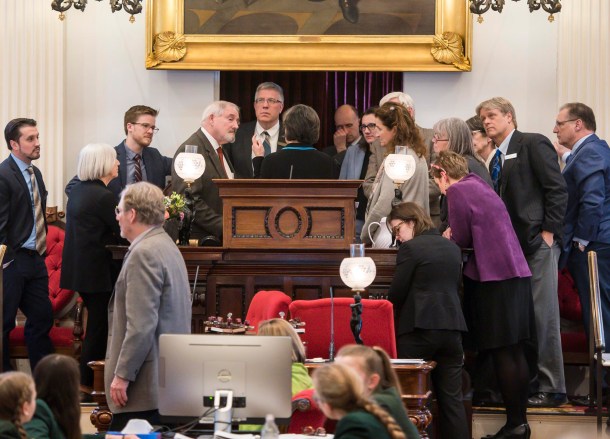
The Vermont House advanced legislation Thursday that would establish a statewide paid family leave benefit funded by a payroll tax paid by workers, or employers who volunteer to cover the cost.
In a vote of 92-52, lawmakers gave preliminary approval to the program, which would be administered by a private insurance carrier and grant employees 12 weeks of family leave or eight weeks of medical leave per year.
While the paid family leave bill, H.107, won a wide margin of support, Thursday’s vote demonstrated that Democrats may fall just short of the support they would need to revive the measure if the bill is vetoed by Gov. Phil Scott.
A slate of more moderate Democrats and independents joined Republicans in voting against the program, expressing concerns over the cost of the program and requiring employees to opt in.
Even if all six members who were absent Thursday supported the bill, Democrats would still need to flip two votes to override the governor’s veto.
Scott has signaled he would oppose a paid family leave program if it was funded by a mandatory tax like the House-backed bill.
He pitched his own, voluntary paid leave proposal to legislators earlier this year, but Democrats have resisted adopting a program that doesn’t mandate universal participation from employees and employers.
For the past two years, Democrats in the House have made enacting a statewide paid family leave program a top priority. They say that the benefit will help draw workers from out of state, and keep young families in Vermont.
Under current law, Vermont’s workers have scarce access to paid family leave programs: only 15 percent of employees are offered paid leave benefits by their employers.
“The focus of this legislation is to provide access to this benefit to those Vermonters who struggle the most,” Rep. Tom Stevens, D-Waterbury, told House lawmakers Thursday. “This program allows all working Vermonters to access a benefit that only a few lucky Vermonters have today.”
The mandatory 0.55% payroll tax used to fund the $76 million program would be paid by workers, unless employers volunteered to cover some or all of the benefit.
Employees on leave would receive 90% of their weekly wages if they make at or below the Vermont livable wage, which is currently $13.34 an hour.
Employees would receive only 50% of what they earn above that, until they reach 2.5 times the liveable wage (an annual salary of about $70,000 or more). At this income level or higher, the most anyone could receive under the paid leave program is $1,334 per week.
By giving the largest portion of the benefit to people who make about $27,000 a year or less, Democrats designed the program so that low income earners would be able to take advantage of it.
In some other states with paid family leave systems, the rate of employee wage replacement is uniform, but lower, offering workers 60-70% of their wages while they’re on leave.
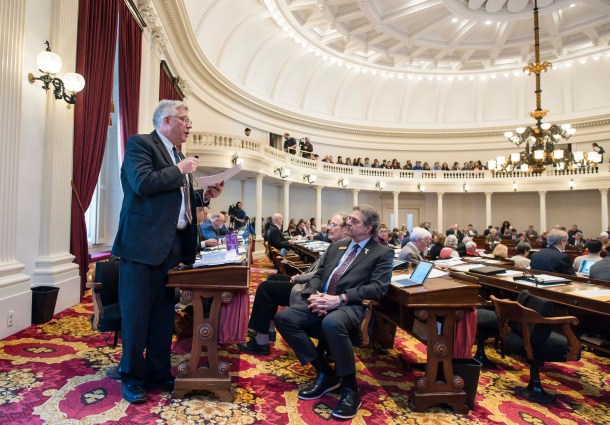
Democrats say a lower rate makes it more challenging for low income residents to afford using the program.
“I think by taking the resources that we have and concentrating them on lower wage workers … I think that really gets to the heart of the problems that really needed addressing in other states, while really ratcheting back the cost of the program and easing the burden on employers,” House Speaker Mitzi Johnson said Thursday morning.
House Republicans voted in a block against the measure and opposed the policy because the tax used to fund the program would be mandatory, and employees would not be able to opt out of paying into the system each year.
The Joint Fiscal Office estimates that an employee making the median income in Vermont, about $58,000 per year, would pay about $318 annually to cover the 0.55% payroll tax.
“It’s a mandatory tax on the very people that we’re trying to protect,” House Minority Leader Pattie McCoy said before the vote.
“I mean we’re just saying here it is folks, and you’re going to pay in and you may or may not be able to ever get any money out of the system.”
Others said that the total cost of the new paid leave system represents the largest new investment the House has been willing to make this year — yet only a small portion of the population will be able harness the benefit.
“The collective $80 million, in my view, is way out line with the benefits that will help only 5 percent of the workforce,” said Rep. Marty Feltus, R-Lyndon.
The legislation is expected to pass the House on a second vote tomorrow.

