

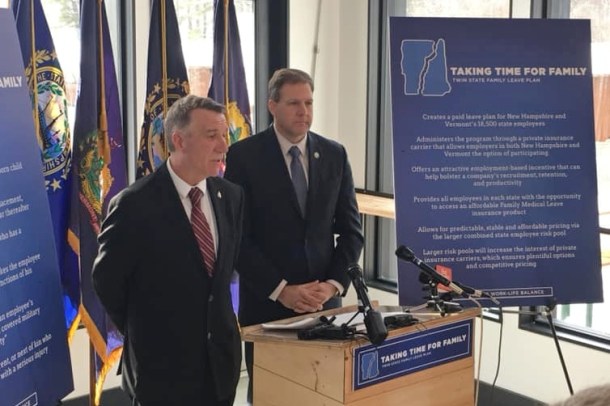
[L]ITTLETON, N.H. — Gov. Phil Scott and New Hampshire Gov. Chris Sununu Wednesday unveiled a proposal for a two-state paid family leave program that would leverage the Vermont and New Hampshire state employee pools to bring down the cost of participation for those in the private sector.
Under the plan, Vermont and New Hampshire’s 18,500 state employees would receive the paid family leave benefit, administered through a private insurance carrier and funded by the state.
Private employers with more than 20 employees and 100 percent employee participation in the program would receive the same rate as the state — a cost which the governors said could be as low as a dollar a day per employee, and would require Vermont to pay about $2.5 million annually to cover state workers.
Employers with fewer than 20 employees would receive a “small employer rate” which would be “modestly higher” than the state rate, according to an outline of the proposal. The program would permit employees to take six weeks of paid family or medical leave per year and receive 60 percent of their weekly wages.
“By wrapping this program around our combined state employees, we will be able to deliver a competitively priced option that will be available for all businesses and their employees,” Scott said at Schilling Beer company, in Littleton, New Hampshire, where he and Sununu detailed the program.
“And we’ll be able to do it without putting another mandate on businesses, or adding to the tax burden of our citizens,” Scott added.
The program is designed to incentivize employers to offer the paid family leave insurance as a benefit to all of their employees, according to Michael Piecak, the commissioner of Vermont’s Department of Financial Regulation.
Employers who see less than 100 percent participation by making the benefit optional or passing costs to employees would see higher rates.
Sununu said that New Hampshire has already been in talks with several private insurance companies who say they would be interested in offering the paid leave benefit.
“By leveraging the economies of scale of each state’s employee base, insurance carriers will be able to write competitively priced plans, something which does not currently exist in either market,” Sununu said.
Scott and Sununu’s announcement of a two-state paid family leave plan comes after both moderate Republican governors opposed paid family leave programs proposed by Democrats in their states last year.
Scott vetoed the paid leave bill lawmakers sent to his desk because it would have established a state-administered benefit, funded through a payroll tax.
In his inaugural address last week, Scott said he would be proposing a voluntary paid leave system in the coming weeks, which drew criticism from Democrats in the Legislature who believe a voluntary program will fail to garner enough participation to make it affordable.
Scott and Democratic lawmakers both believe offering a paid family leave program is an important tool to make Vermont workplaces more attractive as the state is seeing a declining population and labor force.
Ashley Moore, the Vermont director of Main Street Alliance, an organization that advocates for small business interests and is working with Democrats to once again propose paid family legislation this session, said Scott’s plan falls short.
Moore argues that covering only 60 percent of wages is not enough for low-income Vermonters.
She also said a program that doesn’t mandate universal participation would be “cost prohibitive” and that administering the benefit through private insurance will make it too restrictive.
“There are so many restrictions involved when you administer such a program through private insurance market and the model that we’re pursuing is the model that has proven to work,” she said. “We’re able to see our own terms and there is no direct incentive to deny claims in the way that there is under a private model.”
Although Scott and Sununu’s program is dependent on the participation of state employees, the Scott administration did not brief the Vermont State Employees Association until Wednesday.
Steve Howard, VSEA’s executive director, said he had yet to review the fine print of the proposal, but was glad to see the governor putting a paid leave proposal on the table.
Last year, the union backed the Democrats’ paid leave plan.
“We need time to look at the details but the fact that the governor is acknowledging the importance of family leave is a sign that they know how widely supported it is in the public,” Howard said.
“I think what’s become clear to the governor is that Vermonters support a robust family leave policy,” he added.

