

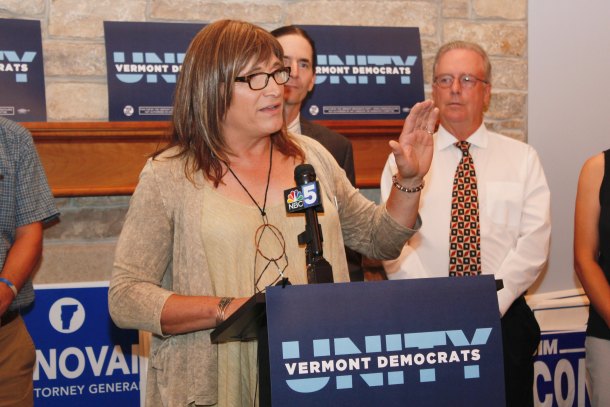
[B]URLINGTON — Dozens of Vermont’s most notable Democrats crammed into an atrium in downtown Burlington Wednesday evening, still riding the buzz from a historic and high profile gubernatorial primary win by a new member of the club.
The night before, Christine Hallquist, who until February was CEO of the Vermont Electric Cooperative, bested her three Democratic opponents in the statewide race, decisively defeating them with 40 percent of the vote.
She also became the first transgender candidate to receive major party backing in a race for governor, a milestone that drew immediate attention from across the national media spectrum.
Before Hallquist spoke at the Democratic “unity rally” (ironically her chief primary opponent, James Ehlers was missing in action) officials remarked at the magnitude of turnout on primary day, which defied predictions of a sleepy Tuesday from political analysts in recent weeks.
With nearly 70,000 Vermonters casting ballots in the Democratic race, Lt. Gov. David Zuckerman, a Progressive/Democrat, boasted that the party’s turnout tripled the 2014 midterm primary.
“We are proving in Vermont that democracy is alive and well and that we have a really strong chance, and we will take over the governor’s office when people didn’t think that was possible, three six and 12 months ago,” Zuckerman said to raucous applause.
Democrats say the incumbent Republican governor, Phil Scott, who in his first term stifled liberal priorities including a shift to a $15 minimum wage and long-term funding for clean water initiatives, is out of touch with the electorate.
“They want a Vermont where we have clean water, where we have mitigating climate change, where we’ve got health care for all, we’ve got a living wage and we’re taking care of our environment,” Hallquist said, addressing the packed atrium in Main Street Landing.
But to make the dream of complete Democratic control of state government a reality (again), Hallquist faces a popular Republican governor who is only rounding the corner of his first two-year term and has history on his side.
No gubernatorial candidate has been successful in ousting a first-term governor in Vermont since 1963, when voters elected Democrat Phil Hoff over Gov. F. Ray Keyser Jr.
Fighting for the center
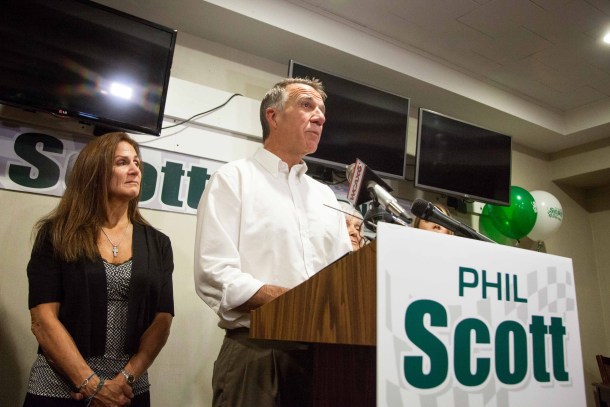
Scott easily won his Republican primary contest on Tuesday, but the results cemented a new reality for the governor: he is losing support among his conservative base.
The governor’s sole challenger, Keith Stern, a grocer with little funding or name recognition, campaigned on a platform of small government and lambasted the governor for supporting gun control measures. He managed to score 32 percent of the vote.
Scott said Tuesday night that he had expected his 35 point margin of victory to be even slimmer, with more pro-gun voters casting ballots against him.
“There’s an increasing disconnect between Phil Scott and the Republican base,” said Eric Davis, a political scientist and professor emeritus at Middlebury College. “What that says to me is that Scott is really going to need the votes of Democrats and some independents to win in November.”
While Scott’s pivot on guns presented a hurdle in the primary, it may not be a liability in the general election.
“I think it rolls off his back,” Rich Clark, a professor of political science at Castleton University said of the primary result. “Republicans are not going to support a Democrat and Phil Scott is still going to do well with some portion of the Democrats.”
A recent Morning Consult poll shows that since Scott signed legislation to restrict Vermont’s gun laws in April, his approval rating among Democrats hit 61 percent. His approval among Republicans was 41 percent, down from 67 percent the previous quarter.
Rob Hipskind, the Vermont Democratic Party’s campaign director, said that although Scott campaigned as a moderate in 2016, he hasn’t governed as one.
“On a lot of issues that matter to Vermonters he’s been on the wrong side,” Hipskind said. “He’s been standing with corporations and the wealthy rather than everyday Vermonters and I think that gives us a great opportunity to draw a contrast.”
Energizing the left
Hallquist’s campaign sees the primary turnout as a sign that Democratic voters are excited and engaged heading into November’s general election.
“We feel like the primary turnout, the fact that more Vermonters voted for Christine last night in a pretty commanding sense than they did Phil Scott, we think that that says something and that people are fired up,” said Cameron Russell, Hallquist’s campaign manager.
In total, Hallquist received about 27,600 votes, while Scott received just over 24,000.
Brittney Wilson, Scott’s campaign manager, said that while Republican primaries in Vermont are tough “given the size of the universe and low turnout,” Scott still won handily.
She said the campaign will continue to tout the governor’s fiscal conservatism and remind voters that he is “the only one preventing a return to one-party rule and unsustainable spending and taxes.”
Turnout in the Republican primary was also up — by about 20,000 voters — compared with 2014: about 37,000 Republican ballots were cast this year.
While Hallquist’s rise has come during an election season that has featured a new crop of progressives, Clark said she is different than many of the Democratic upstarts appearing in races across the country — and like Scott, may have more of an appeal to moderates in her party.
“What’s funny is that if you look at her background — energy company nonprofit, very much a business and financial centrist — she’s not the Ocasio-Cortez,” Clark said, referring to Alexandria Ocasio-Cortez, a progressive who defeated an incumbent New York congressman in a stunning upset in June.
Hallquist’s biggest challenge in the general could be appealing to more progressive Democrats, Davis said. In the primary, two of her opponents, James Ehlers and Brenda Siegel, who Davis said presented themselves as “explicitly more progressive” than Hallquist, each received 18 percent of the vote.
“She didn’t get half the vote,” he said. “What that says to me is she has some challenges to get the core of the progressive Democratic party behind her.”
On health care, Davis thinks progressives would like to see her support a faster path to a single payer system in Vermont.
“When I’ve heard her talk about health care she says she’s in favor of Medicare for all if it’s done in a coalition of several states. Progressives would like to not have to wait for other states,” he said.
On renewable energy, Davis suspects voters on the left would like to hear more enthusiasm from Hallquist about local solar and wind projects.
“The progressives will vote for her, but how enthusiastic will they be about getting out and talking her up?” he said.
Hipskind, of the Vermont Democratic Party, disagreed with the idea that Hallquist may not appeal to progressives.
“She’s there with us on a lot of issues,” he said. “I think that we’re going to see Democrats coming together to support her.”
So did Russell, who said the party is already uniting behind the campaign. Siegel and Ethan Sonneborn, who both lost to Hallquist on Tuesday, have pledged their support to Hallquist.
Ehlers has yet to publicly endorse her, and has said that before he does, he wants to have conversations about her campaign finance policy going forward. Hallquist has already returned the $16,000 she accepted from Vermont businesses after facing criticism from Ehlers’ camp.
Financial playing field
In terms of fundraising, Scott has the edge, for now. As of the latest filings, Scott’s campaign had raised $315,000, while Hallquist’s had raised $172,000.
Scott is also receiving support from the Republican Governors Association, which has already poured more than $1 million into a political action committee that started producing and paying for campaign advertisements last month.
While the Hallquist campaign isn’t looking for it, Russell said it wouldn’t denounce PAC money from Democratic groups.
“We’re not going to go out of our way to suggest to these groups that we are wanting to put ourselves on an unequal playing field with Republican money coming into the state,” he said.
The gap between Scott’s and Hallquist’s campaign fundraising could soon close, analysts say, as the widespread media attention Hallquist has received inspires donations from around the country.
Between midnight and around noon on Wednesday, the day after her primary win, Russell said the campaign received an additional $6,000 in small donations.
Stories about Hallquist’s victory appeared in The New York Times, The Washington Post, NPR, and scores of other news outlets. In recent days, Hallquist has been interviewed on several major television networks.
Just after 5:30 on Wednesday evening, as she was wrapping up her speech to Democrats in Burlington, she said she had to head out.
“We’ve got to go on Anderson Cooper,” Hallquist said. “And I’m going to go brag about Vermont.”

