

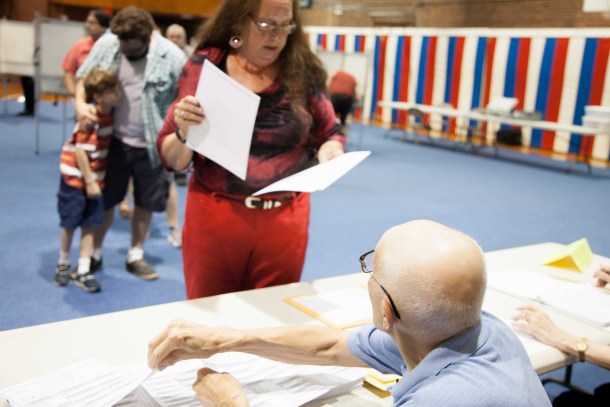
[I]n the weeks leading up to Tuesday’s primary election, experts predicted the turnout would be low and some cited the 9 percent turnout in 2014 as a comparable, but the experts were wrong with early reports showing turnout at approximately 22 percent.
This is the highest turnout in a non-presidential year since 2010 when 24 percent of voters went to the polls.
These preliminary numbers coming from the Vermont Secretary of State’s office are likely to change as municipal clerks continue to complete their canvassing over the coming days, but the turnout will remain higher than many expected.
It’s hard to pinpoint the reason why the voter turnout was so high on Tuesday, but it was clear that it wasn’t just in Vermont.
Both Minnesota and Wisconsin reached voter turnout numbers not seen in at least 16 years, and each state saw the majority of people vote in the Democratic primary.
National experts agree that this uptick in voter engagement is in response to President Donald Trump’s policy platform and the possibility voting in a Democratic majority in the House of Representatives in November.
Christopher Di Mezzo, director of communications for the Vermont Democratic Party, said that this passion for Democratic candidates and the determination to make a statement in the general election was a major reason for the strong showing at the polls in Vermont.
“Vermont is a blue state through and through, with progressive democratic values. Looking at the numbers, Christine Hallquist received several thousand more votes in her primary than Governor Scott did in his — that’s a testament to Democratic enthusiasm and strength ahead of the November election,” Di Mezzo said.
Di Mezzo also said Gov. Scott’s opposition to issues the Democratic Party has adopted brought more voters to the polls.
“Vermonters turned out in the Democratic primary because too much is at stake this election cycle, from the harmful hate-filled policies coming out of Washington to a governor who vetoes much-needed actions like raising the minimum wage to paid family leave,” Di Mezzo said.
But Vermont experts are divided on whether a reaction to President Trump is the reason people went to the polls in high numbers.
In an interview with VTDigger on Wednesday, Rich Clark, a political science professor at Castleton University, said he doubts Vermonters went to the polls to rebuff Trump because Scott’s policies do not reflect the national Republican platform.
“He’s not governing as an extremist in any way, he’s governing very much in the center. There’s nothing to react to,” Clark said of Scott.
Clark also said both major party gubernatorial nominees are running on mostly centrist platforms that make it difficult for voters to strongly support or oppose either candidate.
“If you think about the ideological distribution in Vermont, somewhat looking at a bell curve, Phil Scott occupies a lot of space in the center. Christine Hallquist also moves toward that center, there. So they’re playing for a lot of the moderate voices,” he said.
Matthew Dickinson, a professor of political science at Middlebury College, disagrees slightly with Clark’s assessment of the primary turnout.
Dickinson said it was likely a combination of factors led to the large number of people who voted on Tuesday, including President Trump at the national level but also concerns at the local level.
“I think the Democratic enthusiasm has been up nationally and I would not be surprised if that did not impact the state race in Vermont,” Dickinson said. “The other thing is, on the Democratic side, there was no clear front runner. Each candidate made a concerted effort to get people to the polls and there were some quirky stories: Ethan Sonneborn running as a 14-year-old got media attention and Christine as the first transgender candidate, that added some interest you might not generally see,” he said.
On the Republican side, Dickinson said he felt gun control got people to the polls but not just the voters who opposed it.
“The gun issue got people to come out, but not only on one side of the issue. Social media groups on Facebook and many gun owners were actively getting people to the polls, but people who supported gun control got people to the polls as well,” Dickinson said.
Dickinson said all of these reasons could have worked together to create the strong showing at the polls on Tuesday, but he says at this point it’s still hard to tell.
“The combination of national interest on the Democratic side and the unique level of local context may have contributed to this turnout, but without exit polls it’s just conjecture,” he said.
Xander Landen contributed reporting.

