


Theo Wells-Spackman is a Report for America corps member who reports for VTDigger.
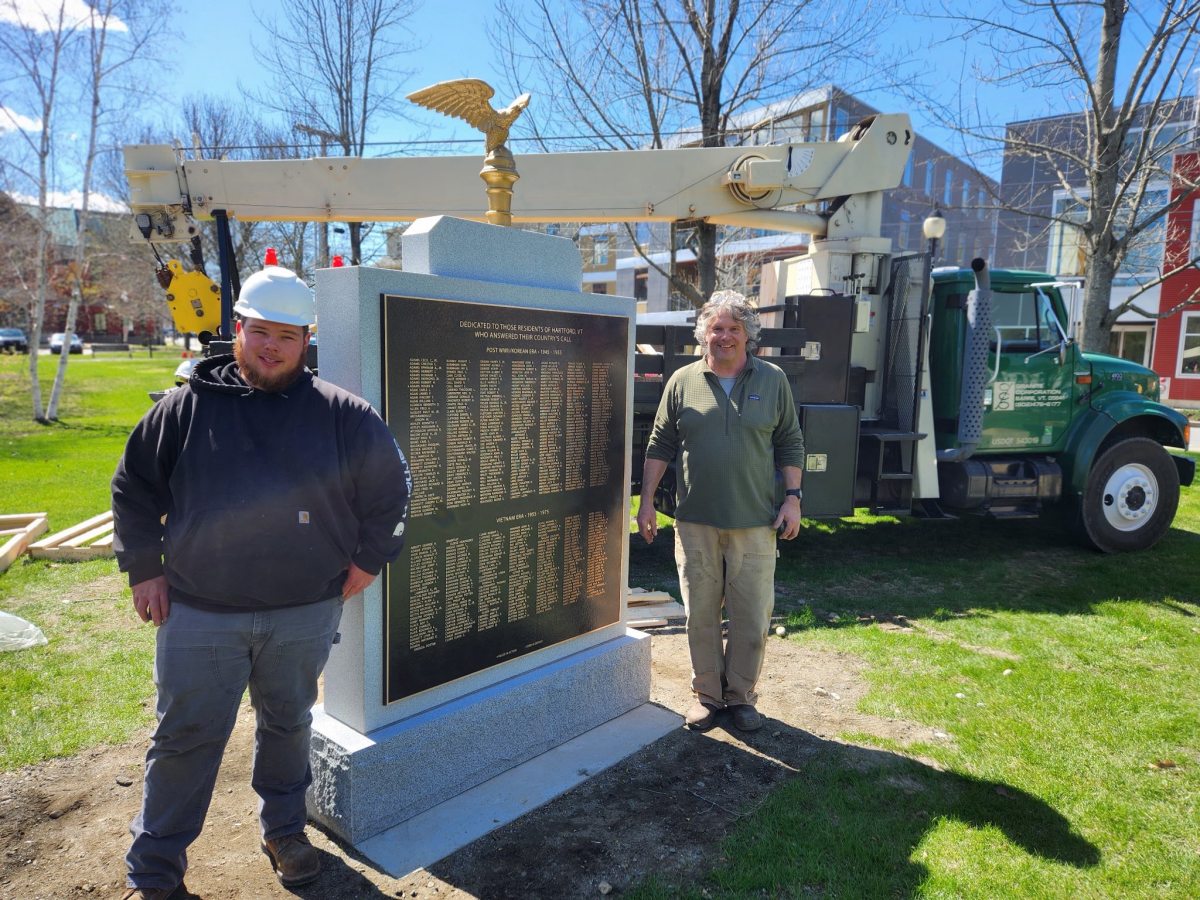
On Monday, a new monument to local veterans of the Korean and Vietnam wars, as well as more recent conflicts, will be dedicated on Railroad Row in Hartford for Memorial Day.
The organizers chose a quintessential Vermont material for the structure, quarried just 50 miles up the road.
“I think it’s going to be a really important, memorable day,” said Mary Kay Brown, who leads the town’s memorial committee. “For the first time, the names of these veterans will be permanently on display and publicly recognized in our town.”
Nearly 900 names, painstakingly gathered from scratch, will appear on the structure’s face, Brown said. And the monument itself is hewn from Barre granite, a Vermont stone with a rich tradition.
Vermont’s granite industry, and its deep ties with war memorials, dates back to the 19th century, according to Scott McLaughlin, a historian and executive director of the Vermont Granite Museum in Barre. Manufacturers in the area initially began making Civil War memorials for towns across the state, and wider demand soon poured in.
Since then, Vermont-crafted monuments have been placed across the country and overseas, including the U.S. Korean War Monument in Busan, South Korea. In the first half of the 20th century, roughly 80% of U.S. monuments were coming from the state, according to McLaughlin. The state’s output of Civil War monuments alone, which numbers in the thousands, spreads across much of the United States.
In sum, “Vermont was king,” McLaughlin said.
It’s not just that Vermont’s granite craftspeople were always highly skilled, though that’s certainly part of it, McLaughlin added.
Barre Gray, the now-trademarked stone that lies in massive abundance in the earth beneath Barre Town, is in many ways perfect for the unique demands of memorial stoneware: soft enough for precise carving, but durable enough to last like a monument ought to.
“You can give these textural differences, even though it’s the same exact material,” McLaughlin said. “You can create a level of human emotion from the viewer because of the realities that you’re simulating.”
Joe Zickmund, who sits on the national board of the American Legion and is a former commander of the organization’s Vermont Department, emphasized the importance of war monuments in Vermont communities. His town of Barre features the well-known Youth Triumphant memorial to the soldiers of World War I, which remains a gathering place on days like Memorial Day each year.
“It’s a place of reflection,” Zickmund said, “and a place to remember.”
Officials in Rutland are planning and raising funds for their own new monument made from Vermont granite, a piece honoring World War II soldiers. Local leaders aim to complete the project this fall, according to Community News Service reporting.
For Brown, her involvement with Hartford’s monument project — and similar undertakings in the past — is deeply personal. Her husband, a veteran of the Gulf War, was involved in Operation Desert Storm in the 1990s.
“We got married the day before he left,” Brown said. “Veterans’ issues have always been important to me.”
A number of Hartford residents whose names appear on the monument are still alive and will be able to attend Monday’s gathering, she added, which will make the event especially resonant. A significant portion of the crowd that day, Brown predicted, “will be, or will be close to, or married to, or the brother of, a veteran.”
Howard Coffin, a Vermont-based war historian and author, gave the dedication speech for a war monument honoring soldiers in his home town of Woodstock some years ago. The structure bore three of his uncles’ names. Coffin said he ended his speech by quoting “Stardust,” a popular song during the second world war.
“It’s a soldier thinking of home,” he said of the lyrics. When he looked out at the crowd, he said, “I bet 50 people were weeping.”
When Coffin helped organize funding for another monument in the early 2000s at Wilderness Battlefield in Virginia, where Vermont lost more than 1,000 men in a single day in 1864, he asked for a likeness of Camel’s Hump to be carved at the top. The mountain was mentioned constantly in thousands of letters he read written by Vermont soldiers, he said.
The other certainty in Coffin’s mind at the time?
“It’s gotta be made out of Vermont stone,” he said.
Brendan Rose contributed reporting.

