

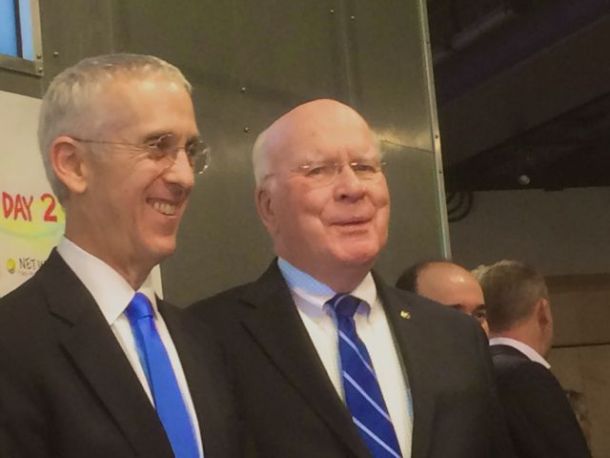
The former U.S. Special Envoy for Climate Change Todd Stern told a packed out crowd at the ECHO Center in Burlington that the Paris agreement he helped to broker “articulates very ambitious goals.”
Climate change, Stern said, is “a monumental challenge” the world must face.
The Paris accord will ultimately succeed, he said, because every nation on Earth is a signatory to it, each nation determines how to implement the deal, and the United States can’t legally withdraw from it for another four years.
The agreement was signed in December 2015 and is set to go into effect in 2020. It seeks to limit global warming to no more than 2 degrees celsius above what the Earth’s temperature was before the Industrial Revolution.
A number of actions likely to be taken by Trump and congressional Republicans threaten that target, Stern said.
Stern predicted that vehicle emissions standards would be rolled back, utility sector rules would be weakened and regulations on the emission of methane, a potent greenhouse gas, would be eliminated.
Trump and the Republicans in Congress are also likely to eliminate a rule requiring the federal government to calculate the social costs (known as “negative externalities” in economic parlance) associated with carbon dioxide emissions, such as damaged agricultural crops, property damage from increased floods and impacts on human health. The current cost is $36 per ton, he said. Cap and trade programs and carbon taxes are designed to offset the financial impact of climate change.
The president and GOP members of Congress have threatened to abandon U.S. commitments made as part of the Paris Agreement, Stern said.
But as a legal matter, the United States can’t formally withdraw from the agreement for four years. However, there are no consequences for countries that renege on promises. The United States could effectively walk away from the agreement “at a moment’s notice,” Stern said.
As a result, United States foreign policy would likely suffer, he said, because countries around the world are heavily invested in upholding their commitments, and a unilateral withdrawal would “be kind of a slap in the face” to allies that remain.
Secretary of State and former Exxon CEO Rex Tillerson has indicated he wishes at least “to keep a seat at the table” in the agreements, Stern said, “and I hope he can prevail.”
Environmental leaders need to reach out to farmers, business leaders and members of the military to galvanize support for the Paris agreement, Stern said.
“There are large numbers of people in all these communities — leaders — who completely understand what’s going on,” Stern said.
Many CEOs of the top 500 American companies also back the Paris agreement. “I think there’s a lot more support where you don’t think there’s support,” he said.
Even the businesses that vociferously oppose the agreement “are completely planning for this stuff — they’re absolutely planning for it,” he said. “You’re not going to be the CEO of a Fortune 500 company … if you’re not a fact-based person.”

