

The bill includes other changes, such as putting into statute that the board must adhere to legislative intent when making rules, but the adjustments are not as sweeping as those in a bill, S.24, sponsored by senators from Bennington County.
Lawmakers are reacting to the state board’s decision to hold off voting on the draft rules until May, saying that waiting until the Legislature is out of session means they can’t weigh in on them. The state board says it’s not trying to circumvent lawmakers.
After hearing about the board’s decision last week, Senate Education Chair Philip Baruth, D/P-Chittenden, added draft language to two of his committee’s bills — one on school district mergers and a miscellaneous bill that would change the structure and some of the duties of the board.
In addition to the other changes, the language would reduce board members’ terms to four years instead of six while allowing them to serve two terms. The legislation also digs into the question of the board’s authority to make rules, cancels the draft rules on approving private schools to receive public tuition money, and creates a 10-member study committee to recommend criteria for those approvals.
Baruth said he gave both sides more than a month to compromise and that too much of the rulemaking process has happened outside the Legislature’s purview.
The board took up the draft rules last summer when the Legislature was not meeting, so putting off the vote until May will mean deciding after the Legislature is out of session, Baruth said.
“The board is acting as though they are a coequal branch of government. They are not responding to the legislative branch, the executive branch or all the people who came out against the rules,” he said, referring to public meetings in Manchester and St. Johnsbury.
The state board has been working since November 2015 on the rules to guide the process that determines if a private school can receive taxpayer money for tuition under school choice.
The draft version of the rules written by the Agency of Education contained errors that drew opposition from private schools and choice towns across the state and that were only recently fixed. A subcommittee of the state board has met with stakeholders from private schools to work out differences. By February this group still disagreed over opening enrollment to all students, including those who receive special education services.
Members wanted more time to meet with various stakeholders and get data on whether special education and low-income students with school choice have the same access to approved private schools.
To do that, members felt they needed the assistance of the Education Agency, which they hadn’t had since August because of a directive from then-Gov. Peter Shumlin.
But Morse was able to get permission recently from Gov. Phil Scott’s office for the agency to help. He said the deadline is May but the board hopes to come to agreement with the stakeholders before then.
“We agreed on agency staff being available,” Morse said. “I presented a motion (to Ethan Latour, the governor’s policy assistant) that would be put to the board, and it had the May date on it, and he was favorable to it.”
That was why Morse insisted on a May date, he said, adding, “It was not designed in any way to avoid the legislative review.”
Baruth said the winding road these draft rules have gone down has been “incredibly flawed.” It wasn’t surprising to him that Bennington Democrat Sens. Dick Sears and Brian Campion proposed stripping the board of its powers. But Baruth said the state board has an important role.
Baruth understood why Sears and Campion were upset by a section of the draft rules they interpreted to mean that all the rules for public schools would also apply to private schools that accept taxpayer money. The state board clarified that the rule didn’t do that, but referred only to federal and health safety standards that all schools must comply with.
Some have questioned whether the state board has the authority to do what the draft rules called for, but the attorney general determined that it did.
Baruth’s legislation would still give the state board policymaking and rulemaking authority, but only within the intent of the Legislature’s past decisions.
The goal of his two bills is to restart the rulemaking process, Baruth said.
He hopes to see more success from a study committee made up of lawmakers as well as representatives of the Vermont Superintendents’ Association, the Vermont School Boards Association, the Vermont Independent Schools Association, and appointees of the private schools and the education secretary.
“I think independent schools see the rules … as an attack on their independence and the public schools see a growing independent schools movement as a threat writ large. That being the case, I think there is an argument for having mediation,” Baruth said, adding that this committee could play that role.
In 1994 there were 59 approved private schools versus 93 today, according to the agency. Since the late 1990s, student enrollments have been declining and competition between public and private schools for the same kids is growing.
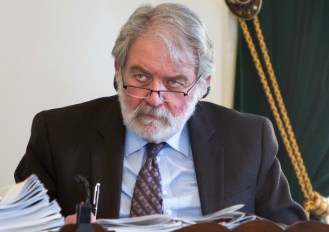
McCormack sponsored legislation in 2014 that would have gone further to level the playing field between public and private schools than the state board’s draft rules. He has a problem with sending taxpayer dollars to schools that don’t have to comply with the same rules.
“I wonder if it is constitutional,” he said. “But politically, I tried to address it with a bill and I got slammed. The state board is getting slammed now for addressing the issue of tax dollars in private schools.” He believes the courts will have to settle this as they did with school funding in the 1997 Brigham decision that led to Act 60.
Baruth agrees that special education enrollments in private schools need to be looked at, and he hopes the committee his bill sets up will do that. “I think the state board has their finger on something that needs clarification, and that is what we need to look at,” he said, but he added that the current rule process is too tainted.
Part of the problem is that private schools, even those getting public dollars, are not required to provide the state with information and data that would shed light on enrollments, reasons a student leaves a school, or levels of poverty. They volunteer information to the agency, but it is not verified.
Rep. David Sharpe, D-Bristol, head of the House Education Committee, said he doesn’t know why a study committee would have more access to such information. “(Private schools) don’t have to provide this information. We simply don’t know,” he said. “I think one of the rules the state board should make is to compel the independent schools to provide this information. I suppose the Legislature could do it, but that is not in this bill.”
Sharpe understood Baruth’s concerns about the state board waiting until May, but he would rather see members approve the rules they agree on that have to do with financial reporting and other matters. “Let’s pass what they agree on, put a study committee together to look at the pieces where the state board has not been able to come to an agreement with independent schools, and let’s move forward,” he said.
Baruth said the things the rules deal with should have been considered by the Legislature or at least with lawmakers’ guidance. “The idea that you would have a state board that can hold off the legislative branch, the executive branch and the people they are regulating won’t instill confidence for anybody,” he said.
