


But the Belisles’ intentions have drawn opposition from neighbors and residents of Swanton, who say the structures will devalue their property and diminish their quality of life as a result of noise and other effects.
Unlike many wind energy developers, the Belisles plan to continue living in their home just 500 feet below the turbines and half a mile away. The Belisles have also offered to purchase homes of nearby neighbors who, after six months of living with the turbines, find the structures intolerable.
That’s not enough, they’ve been told. The Belisles, say foes of the project, ought to give the town of Swanton $100,000 to pay for a legal fight against the couple. They should pay for moving costs for homeowners who elect to take the Belisles up on their buyout offer, others say. If they were truly concerned about their community, still others say, the Belisles would abandon the project.
Some of the most vocal opponents of the project actually purchased their property from the Belisles. As part of the sale, the Belisles say, the buyers signed statements attesting to their knowledge of the couple’s intentions to develop wind turbines on the contested hillside — and possibly a rock quarry, or a 50-residence subdivision as well.
But while the project has drawn vocal opposition from wind energy opponents around the state, some of the Belisles’ neighbors say they’re no more concerned about the project than is the couple down the road who will carry it out.

Seeing dividends for themselves and the environment
For his part, Travis Belisle said this is just another job — one of several he’s working on.
“I’m not great at hockey, I’m not great at football, but I am great at working,” he said.
A contractor who’s built multiple residential developments in the Swanton area and logged the contested hillside, and whose earthmovers and vehicles of all description dot the compound where he lives with his wife, he doesn’t give the appearance of an eco-warrior.
He got the idea to build a wind farm from a friend in the construction business who now owns a stake in the Georgia Mountain wind project near Milton, he said. The venture would represent a good investment, he was told.
The Belisles say they’re also motivated by a concern for the environment — that having harmed the natural environment in countless ways, they see an opportunity in the wind towers to make up for some of the resources they’ve consumed.
Travis Belisle said he’s also a strong believer in property rights and a longtime Republican, and that he’s been surprised by the reactions from his fellow conservatives.
Former lieutenant governor and erstwhile wind power advocate Brian Dubie, who lives just over a mile from the site, has been a vocal opponent of the Belisles’ plans.
Republican lieutenant governor candidate Randy Brock, who lives in Swanton, has voiced disapproval of the project.
Republican gubernatorial candidate Phil Scott has said he’ll place a moratorium on ridgeline wind development.
“What are these Republicans running on? They say they want to see jobs, they say they want to see livable wages, but their actions — you guys are talking out of both sides of your mouths,” Travis Belisle said.
Offering a deal, but some are suspicious
The Belisles say they thought they’d extended an olive branch to the project’s critics by offering to purchase dissatisfied neighbors’ homes.
The way the arrangement works, Ashley Belisle said, is that homeowners who want to move away will get an appraisal no sooner than six months after the towers go up. Critics, like Christine Lang, who bought her property from the Belisles, say this will mean dissatisfied neighbors will receive only the diminished home value that remains post-construction.
A real estate agent, Ashley Belisle said that’s not how the appraisals will work.
Instead, appraisers will consider the sale price of at least two similar homes that have sold in the area within the past year — probably from Swanton, possibly from St. Albans, she said.
The value of homes appraised near the turbines will be determined from these sales of comparable residences, she said, and not from the homes’ proximity to the wind generators.
“The appraiser’s not going to come here and say, ‘Oh, you’ve got a turbine next to you, we’re going to dock $30,000,’” Travis Belisle said.
The purchase offer seemed like it would placate some of the most vocal opponents, the couple said, since they came up with the idea in response to concerns voiced at community meetings. Much of what they’ve heard in response hasn’t been positive, Ashley Belisle said.
“You think you’re doing somebody a favor, and listening to them, and they do nothing but pick it apart,” she said.
One of the more prominent opponents of wind energy in Vermont, Annette Smith, said she’s not impressed by the offer.
“I view his property value crap as a distraction reporters grab onto as ‘something,’” said Smith, executive director of the activist group Vermonters for a Clean Environment. “I’m sorry, it’s not nothing, it’s worse than nothing.”
Smith suspects the couple would find a way to turn still further profit off reselling the homes.
The fact that most residents of that neighborhood signed statements before purchasing their homes, attesting to the fact that the Belisles may build a wind farm, or dig a rock quarry, or build a new subdivision on the hillside, doesn’t mean they understood what they’d signed, Smith said.
“What right do these people have,” Smith said, “to force the whole neighborhood out of their homes? They’re saying … get out of town, we’ll get other suckers in here.”
The Belisles, if they were serious about acting in good faith, should give the town $100,000 to fight the project, Smith said.
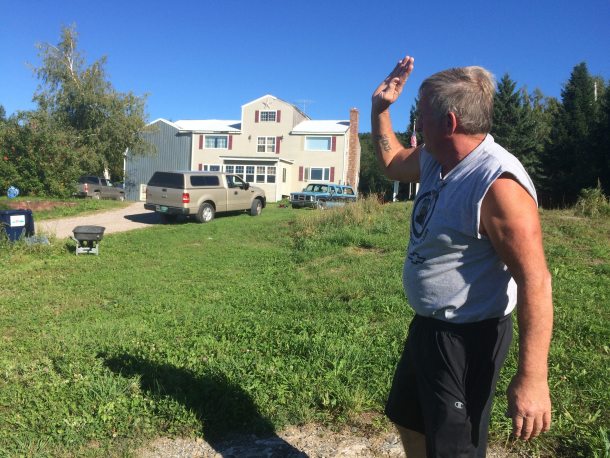
Better than the alternative?
Some of the Belisles’ neighbors feel the same way, but others say they’re thankful it’s only wind towers that are at stake and not something more destructive like another subdivision.
Joe Fitzsimmons is a barn builder, wrestling coach and former internationally ranked arm wrestler. He said he’s known Travis Belisle since the developer was a child and that he’s happy for his neighbor to profit off his land.
“You’ve got a guy who wants to, quote, go green — big deal,” Fitzsimmons said. “Big deal. If he makes money off his property, it’s his property.”
Fitzsimmons said he knows what the turbines look and sound like, having built additions and garages near the four 500-foot-tall turbines on Georgia Mountain, near Milton. Every morning he can see the 40 turbines erected on the New York side of Lake Champlain, and the sight never bothered him.
The father of 10 children, Fitzsimmons said his real worry lies elsewhere.
“The things I don’t like in life right now, it’s this,” he said, pantomiming a smartphone user intently focused on one of the devices.
Fitzsimmons said he can’t understand the opposition from neighbors who bought their properties from the Belisles.
“The people that complain about it, I wouldn’t turn my back on them,” he said. “They all signed that paper. They’re all saying, ‘This is all wrong, save our ridgeline’ — every one of those people knew.
“Yeah, there’s going to be a little (disruption) when they start it, and because of the roads, they’re going to scare the wildlife, but it comes back,” Fitzsimmons said. “Even right in St. Albans, when they built the Payless, all the deer ran away. Now you still run over the deer in the industrial park. It always comes back.”
Another of the Belisles’ neighbors, Chris Maynard, bought his property from the couple, and with his wife built a home upon it.
Maynard lives within half a mile of the turbines’ proposed location and said he loves where he lives.
“We sit back from everything. Town’s just down the road, you don’t hear the city,” he said. The 2.4-acre property contains a big backyard where his dogs and children play. The neighbors are great, and there’s no traffic nearby to worry about, he said.
“What it comes down to is, it’s a good spot to raise a family,” he said.

Maynard’s been deployed three times, with the U.S. Navy and with the U.S. Army National Guard, and since returning from Afghanistan to the States he’s taken up a job with immigration services. He interviews potential immigrants, and spoke at his house hours before heading to a service for new U.S. residents in Burlington.
“When we bought the house — when we built it here — part of the agreement was that Travis had the right to do wind, or a (rock) quarry, or 50 additional houses,” Maynard said. “I’d definitely take windmills over the other two.”
“I’m not really concerned about it,” he said. “It’s like the people that live next to an airport, that complain it’s going to be loud. You knew it was going to be loud. If they come, it’s nothing they said wouldn’t happen anyway, so to fault someone for doing what they said they were going to do, I’m not really in a position to do.”
The sight of the wind turbines, Maynard said, “doesn’t mean a thing” to him.
“These are sitting back on a ridge,” he said. “It’s not going to change the color of the leaves or anything.”
Raising opposition
Maynard and Fitzsimmons said they’ve not been swayed by anti-wind activists who’ve visited the neighborhood to warn residents of harms they say will accompany the turbines.
Others in the neighborhood aren’t so sanguine.
Christine Lang was often seen this winter in the Legislature with a band of wind-power opponents led by Smith. Lang lives with her husband a few houses down from Maynard and said she’s afraid the turbines could poison her well water, introduce radon into her house or crack her home’s foundation.
Along with the towers, Lang said, will come “interstate-grade roads” built up the little rural hillside, and excessive rainwater erosion and various other environmental harms.
Lang said she’d be happy were the Belisles to build another 50-home subdivision on the hillside, though, or a rock quarry like the one already located half a mile from her house.

She’s suspicious of the appraisal process and suspects bad intentions on the Belisles’ part because they haven’t volunteered to pay for appraisals, radon tests, water tests or moving costs, Lang said.
She also expects the turbines to violate sound limits established in state law and predicted the state will sanction the violations.
Lang said it’s “100 percent impossible” that Vermonters won’t prevent the towers’ construction, however, once they wake up to the injustices they represent.
“It’s not going to happen,” she said. “I’m sorry he spent all this money on it, but people have been telling him how it’s inappropriate.”
One of Vermont’s better-known wind developers, David Blittersdorf, who owns a majority stake in the Georgia Mountain project, agreed with Smith’s assertion that the Belisles might make money off the homes of neighbors who take up the offer to buy them out. Blittersdorf said the offer, and the fact the Belisles will live directly beneath their turbines, might put that issue to rest nevertheless.
By purchasing unhappy neighbors’ homes, the Belisles “will probably turn (the properties) around and make money off it,” he said. “They’re smart enough to know it’s not going to be a big problem.”
“I don’t know that it’ll calm many people down, but it’ll take that issue away,” he said.
Like Smith, Blittersdorf blamed the media for misrepresenting the situation.
There’s a silent majority of Vermonters happy to see wind turbines put up, he said, but “the press really likes to report on negatives and give a very small minority of people who have the most volume a place to stand in opposition. That’s sad.”

