

SOUTH BURLINGTON — City officials, the Vermont Air National Guard and the Burlington International Airport are making progress toward a joint noise mitigation commission that would include representatives from other affected communities.
Newly released noise exposure maps show more than 2,200 people fall into the area negatively impacted by excessive noise from the airport and the F-16 fighter jets now in use. The maps don’t account for louder F-35 fighter jets that are expected to be based at the airport in 2020.
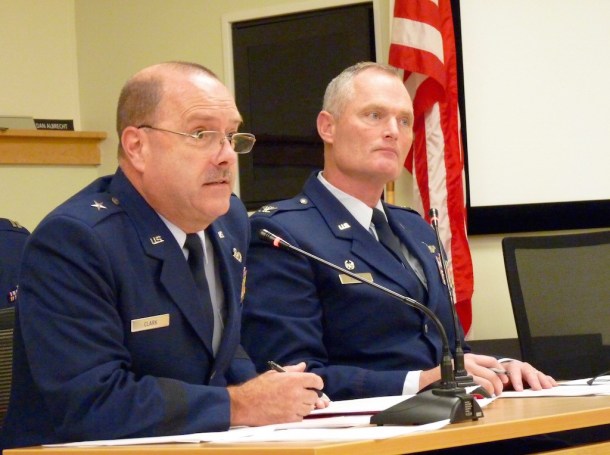
At a Monday City Council meeting, Brigadier General Joel Clark said the Vermont Air National Guard would be willing to participate in noise mitigation efforts, but was cautious about what he could deliver.
“If we come to the table, I can’t make any promises other than to tell you how we fly and what we can do to minimize the noise,” Clark said. Options for limiting the noise from fighter jets are constrained by safety issues, he said.
It’s still unclear what form a noise mitigation entity will assume. City Councilor Meaghan Emery is proposing a Noise Mitigation Commission that would include the airport, Air Guard and residents from South Burlington and other affected communities, such as Winooski, Colchester, Williston and Burlington.
The commission would be modeled after one in Madison, Wisconsin, which also has an Air Force base and commercial airport. The Wisconsin group’s primary function is to ensure residents concerns are heard and that available federal resources are used to address noise issues, Emery said.
Gene Richards, director of aviation for the Burlington International Airport, said the airport would not participate in a commission that includes residents as representatives. He proposed a committee made up of elected officials from impacted municipalities that would be chaired by his deputy, Nicolas Longo.
Richards says if residents are represented on a noise mitigation commission, people with “agendas” could hijack the proceedings, and Emery’s “anti-F-35” commission would be unproductive.
He accused Emery of spreading “irresponsible misinformation” about the new noise exposure maps.

Emery has described homes in the 65 decibel area, the area most impacted by airport noise, as “not fit for residential use,” which Richards disputes. Federal Aviation Administration regulations advise against development in the 65 decibel area, but “where the community determines that residential or school use must be allowed” abatement measures are necessary, according to information provided by Richards.
Living in the 65 decibel area erodes people’s quality of life and the value of their property, Emery said. The affected area, which has more than 600 single family homes, is an important chunk of the region’s affordable housing. Chamberlin Elementary School and several places of worship are also located in the neighborhood.
The new noise maps will be used to apply for federal money to soundproof the homes of eligible residents in the 65 decibel area, Richards said. Emery said she would like to see if that money can be used to build infrastructure that will prevent more sound from escaping the airport.
A ‘troubling picture’
The Burlington International Airport and Vermont Air National Guard haven’t been “transparent” about the Air Force and FAA regulations they must follow, according to Emery.
That behavior is part of a “troubling picture,” she says.
Emery points to inaccurate information in the Air Guard’s application to base the F-35 in Burlington, and questions about why changes to F-16 operations in 2008 weren’t addressed sooner, she said.
In 2013, the Boston Globe published a report suggesting U.S. Sen. Patrick Leahy, D-Vt., exerted influence over the selection process, and the impact of bringing the F-35 to Burlington was downplayed. A group of residents from affected communities is suing the Air Force for not taking noise and potential health impacts from the F-35 into account. That case is currently winding its way through District Court.
The noise maps released last month are the first to account for the Air National Guard’s F-16 fighter jet engines 2008 use of a new engine type. That coincided with the use of external fuel tanks and afterburners, which greatly increased noise impacts from the jets.
At Monday’s City Council meeting, Emery asked Gen. Clark why there was no environmental review of the engine changes in 2008.
Clark said the National Environmental Policy Act “requires federal agencies to assess all potential impacts and effects of federal actions and allows for various levels of review.” He did not say whether any level of environmental review was required or completed when the Air Force started using afterburners in 2008.
The F-16’s engine conversion did not require an environmental review, according to a statement from the Vermont Air National Guard public affairs officer. The use of afterburners was unrelated to the engine block change and was the result of “increased exterior loads, longer training sorties for operational training missions” and other structural issues, according to the Air Guard.
The statement did not address whether the increased use of afterburners should have triggered environmental review or whether any type of review was conducted.
The Burlington International Airport released noise maps in 2006 and did not update the information after the Vermont Air National Guard’s upgraded the planes in 2008, Emery said.
The airport received updated noise information from the Air Guard in 2012. In May of that year, the airport applied for federal money for a sound study, and new noise exposure maps were released with the study in November.
Richards said the new maps are “an indication of what’s going on here since the mission changed.”
Richards said he does not know why it took four years for the Vermont Air National Guard to provide the airport with new data, but he said he surmises it’s the same reason it took the airport three years to complete a new sound study: navigating a large federal bureaucracy is a slow process.

