





Amid lots of chatter about a tight budget in the Statehouse, lawmakers heard a humble request on Friday from representatives of a product that might as well be synonymous with Vermont itself: maple syrup.
Vermont’s identity might be built on the backs…er, trunks, of maple trees — we are, after all, the top maple producer in the country. But you wouldn’t know it by looking at the state’s Agency of Agriculture, Food and Markets, which does not have a single maple expert on staff, Allison Hope, executive director of Vermont Maple Sugar Makers’ Association, told lawmakers.
The University of Vermont Extension Program, which offers technical assistance to farmers through about a dozen offices around the state, staffs but one expert to offer support to maple producers: Mark Isselhardt.
That means Vermont sugarmakers often rely on the association, which has two full-time staff members, and the Proctor Maple Research Center, for technical help.
While the New York equivalent of the Vermont Maple Sugar Makers’ Association receives $250,000 per year from the state’s agriculture department, the Vermont association, a nonprofit, does not receive any direct annual funding from the Vermont Agency of Agriculture. And New York produces less maple syrup than Vermont. Obviously.
“They are able to do things that we are not,” Hope said.
To that end, Hope pitched to lawmakers a dedicated staff member at the Agency of Ag and an unspecified amount of fixed annual funding for the association.
Even without the help, Vermont’s maple industry has experienced immense growth, by 350% from 1992 to 2022. “I’d be hard-pressed, I think, to find another ag or forestry product that has experienced that kind of growth,” Hope said.
And, though Isselhardt reported to lawmakers that the health of sugar maples across the state is currently “okay,” maples are under threat from climate change.
Sugar maples, known as a “goldilocks” species among scientists for their fondness of specific weather conditions, face threats from: extreme wet weather, extreme dry weather, invasive species, disease and wind — like the gusts that knocked out power for almost 30,000 Vermonters earlier this week, and the gusts that will likely come with a storm expected to begin a few hours after this newsletter lands in your inbox.
Hope characterized her funding request as a “long-term ask,” and said she hoped her testimony would serve as a beginning to the conversation.
“I completely understand: We’re coming in at a time where we have regular flooding and regular windstorms and inclement weather, and you’re getting asked (for relief) by the loggers and the dairy farmers,” Hope said. “There’s no end to the need in the state.”
Still, James Buck, board chair for the association, said he thinks Vermont’s maple industry, as a nationwide leader, is well-positioned to make the ask.
“We need some help,” he said.
— Emma Cotton
In the know
As Vermonters grapple with burgeoning health care costs, advocates have urged lawmakers and Gov. Phil Scott’s administration to stop removing Vermonters from Medicaid.
Between April and December of last year, 27,984 Vermonters were removed from Vermont Medicaid health insurance coverage, according to data reports submitted to the federal government by the Department of Vermont Health Access.
Fourteen million Americans who lost Medicaid coverage in the past year, roughly 70% were disenrolled for “procedural reasons,” according to KFF — meaning they did not meet a deadline or incorrectly completed a renewal application.
In Vermont, 20,152 of the people removed were done so for such administrative reasons. It’s not clear how many of those people might actually be ineligible for Medicaid coverage.
Vermont’s rate of procedural disenrollments — about 70% — is in line with most other states. A handful of states, however, have managed to bring that rate down: In Maine, for example, only about a quarter of disenrollments are due to procedural reasons, and in Illinois, only 13% were removed for those reasons — the lowest rate in the country, according to KFF.
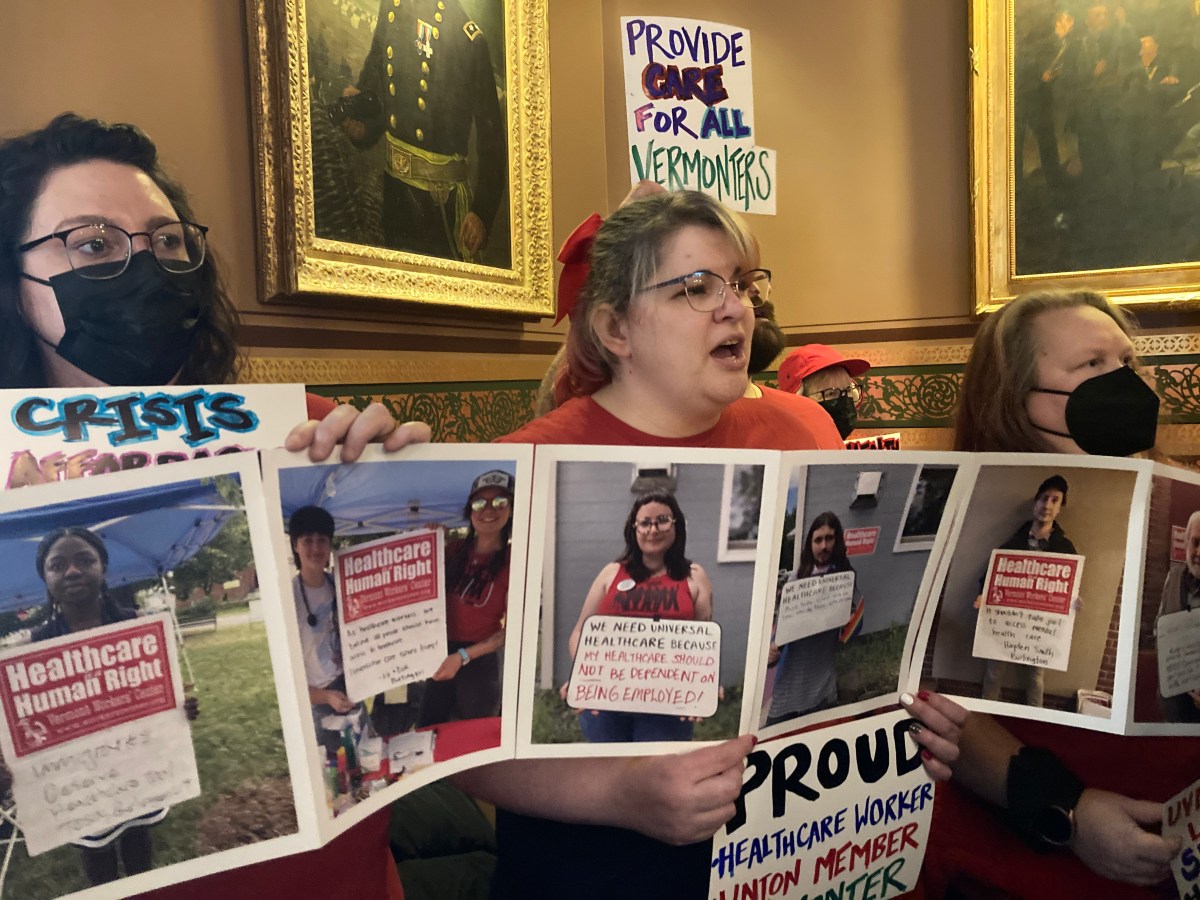
On Friday — the same day as a raucous Statehouse rally against the Medicaid removals — Vermont lawmakers announced a sweeping proposal to expand Medicaid access in the state.
— Peter D’Auria
State transportation officials told legislators this week that Vermont’s electric vehicle transition has made substantial headway in recent years but still has a long way to go to meet its goals.
Vermont currently leads the country in efforts toward electrification of the transportation sector, according to data shared by officials based on a study conducted by the Natural Resources Defense Council, which compared states based on their charging infrastructure, incentives and emissions requirements.
Still, the Green Mountain State is lagging behind its targets.
— Habib Sabet
On the move
The Vermont Cannabis Control Board is asking lawmakers to eliminate caps on the potency of certain marijuana products from state law — a move officials said could keep more users in the legal market but that faces opposition from some medical leaders.
The request is one of several proposed changes to the state’s marijuana policies included in H.612, which the House Government Operations Committee took up for the first time on Friday.
— Shaun Robinson
On the hill
Almost 40 percent of Vermont’s 3,225 federal civilian workers will receive a raise thanks to a revision of their pay scale by the U.S. Office of Personnel Management, Vermont’s Congressional delegation announced on Friday.
Once the change is implemented, federal employees with jobs based in Addison, Lamoille and Washington counties will receive the same pay as federal employees in the Burlington area, while federal employees in Orange and Windsor counties will have the same pay as those in the Boston area, the delegation statement said.
Differences between pay scales between localities is a significant barrier to the ability of offices in the Twin States to recruit talented workers, according to a letter to the personnel office penned by members of the Vermont and New Hampshire delegations in November.
The letter urged adoption of a federal working group’s proposal for a nationwide sweep of changes to the locality-based pay scale to keep up with cost-of-living increases. It also noted that federal salaries are generally more than 20 percent lower than for comparable jobs in the private sector.
— Kristen Fountain
Womp womp
Final Readers, we know you’ve all been waiting with baited breath to hear how our inaugural sports wager panned out. Well, it didn’t. And now we’re out $5. There’s a lesson in here somewhere: The house always wins. Or at least, the Celtics don’t always win. Looks like we’ll have to stick with the Patriots from now on.
— Shaun Robinson & Peter D’Auria
What we’re reading
RSV and other illnesses are crowding emergency rooms, health department warns, VTDigger
Court upholds Vermont gas purchase of methane from a New York landfill, Seven Days
Bucks Beat the Celtics So Bad Even TNT Changed the Channel, Sports Illustrated
Correction: An earlier version of this newsletter misspelled Mark Isselhardt’s surname.
