


Longtime journalist-turned-historian Steve Terry had just enrolled at the University of Vermont when John F. Kennedy campaigned in Burlington the day before his 1960 win as the youngest person ever elected U.S. president.
“Like all students, I suppose, I was certainly enamored by JFK,” the now 81-year-old recalled in a recent interview.
Three years later, Terry was a UVM senior when Kennedy, 46, was assassinated on Nov. 22, 1963.
“I remember, like almost all people, exactly what I was doing when I heard the news that the president had been shot,” he said. “I was at the library interviewing a student leader, then rushed back to my fraternity house. Minutes later, I saw that famous TV picture of Walter Cronkite announcing to the world that JFK was dead.”
Decades before cellphones, personal computers and cable news, more than 90% of all U.S. households with televisions watched part of the three major networks’ continuous coverage that preempted all regular programming until the end of the president’s funeral three days later.
“My gosh, I witnessed Jack Ruby assassinating Lee Harvey Oswald,” Terry said of the Dallas man who jumped before live cameras on Nov. 24, 1963, and killed the suspect in Kennedy’s shooting. “It was a time of tremendous turmoil.”
Terry would go on to chronicle the subsequent turbulence as a reporter and editor at the Rutland Herald, a staffer for the late U.S. Sen. George Aiken, R-Vt., a communications executive at Green Mountain Power, and an author of several history books.
“In the years before,” he wrote in one, “Vermont had been seen as a small and sleepy rural state where change came about only slowly and grudgingly. In the years during and after … Vermont became known for social ferment and rapid change.”

‘How Red Turned Blue in the Green Mountain State’
Vermont is often pigeonholed as the breeding ground of such progressive icons as Bernie Sanders and Ben & Jerry’s. But in 1960, it was the only state in the nation that had supported the top of every Republican ticket since the GOP’s founding in 1854.
“Senator Kennedy Invades Republican Vermont,” the now-defunct Burlington Daily News reported in a banner headline after his election-eve visit on Nov. 7, 1960.
Even after attracting a crowd of 10,000 people, Kennedy lost Vermont to Richard Nixon, 41.3% to the outgoing vice president’s 58.6%. But two years later, Terry, who began as a student journalist, witnessed state history when he saw Philip Hoff claim victory as the first Democrat to win election as governor by popular vote — sowing the seeds of today’s left-leaning political landscape.
“Hoff had tried to portray himself as a politician in the Kennedy mold — young and energetic and looking to lure talented people into public service by promising that they could change things for the better,” Terry went on to write with co-authors Samuel Hand and Anthony Marro in their 2011 book “Philip Hoff: How Red Turned Blue in the Green Mountain State.”
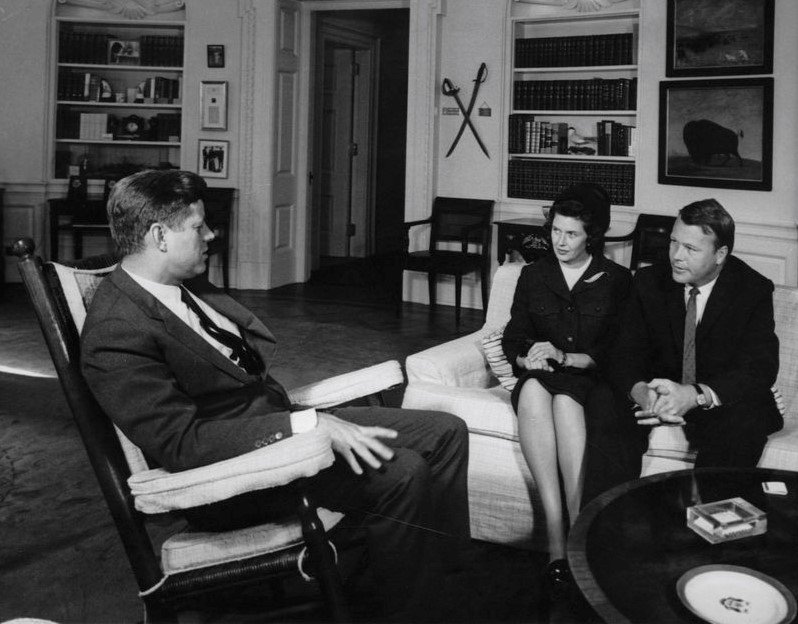
Soon after his 1962 win, Hoff and his wife, Joan, accepted Kennedy’s invitation to visit the White House.
“He couldn’t have been more cordial and helpful,” Hoff told this reporter in 2013. “I remember Joan was so nervous that her knees shook.”
‘I’ll talk to you when I get back’
Back home, Vermont was shifting. In the southern half of the state, crews were constructing the interstate highway — the largest civil engineering project in human history — while up north, Addison and Chittenden counties were complaining of a major drought.
“The water shortage should not be allowed to endanger the health of Vermonters,” the state’s health commissioner told the press in the fall of 1963.
Hoff asked the federal government to declare the upper counties a disaster area in hopes of obtaining help.
Bureaucratic Washington balked.
In response, Hoff asked Kennedy to reverse the decision. On Nov. 21, 1963, the nation’s newspapers reported on a civil rights bill stalled in Congress, escalating fighting in Cambodia and Vietnam, and a stock split for what was then the world’s largest corporation, the American Telephone and Telegraph Co. But when the president summoned his director of emergency planning to the Oval Office that morning, he spoke of a new last-minute worry:
How to help the Green Mountain State.
“He said he had been contacted by Governor Hoff about the drought situation,” the late Edward McDermott recalled to former Associated Press reporter Christopher Graff in an interview 20 years later. “He said, ‘You run up there and see Hoff. He’s a good fellow. And I’ll talk to you when I get back.’”
Kennedy then walked out of the Oval Office and through the Rose Garden to a waiting helicopter for a two-day trip to Texas.
“I remember that he had a twinkle in his eye when he told me to go to Vermont,” McDermott said.
The emergency planning director had just finished his visit when he learned of the shooting in Dallas. A declaration of Addison and Chittenden counties as disaster areas was signed by the new president, Lyndon B. Johnson, leading to more than $100 million in aid for improvements Johnson viewed during a visit to the state in 1966.

‘Still driving what we think about today’
Many Vermonters first heard of Kennedy’s assassination when CBS News interrupted WCAX-TV’s 1:30 p.m. broadcast of the daytime drama “As the World Turns” with a bulletin.
“Cronkite removed his glasses and caught his breath,” recalled Terry, who now writes occasional op-eds while raising Belted Galloway beef cattle in Middlebury. “This was a startling announcement at a time when the world was not used to such immediate news coverage of big events.”
Others arrived home to discover morning newspapers had printed special afternoon editions. The Rutland Herald, for example, published its first “extra” since World War II.
Since the president’s death, many have posed the question, “What if JFK had lived?” Terry’s 2019 book “Say We Won and Get Out: George D. Aiken and the Vietnam War” revealed that his late boss had confided that Kennedy was secretly planning to withdraw from the fight during his anticipated second term.
“Was Aiken right about Kennedy’s resolve to get out of Vietnam after the 1964 elections?” Terry wrote. “We will never emphatically know the answer.”
Six decades later, even more is untold. Two-thirds of Americans weren’t alive during the Kennedy administration, according to the census, leaving only retirees such as Terry to remember.
“Nowadays, if it’s not on social media, it doesn’t exist,” he said. “There seems to be an absence of memory of events that happened a week earlier, let alone years earlier. Maybe this is just my age, but we don’t seem to have deep introspection as to the roots of what’s happening today. History doesn’t seem to be in our culture anymore.”
That concerns Terry, who notes that current debates about violence, gun control and the propagation of conspiracy theories date back to the scarring headlines of 1963.
“All the questions about the assassination are still nagging 60 years later,” he said. “Those events, in some ways, are still driving what we think about today.”
