




After weeks of testimony and rounds of edits and redrafts, the Senate Judiciary Committee has one final hearing on its bill to end police officers’ qualified immunity before it meets its Crossover Day fate.
S.254 is scheduled for a “possible vote” at 9:30 a.m. Friday. If it fails, it faces the chopping block (unless, of course, lawmakers pull off some legislative gymnastics to keep it in play).
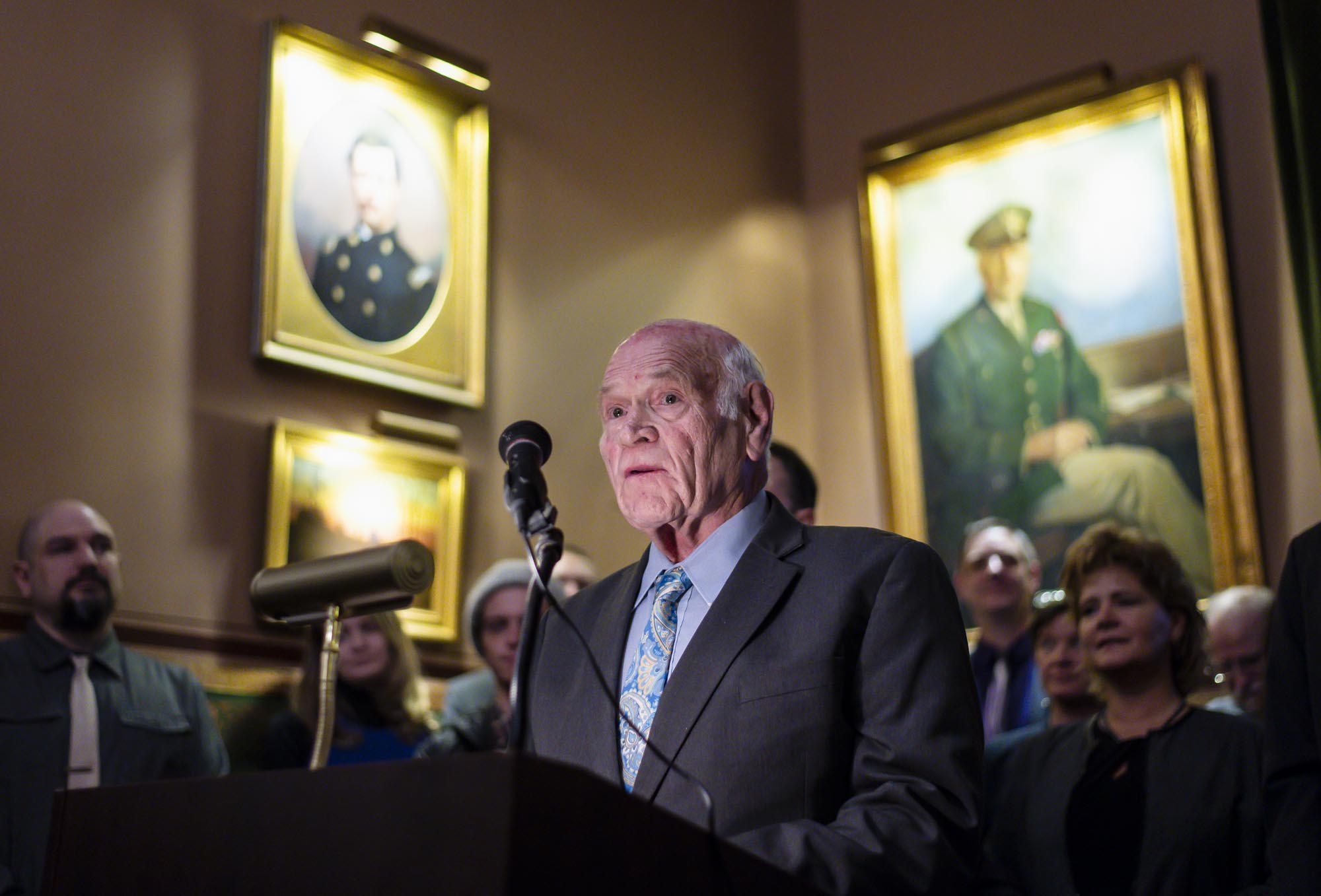
At a noon news conference with other lawmakers and criminal justice advocates on Thursday, Sen. Dick Sears, D-Bennington, who chairs the committee and is leading the bill, didn’t outright say that the bill is doomed, but that the committee may need more time — a luxury in short supply.
“What we’re learning deserves more attention than we may have time for this session, but certainly, hopefully setting up for the future to make significant change,” he said.
Sears left that press conference early, but reached by the phone around 4 p.m. Thursday, he said he was still working on a final draft. On what this latest version contains, he remained mum, except to say that he “at the very least” wants to codify the Vermont Supreme Court’s Zullo v. Vermont decision, which grants citizens a private right of action against state police “based on alleged flagrant violations of Article 11.”
But just a day earlier, Sears himself had said that both proponents and opponents of the original S.254 weren’t keen on that idea.
There could be another way forward. S.250, a wide-ranging reform bill from Sen. Kesha Ram Hinsdale, D-Chittenden, also contains a section that would end qualified immunity for cops. On Thursday afternoon, she said she is unsure whether S.250 will get the Senate Government Operations Committee’s final OK by Friday. But, like anything, crossover deadlines are ultimately up to the discretion of legislative leadership.
“I would hope that leadership would be willing to use discretion in this regard, because qualified immunity is also important to the Pro Tem (Sen. Becca Balint, D-Windham),” she said.
As for S.254, according to Sears: Stay tuned until Friday. “We’ll see what happens,” he said.
— Sarah Mearhoff
IN THE KNOW
A controversial change to the “right to farm” bill is likely to die in the Senate Committee on Judiciary.
The bill would have limited the types of nuisance suits that neighbors can bring against farmers, and it would have required neighbors, or whoever brings the suit, to pay for the farmers’ legal expenses if it failed.
Sen. Corey Parent, R-Franklin, introduced the bill following a high-profile trial in which landowners in Addison County sued a neighboring farm for sending large amounts of runoff through their fields and into Lake Champlain.
Lawmakers in the committee took testimony from a number of farmers and environmentalists about the bill earlier this session. As newcomers unfamiliar with farming increasingly move to the state, farmers argued, farmers will be more likely to face unnecessary lawsuits — and they’re already operating on shoestring budgets. Environmentalists said farmers are given ample protection in Vermont’s existing “right to farm” law, which has seldom been used.
Sen. Dick Sears, D-Bennington, who chairs the Senate Judiciary Committee, said in an email that the bill isn’t likely to make it out of committee before the crossover deadline on Friday.
“We are concerned about some unintended consequences,” he said. “We’re also looking at the Addison County case which has not yet been resolved.”
— Emma Cotton
The Senate Committee on Economic Development, Housing and General Affairs is putting together a grant program to help employers keep paying employees who cannot show up for work because of Covid-19.
Businesses asked for the help.
The grants would reimburse up to 80 hours of pay for an employee who had to stay home in the preceding six months, up to a maximum of $5,110 per employee. Senators are considering covering absences for all of 2022, which would allow employers to get reimbursed for paying people who stayed home during the Omicron wave.
Joyce Manchester, senior economist at the Legislature’s Joint Fiscal Office, estimated that the plan would cost $24.5 million to $27.5 million, based on an assumption of 62,000 cases during all of 2022. With 46,000 cases reported during January and February, that would require no more than 16,000 cases for the final 10 months of the year.
Manchester estimated that employers would apply for 45% of absences of an average of 35 hours at an hourly pay of $25 an hour.
The chair of the committee, Sen. Michael Sirotkin, D-Chittenden, said “the price tag drops precipitously” if the state were to restrict employers to applying for absences recorded after the bill becomes law, rather than allowing employers to seek retroactive reimbursement back to Jan. 1.
The committee is set to continue working on details of the grant program Friday before a possible vote on its economic development bill.
— Fred Thys
For the last two years, at least one thing in Vermont’s K-12 schools has been a welcome constant: Every single child eats for free.
A pandemic-era waiver from the federal government has paid for universal school meals across the country since 2020. But federal funding is set to expire in June, and anti-hunger advocates are now renewing their push to get lawmakers to make free school meals permanent in Vermont, no matter what the feds do.
The House Education Committee on Thursday listened to hours of testimony from supporters of S.100, who argued that the pre-pandemic system of subsidized lunches left too many children to fall through the cracks and created a stigmatizing experience.
At one point, one of the committee’s members, Rep. Terri Lynn Williams, R-Granby, offered a brief but emotional reflection on her own experience.
“I just want to say that the last hour — this testimony has been about me. The life I lived. And all of these testimonies have brought me right back to when I was a kid, going through all that same stuff. And it never goes away,” Williams said, breaking into tears. “It makes you stronger. It makes you realize what the world is like around you. But it never goes away. I just want to say that.”
— Lola Duffort
ON THE MOVE
The Senate gave preliminary approval Thursday to S.139, a bill that would prohibit public school mascots that stereotype a race, gender or sexual orientation.
The bill directs the Agency of Education to develop a “school branding policy” by Aug. 1. The policy would prohibit school branding that references or stereotypes race, creed, color, national origin, sexual orientation or gender identity.
It also would ban school branding that references “any person, group of persons, or organization associated with the repression of others.”
— Riley Robinson
Mirroring the House’s speediness earlier this week, the Senate on Thursday fast-tracked H.717, a bill providing $644,826 in humanitarian aid to the people of Ukraine as Russia continues its military invasion.
The figure represents $1 for every Vermonter, plus $1,749: the sum the Vermont Department of Liquor and Lottery collected from sales of Russian-sourced products between Feb. 24, when Russia launched its invasion, to March 2, when Vermont took Russian liquor off its shelves.
The bill passed by a unanimous voice vote with little debate, save for an amendment introduced then quickly withdrawn from Sen. Kesha Ram Hinsdale, D-Chittenden. She said her amendment was meant to “draw attention to the need to open our hearts wider for every conflict that occurs on this globe, and particularly ones that we have to recognize we have a hand in.” She withdrew her amendment so as not to delay getting the money out the door.
The bill now heads to Gov. Phil Scott, who will sign the measure during a “Freedom and Unity” vigil held alongside members of Congress and legislative leaders on the Statehouse steps Tuesday.
Members of the public are encouraged to join and bring candles or lights. The event begins at 6:30 p.m.
— Sarah Mearhoff
IN CONGRESS
The U.S. House late Wednesday night passed the nation’s $1.5 trillion omnibus spending bill, averting government shutdown and funding programs through the end of September. U.S. Rep. Peter Welch, D-Vt., was among those voting in favor of the spending package, which will deliver over $200 million in earmarks to Vermont.
— Sarah Mearhoff
WHAT’S ON TAP
FRIDAY, MARCH 11
9:30 a.m. — The House is set to vote on whether to override Gov. Phil Scott’s veto on the Brattleboro charter change bill, H.361.
9:30 a.m. — Senate Judiciary has scheduled markup and possible vote on S.254, which would end qualified immunity for police officers.
1 p.m. — House Human Services to vote on a committee bill addressing opioid overdose response services.
WHAT WE’RE READING
Across the state, Vermonters find ways to support Ukraine (VTDigger)
For some Vermont parents, racial differences hit close to home (VPR)
