
When a law has unintended consequences, legislators should be willing to go back and change it, said Sen. Russ Ingalls, R-Essex.
That’s what he tried to do, as the chair of the Senate Agriculture Committee, when his committee took up H.941, which seeks to largely protect farms from being regulated by municipal bylaws. Legislators passed the bill on the Senate floor Wednesday.
“Vermonters should have the right to grow food no matter what. They should have the right to raise animals for their consumption, if they like, and sometimes farming is not pretty,” Ingalls said in an interview.
Ingalls said he was previously under the impression that state law protected farms from municipalities meddling in their practices. Then last year, a Vermont Supreme Court decision interpreted the law in the opposite way.
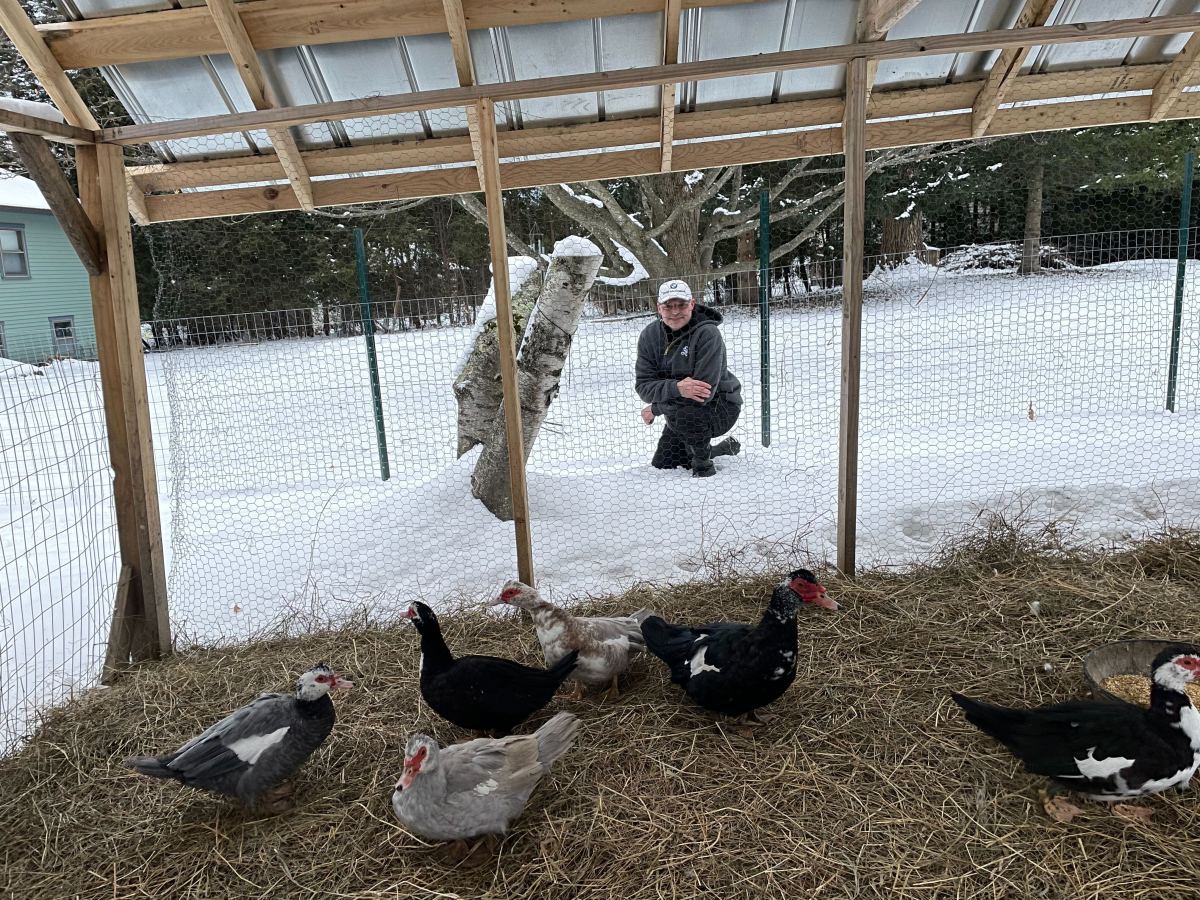
Before reaching the state’s highest court, the lawsuit started with a spat between neighbors in Essex Junction. Much to the disdain of his next door neighbors, Jason Struthers grew cannabis, raised ducks and farmed vegetables in his half-acre backyard on Taft Street.
His neighbors reasoned that Struthers shouldn’t be allowed to run a farm or cultivate cannabis on their quiet cul-de-sac, because they live within the city’s residential zone and within 500 feet of Essex High School. Struthers argued in turn that he’s exempt from the city’s regulations because he’s protected by state agriculture and cannabis laws.
Last year, the state Supreme Court ruled that municipalities in Vermont can regulate both farming practices and cannabis cultivation by enforcing local zoning laws. The bill passed by the Senate on Wednesday attempts to set the record straight, Ingalls said.
Under the bill, farms would be exempt from municipal bylaws if they rake in enough money or farm enough animals to be subject to regulations by the Vermont Agency of Agriculture Food and Markets.
Lands used for other agricultural practices like viticulture, vegetable farming or tapping maple sap would also be exempt from municipal bylaws. The bill would also exempt small poultry flocks from municipal bylaws, with the exclusion of roosters.
The bill does not define, though, what number of birds constitutes a “small poultry flock.” The lack of a statewide definition could create ambiguity for town or city officials that enforce local regulations, according to Samantha Sheehan, a policy specialist for the Vermont League of Cities and Towns.
Sheehan said that without a clear definition, the state is very likely to see another lawsuit disputing how many birds someone can raise on their property.
Under the bill, municipal bylaws would still apply to farms that raise, feed or manage livestock on less than one acre. The bill also lays out specific measures for when municipalities can manage swine and their waste. And under the bill, the secretary of agriculture would have the ability to decide if a farm will be subject to municipal bylaws, if someone has livestock on a farm that is one to four acres.
The bill will now go back to the House.
In the know
Gov. Phil Scott on Wednesday vetoed a bill aimed at reducing harmful runoff from road salt into Vermont’s waterways. The bill, S.218, also proposes creating certifications for commercial and municipal salt applicators, and giving applicators certain protections from slip-and-fall lawsuits.
Scott said at a midday press conference Wednesday, when asked about the bill, that he doesn’t think it does enough to protect the people who apply salt, particularly those who work for municipalities. He issued a press release saying he’d vetoed the bill several hours later.
“I found nothing that would lead me to sign it,” he told reporters.
Scott’s veto all but certainly kills the bill, since it faced substantial opposition from Republicans on the House floor last month and Democrats don’t have enough votes there, much less in the Senate, to override Scott’s objection on their own.
Scott announced that he’d signed two other bills into law Wednesday: S.163, a bill on the role of nurses with higher levels of certification, and S.181, which changes when certain investigatory reports must be filed with a court before a judge gives someone a deferred sentence.
— Shaun Robinson
Lawmakers on the Senate Education Committee spent Wednesday afternoon hammering out a bill that would set Vermont’s school districts on a path toward consolidation.
The bill, H.955, narrowly passed out of the House last month. The legislation would allow Vermont’s 119 school districts to voluntarily merge.
Senate lawmakers are hoping to vote on a version of the bill by Friday to keep the legislation on track for final approval before Memorial Day.
They’ve got their work cut out for them.
“We’re at a soul-searching time” in the process, said Sen. Kesha Ram Hinsdale, D-Chittenden Southeast.
“And we’ve got, like, a day to do some soul searching,” Sen. Nader Hashim, D-Windham, replied.
Most of the committee questioned whether the House’s construct would achieve the sort of consolidation and cost savings that lawmakers envisioned last year, when they passed Act 73.
Under the current version of the bill, study committees would be formed to work toward voluntary mergers. But merging itself would not be mandatory, and would ultimately be decided by the study committee and the voters in each district.
Sen. Steve Heffernan, R-Addison, on Wednesday proposed giving the study committees a year to formulate possible mergers before the Legislature would have a final say over which districts merge.
“It’s giving an open option for everybody to get at the table and talk,” he said.
— Corey McDonald
On the move
The Senate on Wednesday advanced H.739, a bill that would ban the herbicide paraquat. The agricultural product has been linked to Parkinson’s disease and is banned in dozens of countries. If the Senate passes the bill, it will need further approval by the House.
— Ethan Weinstein
ICYMI
Brendan Kinney, who currently serves as the chief operating officer of Vermont Public, will take the reins from Sky Barsch as VTDigger’s CEO next month. His hiring was announced on Wednesday.
The board of Digger’s parent organization, the Vermont Journalism Trust, chose Kinney unanimously after a competitive national search this spring. He’ll be joined soon by interim Editor-in-Chief Susan Allen — a veteran of Vermont journalism herself.
— VTD staff