

It has been an incredibly difficult year for Vermonters as we cope with the uncertainty of the pandemic and its manifestations.
VTDigger’s reporters, editors and photographers have made an effort to cover the full arc of this historic year in which the Covid crisis, economic instability and calls for racial justice have altered the lives of Vermonters and the future of the state for years to come.
This is a year most of us would rather forget, but there are inflection points worth remembering. Here are 10 of the most critical news events that marked 2020.

Teens interrupt governor’s speech with climate change demands
Teenage Extinction Rebellion demonstrators shouted climate change action chants during Gov. Phil Scott’s state of the state address in January. The group of 16 protestors continued for 15 minutes before the governor asked police to remove them from the downstairs gallery of the House chamber. Several were detained by Vermont State Police and later released.
The protests started with a rally on the Statehouse steps where Rory Patch expressed frustration with the slow pace of government response to what she described as an existential crisis for the human race.
“I’m here because I’m afraid I’m going to die,” she said. “We have a right to a livable future and so do our children. And so do our children’s children. We need to achieve a just transition, through the climate crisis. Because we are unable to trust the government to do so.”
The demonstrators demanded that lawmakers support a Vermont “Green New Deal,” which calls for investments in weatherization, renewable heating systems and public transportation.
The disruption of Scott’s address was the second in a row.

Sanders wins NH Democratic primary, then bows out
Sen. Bernie Sanders, I-Vt., trounced his Democratic rivals in the New Hampshire primary, beating the now President-elect Joe Biden by 50 points. He had the home court advantage in Vermont’s sister state. But he also had name recognition thanks to his last presidential bid in New Hampshire in 2016 where he beat Secretary of State Hillary Clinton by 22.4 points in the Granite State contest and later relinquished the nomination after the Democratic convention that year.
His second historic win in New Hampshire came on the heels of a second place finish in Iowa. He later went on to beat out a field of five rivals in Nevada and California, but lost traction in South Carolina where he failed to garner support among Black voters. He subsequently lost in Wisconsin.
Six weeks later, and three weeks into the pandemic, which hampered his ability to hold the kind of stirring rallies that had been the hallmark of his candidacy, Sanders suspended his campaign and conceded the Democratic primary to Joe Biden.
“The path toward victory is virtually impossible,” Sanders told his supporters. “So while we are winning the ideological battle and while we are winning the support of so many young people and working people throughout the country, I have concluded that this battle for the Democratic nomination will not be successful.”
Sanders did win the ideological battle for the hearts and minds of many Americans. As VTDigger political columnist Jon Margolis put it, “Bernie Sanders changed America.” The slogans he hammered on in his first failed bid for the presidency in 2016 became the rallying cry for a progressive wave of House and Senate newbies in 2018 and other presidential candidates in 2020. A $15-an-hour minimum wage, health care for everybody and free college tuition are now common rhetorical refrains in the political discourse.

The first Covid wave alters our way of life
On March 13, Gov. Phil Scott declared a state of emergency in response to a World Health Organization declaration that Covid-19 had escalated to a global pandemic. At that point, only two Vermonters had been diagnosed with the coronavirus (the first on March 7), but cases had already mushroomed in Washington state, and New York City was becoming a hot spot. Earlier in the year, China and Italy had seen an explosion in cases and thousands of deaths.
That first order from the Scott administration restricted visits to elderly care facilities, limited public gatherings and expanded unemployment insurance to Vermonters who were required to self-isolate or quarantine.
The first emergency order was a harbinger of things to come. We learned that it took two weeks for coronavirus symptoms to emerge. That older people, especially those with comorbidities are much more susceptible to the disease and are more likely to die from it. That social distancing was essential. That masks deterred the aerosols from exhalations from spreading into the environment and infecting others. That life as we know it had changed.
Within a matter of weeks, it became apparent that Covid had quietly spread through asymptomatic and minor symptom transmission to Vermonters throughout the state. We learned that outbreaks were ravaging nursing homes with fatal fury. A family in Wilmington lost a set of twin brothers after siblings had sugared together in early March.
There was a major spreading event at a UVM basketball game that ultimately led to the deaths of three men, including Rep. Bernie Juskiewicz.
Scott responded by modeling good behavior and emphasized that heeding the science was essential to protect the vulnerable and the elderly. On March 26, he shut down the K-12 school system, which forced educators to quickly adapt to online learning, often without adequate broadband access for Vermont’s 78,000 students. School officials in the Northeast Kingdom said 25%-30% of students don’t have internet access.
Ski areas suspended operations in mid-March. Most businesses, including bars, restaurants, hotels, gyms, hair salons and movie theaters were closed by April. Restaurants alone are a $1.1 billion industry in the Vermont economy, which is heavily dependent on tourism.
People were outraged by the impact on the economy. But Scott persevered in his belief that Vermonters could beat the contagious disease by staying home. He calmly rebuffed President Donald Trump’s confusing and baseless claims about Covid.
Burlington Mayor Miro Weinberger also took early action to curb the spread of coronavirus, meeting with UVM officials, mandating masks in public places, limiting gatherings, and closing bars and restaurants — sometimes ahead of the governor’s initiatives.
The logistics of preparing for a Covid surge were overwhelming. The state scrambled to obtain adequate PPE and ventilators and the Vermont National Guard assembled emergency spillover facilities at the Champlain Valley Expo Patrick Gymnasium. Hospitals cross-trained personnel in Covid treatments, including isolation methods, intubation of patients and testing protocols. Southwestern Vermont Medical Center started a new drive up testing program that was quickly replicated by health care facilities around the state. Hospitals stopped elective procedures, which took a heavy toll on the industry. By June, the state’s 14 hospitals had lost $107 million in revenue.
Locals stopped going anywhere. Second homeowners came to the state in droves to quarantine and escape escalating outbreaks in Boston and New York City. In that first wave, which lasted through May, 52 people died. VTDigger memorialized those who were lost to Covid in the spring.
Vermonters waited. There were shortages of toilet paper, handwipes and flour, and grocery stores made one-way lanes through food aisles and installed plexiglas shields to protect cashiers. People made masks for each other and delivered food to neighbors in need. Men grew beards. Women dyed their own hair. Sourdough baking became a thing.
People were agitated. The idea of wearing masks, not going out except to buy groceries and hardware, and not seeing family seemed awfully extreme. But Vermonters listened. And slowly, but surely, the state bent the curve. Gradually, the Scott administration “reopened the spigot.”
By summer, Vermonters were able to hike, golf, swim and gather in small groups outside wearing masks and social distancing.
The mantra, in doggerel form, from Department of Health Commissioner Mark Leveine and the governor’s office remained the same: Masks on faces, six foot spaces, uncrowded places.
By June, our sudden luck seemed miraculous. The state had the lowest case rate in the country — in stark contrast with another small population state South Dakota where the Republican governor had flaunted the immutable rules of science — case rates and deaths skyrocketed.

Unemployment skyrockets and food lines form
By April 9, more than 70,000 Vermonters were immediately unemployed as a result of the business shutdowns, another 8,000 business owners, independent contractors and self-employed people also were out of work.
The Vermont Department of Labor estimated that unemployment levels hit 20%, an all-time record not seen since the Great Depression. Before the pandemic, the state’s unemployment rate was 2.2%.
The labor department was overwhelmed by the demand. The agency received 10,000 calls a day, and sought additional help from workers at Green Mountain Power, Vermont Gas and Efficiency Vermont. The 30-year-old mainframe computer system was so backlogged that the department wasn’t able to process all of the claims that Vermonters attempted to file. People waited weeks for payments to begin.
Food insecurity ravaged communities. One in three Vermonters didn’t know where the next meal was coming from. The number of people seeking food assistance at local foodbanks shot up dramatically. Depending on the location, demand increased from 30% to 100%. The Vermont National Guard ran out of meals at drive through distribution events held around the state. Drivers queued up on I-89 ramps in Burlington waiting for food, and about 2,000 cars showed up at a Berlin event.
Less than two weeks into the pandemic, Burlington-based restaurant Skinny Pancake launched Shiftmeals, a program that produced meals for people in need with funding from the Vermont Community Foundation, the Boston Beer Company and High Meadows Fund. The startup effort morphed into Everyone Eats — a federally funded free meal program that became a pandemic prototype for how the state could pay cash-strapped restaurants that were shutdown during Covid to prepare locally produced food for struggling residents.
Covid relief package buoys sagging Vermont economy
In response to the economic crisis that ensued with the onset of the pandemic, Congress passed the Coronavirus Aid, Relief and Economic Security Act in April, plowing $1.25 billion into the Vermont economy. The federal funding represented more than 16% of the state budget and was used to support hospitals and the K-12 school system during Covid, bail out farmers, expand broadband and stablize the Vermont state college system.
The state distributed the CARES Act money to ski areas, homeowners with mortgages, childcare programs, municipalities and the judicial system. It was the largest single federal grant ever provided to the state of Vermont.
Vermont received the second-largest share of the money from the $2 trillion CARES Act, with just over $2,000 per person. Only Wyoming, which has a slightly smaller population of 578,000, received more money per capita, at $2,160. For any state with a population of 7 million or above, the per capita payout was only about $388.
Another component of the CARES Act — the Payroll Protection Program — doled out $1.2 billion in loans to 12,740 businesses in Vermont, to ensure companies kept employees on payroll.The program covered two and a half months of payroll and supported large and small operations, with loans ranging from less than $150,000 to $5 million. Construction companies, manufacturers, private schools and colleges, breweries, law firms, resorts, utilities and media all took advantage of the federal loans. At the end of the year, many companies that met certain criteria sought to convert the loans into grants.
In May, Congress followed that initial infusion of cash into the economy with the $3 trillion Health and Economic Recovery Omnibus Emergency Solutions, or HEROES Act, which would have plowed $2 billion into the Vermont economy.
But the bill landed with a thud on President Donald Trump’s desk. Congress scaled it down to $900 million and still couldn’t make progress with the White House.
The legislation is, of this writing, close to final passage as the Senate wrangles over the size of direct payments to individual Americans, which has ranged between $600 and $2,000, and a plan to eliminate a legal liability exemption for tech platforms. The bill includes an expansion of federal unemployment benefits, another payroll loan program for companies, rent and utility payment assistance, funding for performing arts and theaters, aid to farms, funding for broadband infrastructure and payments to low-income families for monthly internet fees, and assistance for Covid testing, contact tracing and distribution of the coronavirus vaccine. The state will also get $900,000 to help with burial and funeral costs for deaths caused by Covid.
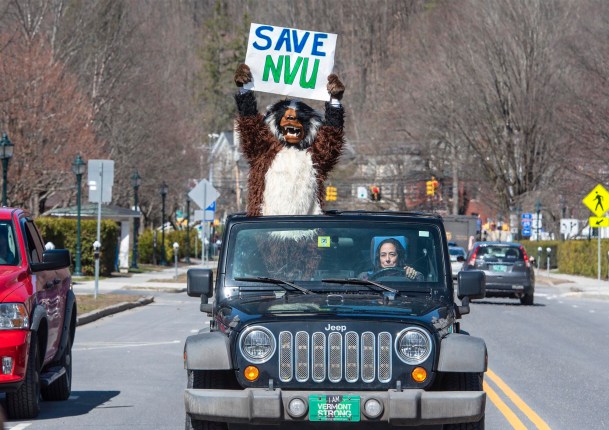
State colleges teeter on the brink of collapse
As the economic crisis deepened, colleges came under immense financial pressure. The Vermont State Colleges System, which was already weakened by years of state underfunding and declining student enrollments, faced a dire fiscal picture in April after the system pivoted to online learning and returned $5 million in room and board fees to students during the pandemic. The system already had an operating deficit of $7 million to $10 million, and anticipated a drop in enrollment of between 15% to 20% and operating deficit of $12 million in the 2020-2021 school year.
Jeb Spaulding, chancellor of the colleges, recommended a reduction in force of 500 employees and the closing of three campuses run by the system in Johnson, Lyndonville and Randolph. The proposal triggered an enormous backlash from communities, lawmakers, students, alumni and employees. Spaulding withdrew the proposal five days later and then subsequently resigned.
The problem, however, remained: How to shore up the system. By June, the projected deficit mushroomed to a projected $19 million to $46 million, and a report recommended $30 million in bridge funding. Ultimately, the Vermont Legislature and Gov. Phil Scott approved $36 million to keep the system afloat in the current year.
In December, a special legislative panel recommended that Castleton University, Northern State University and Vermont Technical College be merged into one school. The panel suggested that the state spend $77 million in one-time money over the next five years to help the colleges undergo a systemwide transformation.

Across the state, thousands join racial justice protesters demand change
In the aftermath of the police killing of George Floyd, a Black man in Minneapolis, racial justice protests swept the nation. Vermont was no exception. Thousands of Vermonters, white, Black, indigenous and people of color gathered in the streets to demonstrate against police brutality, police killings and racial discrimination.
The largest demonstrations were in Montpelier and Burlington, but local residents also gathered in the Mad River Valley, Randolph, Brattleboro, Bennington and Newport.
Demonstrators called out the names of Black people in other states who had been killed by police. They shouted “I can’t breathe,” the last words of Floyd who was apprehended by Minneapolis police for allegedly buying a package of cigarettes with a counterfeit $20 from a convenience store. Video footage showed that Officer Derek Chauvin had pinned Floyd’s neck with his knee. Protestors held periods of silence commemorating the 8 minutes and 15 seconds during which Floyd suffocated to death.
Protestors painted Black Lives Matter in yellow on the streets of Montpelier, Bennington and Burlington. The Black Lives Matter mural in Montpelier was defaced, and in Bennington where 150-200 people gathered to peacefully demonstrate, four onlookers, including a self-proclaimed white supremacist, were arrested for disorderly conduct.
More than 1,000 people gathered in Burlington for protests on June 20 and again on July 4. Hundreds more called into city council meetings to demand changes to law enforcement. They pointed to the 17 police killings in Vermont over the past decade, double the number of deaths by law enforcement in the 2000s. They criticized the city for not firing three officers who were involved in a 2019 killing of a white man and use of excessive force in two separate incidents involving Black men. Mayor Miro Weinberger said the officers involved had already been exonerated and could not be expelled. Later, the city agreed to a $300,000 buyout for one of the officers.
They called for the defunding of the police and largely succeeded in Burlington where the mayor and city council eventually voted to reduce the law enforcement budget by 30%, eliminating 29 positions out of a total of 105. The money is to be redirected to social services.
The Vermont ACLU, Justice for All, Migrant Justice, and the Vermont branches of the NAACP called for statewide reforms, including an end qualified immunity for officers involved in police brutality, removal officers from schools, limited police involvement in low-level offenses, banning police use of military-grade equipment and techniques, and prohibiting the use of invasive surveillance techniques.
The groups are also seeking community control over police departments, increased transparency and data collection, and the appointment of independent counsel outside of the State’s Attorneys and the Attorney General’s office to review and prosecute police misconduct.

Phil Scott and Molly Gray win 2020 general election; Statehouse leadership changes
Gov. Phil Scott swept back into office for a third term with a 60-point lead over his Progressive rival, Lt. Gov. David Zuckerman on Nov. 3. Scott, a moderate Republican, has been widely praised for his leadership during the pandemic and Zuckerman, who is an able campaigner, was hampered by the Covid election season which curtailed the kind of retail, door-to-door politics that challengers rely on to best an incumbent.
A newcomer to politics, Molly Gray, a Democrat, became the fourth woman in Vermont history to win the lieutenant governor’s seat. Gray, an assistant attorney general, beat Republican Scott Milne by nine points. Gray, a darling of the Democratic party, ran a fierce campaign and had the endorsements of Sen. Patrick Leahy, Rep. Peter Welch and former Gov. Madeleine Kunin.
The election resulted in a major change up in the Statehouse. Senate Pro Tem Tim Ashe, a Progressive Democrat from Burlington, lost his bid for lieutenant governor in the Democratic primary and will be replaced by Majority Leader Sen. Becca Balint of Windham County next week. She is the first woman and openly gay lawmaker to hold the position of pro tem.
House Speaker Mitzi Johnson lost her seat in a competitive race with two local Republicans and will be replaced by Majority Leader Jill Krowinski of Burlington.
It’s the first time three women will hold key leadership positions in the Legisalture. Krowinski and Balint have worked together for years and it’s likely that they will present a more united front against Scott than their predecessors, Johnson and Ashe who squabbled over policies, enabling the governor’s office to gain the upper hand.
Republican inroads in the House, however, will make it harder for Progressives and liberal Democrats to override vetoes from the governor. Scott vetoed six bills in the last legislative biennium, and four in the last session. Democrats succeeded in overriding only two.
In a normal year, the general election would be top news, but there was nothing typical about 2020, including the way we voted.
When the pandemic hit, Secretary of State Jim Condos immediately sought emergency authorization to expand the state’s mail-in voting system. Condos was concerned that voting could lead to Covid outbreaks, especially among older pollworkers. The proposal met opposition from House Republicans, but eventually several measures passed, allowing town clerks to send mail-in ballots to voters in the primary, and the state to send ballots in the general election.
More than 360,000 Vermonters voted in the general election — an all time record — and more than 80% of those who cast ballots did so in person. The second highest turnout was in 2008, when 327,000 Vermonters cast ballots. The mail-in system was so successful in tamping down Covid exposure and surpassing turnout expectations that Condos is hoping to use the same system for Town Meeting Day in March.

UVM Health Network cyberattack costs $63 million-plus
On Oct. 28, ransomware hackers attacked the UVM Health Network computer system, leading to an ongoing interruption in care for thousands of patients, revenue losses of $1.5 million a day, totaling more than $63 million. Those losses do not include the cost of restoring systems that impact UVM Medical Center and its affiliates, Vermont Central Vermont Medical Center in Berlin and Porter Medical Center in Middlebury.
Roughly 20% of the hospitals’ IT operations are still not functioning. Providers returned to paper records. The patient scheduling system was defunct. The radiology department didn’t have access to records for patients seeking surgeries.
The hospital president, Dr. Steve Leffler, initially predicted it would take “days, not weeks” to restore the hospital systems. After the attack, the Federal Bureau of Investigation swooped in to investigate, as several other health systems around the country had fallen victim to similar attacks. Gov. Phil Scott deployed a National Guard unit to help clean and restore the hospital’s 5,000 workstations and laptops.
The hospital temporarily furloughed and reassigned more than 300 workers.
In the nearly two months following the hack, hospital officials have remained tight-lipped about the perpetrators and methods of the attack, citing an ongoing investigation by the Federal Bureau of Investigation. For weeks, Leffler hedged questions about whether the downed computer system was caused by ransomware hackers. Last month, the head of the IT department admitted that attackers left a link in a single folder on a network computer to contact the hackers. It presumably led to a ransom request — but hospital officials never opened the link to check.
“We considered it for about five seconds,” said Doug Gentile, senior VP of network information technology. Ultimately, contacting the hackers or paying a ransom wouldn’t have saved time or effort, Gentile and hospital leaders concluded.
Gentile’s reconstruction provided the first glimpse into the cause of the cyberattack, which crippled the state’s largest hospital and affiliates for weeks.

The second Covid wave hits and a vaccine is slowly distributed
After a summer in which normalcy partially returned — small gatherings were allowed outside with masks, restaurants and bars reopened, and haircuts and gym workouts were permitted — Vermonters braced for a return to shutdowns, more economic peril and food insecurity as winter approached.
Schools reopened after Labor Day, two weeks later than usual. The state offered guidance for the particulars of reopening, but didn’t make a recommendation about whether schools should offer in-person learning. Ultimately each local district made the call. Most schools took a hybrid approach, offering a combination of in-person and online learning. A few went all-in on one or the other.
But questions remain about poor ventilation systems, protection for teachers, cleaning and disinfection routines, inadequate PPE and lack of broadband for online learning. Community transmission of Covid has occurred at dozens of local K-12 public schools.
The first sign of a resurgence was a cluster of Covid cases in central Vermont caused by a hockey team outbreak that started at the Montpelier ice rink in mid-October. The coronavirus spread to 124 people in the region.
The governor shut down local ice rinks on Oct. 16 and they have not reopened since. Similar spreading events occurred in New Hampshire.
The super-spreader was an adult league player who traveled out of state to pick up his son and some of his friends. At least one of the youths was positive for Covid-19. The father, son and the friends then stayed in the same home, and the father continued to go to the rink and take part in social events even though he had been exposed to the virus.
As the holidays neared and case counts began to soar, the Scott administration told Vermonters they could continue to frequent eateries, shop, stay at local hotels, but shouldn’t walk with neighbors outside. The governor eventually relented on the latter after a hue and cry from residents.
Family gatherings for Thanksgiving were banned, and even so, the spread continued, making December the deadliest month since the onset of the pandemic in March. At this writing, 135 Vermonters have died from Covid, most lived in nursing homes.
Nevertheless, ski areas, one of the great drivers of the Vermont economy, have been allowed to reopen. The state rules allow out-of-staters to frequent resorts as long as they have quarantined for two weeks before arriving. After a 40-inch dumping of snow in mid-December that hit Southern Vermont, thousands of people, many with out-of-state plates, swarmed ski areas. Many locals question whether the honor system is working and a new cluster in Dover where Mount Snow operates has emerged.
The economy, meanwhile, continues to flag. Economist Art Woolf says 30,000 jobs have been permanently lost. Many Vermonters without work are no longer counted on the unemployment rolls. About 20,000 are receiving unemployment benefits, and another 8,000 independent contractors, business owners and self-employed Vermont residents are getting Pandemic Unemployment Assistance.
The recessionary hangover that looms in 2021 could be assuaged with a short-term Covid relief remedy in the next month or so and long-term investments promised by President-elect Joe Biden. But in the meantime, Vermonters who have received their last unemployment check are in the lurch.
With the distribution of vaccines in Vermont, there is hope that life will return to a new normal, eventually. The governor has said it will be summer at the earliest before a critical mass of Vermonters are vaccinated.
About 14,000 residents have been received initial doses, with a second booster shot to be administered in a few weeks. The first group to be vaccinated, known as 1A, includes health care personnel, including clinical staff and support staff, and residents of long-term care facilities. The 14,000 represents about one-fifth of the 1A group and about 2% of the eligible population in Vermont, state officials say. As of Dec. 31, residents at 21 of the state’s 37 skilled nursing facilities had received their first dose of the vaccine. The state expects to finish vaccinating the 1A group by the end of January, and then the state will move to the next group, those over age 75.
The federal government promised 11,000 doses this week, but the state only received 7,800 — a problem also reported last week in Vermont and in several other states. The state submits requests for the vaccines each week to the U.S. Centers for Disease Control.

That’s a far cry from what’s needed. The health department says it will prioritize the 400,000 residents in Vermont who are either over the age of 65 or who have a chronic condition such as asthma, diabetes or high blood pressure. With such a large mass of people who need vaccination, the state has resorted to “age bands,” as a way to break down the large group.
Still, the fact that vaccines have been made available this quickly, is incredible. Epidemiologists originally estimated it would take 18 months to 2 years for development of a vaccine for the coronavirus.
That doesn’t mean the next six months will be easy. Vermonters are sick and tired of the health care crisis, the loneliness, the waiting and the economic misery.
But with the New Year, there is hope and an opportunity to keep each other safe by staying calm and carrying on in the stalwart way Vermonters have done so far.
We here at VTDigger will be there to cover whatever 2021 brings.
