


VTDigger is posting regular updates on the coronavirus in Vermont on this page. You can also subscribe here for regular email updates on the coronavirus. If you have any questions, thoughts or updates on how Vermont is responding to COVID-19, contact us at coronavirus@vtdigger.org
Just after 1 a.m. on Saturday, March 26, six trucks of personal protective equipment pulled up at a warehouse in Chittenden County.
The trucks were stuffed with latex and nitrile gloves, N95 masks, Tyvek coveralls, face shields, and surgical gowns from the national strategic stockpile. It was the biggest — and likely the last — delivery in the state’s effort to combat the coronavirus, according to Tim Stetson, the strategic national stockpile coordinator for the Vermont Department of Health.
With the delivery, state officials have said that Vermont has enough protective gear to equip medical providers, assuming the current projections for the spread of the coronavirus hold steady. By Sunday, 512 people had tested positive for the virus, and 22 had died.
As hospitals in New York City face shortages of necessary equipment, Vermont officials laid out a rosier picture at Gov. Phil Scott’s press conference on Friday.
“If everything holds, and our trajectory remains where it is today, we will have plenty” personal protective equipment, said commissioner of the Department of Public Safety Mike Schirling. Even so, he added, the state continues to order “any and all available PPE.”
In spite of the assurances of public officials, some health care providers are scrambling for more. While the state forecasts it can meet the hospital demand, fire departments and rescue crews worry they won’t have enough gear to protect their crews.
Jim Finger, chief executive officer of Regional Ambulance Service in Rutland, said last week that his service is running low on PPE, estimating that he had enough for a “few days,” and he has asked the state for more.
“We’ll see if it comes,” he said.
Asked what would happen without that resupply, Finger replied, “We’ll see if we get there.”
To keep up with the demand, rescue crews and hospitals are taking extraordinary steps that they never would have considered otherwise, including reusing equipment.
And while the state is saying it can meet the current likely scenario for the spread of Covid-19, if the worst-case scenario plays out, the PPE supply would run out quickly.
For example, under the most likely projections of the spread of the virus, Vermont would need 620,000 N95 masks by early May which the state forecasts it can meet. Under a worst-case scenario, according to the state’s projections, the number of N95 masks needed would increase to 900,000 by early May, leaving the state 280,000 short. That gap would get much wider in June.
As the PPE supply is depleted, the state will rely on orders from private suppliers to fill the need.
“This is a ‘keep you up at night’ kind of thing,” said Al Gobeille, chief operating officer of the University of Vermont Health Network. “We can’t run out.”
That’s because PPEs, especially N95 respirators which provide 95% protection from inhaling virus droplets, are critical to protecting the health of front-line medical workers. Covid-19 is a highly infectious virus, and while 80% of people are asymptomatic and only suffer mild cases of the disease, 20% experience moderate to severe symptoms. People with underlying health issues like diabetes, lung diseases, including asthma, and cardiovascular diseases, such as COPD, are more likely to become sick enough to need hospitalization.
Last week, the Centers for Disease Control and Prevention announced new research that shows 25% of people with Covid-19 are carriers who do not have symptoms and recommended that in addition to social distancing, people wear masks to prevent transmission of the disease by talking and even breathing.
Doctors, nurses and emergency responders come in direct contact with seriously ill Covid-19 patients, including those who need to be intubated, and many in places where there have been major outbreaks, health workers have contracted severe symptoms. Vermont health care professionals have told VTDigger they are updating their wills and self-isolating from loved ones.
While the coronavirus is often more dangerous for older people, some young people can experience what is known as a “cytokine storm,” in which their immune systems overreact to the coronavirus. One symptom of the disease can be an escalated heart rate for many minutes.
In New York City, the 911 system has been overwhelmed and emergency responders have cared for patients who have suffered heart attacks — after being released from Covid-19 treatment.
On Friday, the Scott administration released data on health workers with Covid-19. There were 19 infected personnel at UVM Medical Center, two at Northwestern Medical Center, and one each at Copley Hospital, Central Vermont Medical Center, North Country Hospital Dialysis Center, the White River Junction VA, Rutland Regional Medical Center and Southwestern Vermont Medical Center physical therapy.
What’s in stock
Saturday’s shipment marks the third delivery Vermont has received from the national stockpile, which has sites at 12 undisclosed locations around the country. The Vermont National Guard has agreed to help organize and store some of the equipment. The Department of Health collects applications from the hospitals or organizations, and then sends it out in shipments using Agency of Transportation vehicles.
Agency of Human Services Secretary Mike Smith reported Friday that the state has 1.9 million gloves in stock and 59,000 surgical masks. The state has 283,000 N95 masks — less than half of what is likely needed. Even as officials have offered assurances that it can meet hospital demand, they’ve continued to take a no-holds-barred approach to ordering more.
State officials have solicited donations from companies as disparate as building contractors, lighting companies, and a Burlington makerspace. And they’ve submitted orders for millions of sets of protective equipment from private companies, according to Levine.
“As we’ve indicated before, we’re not using estimates to purchase — we’re purchasing any and all available PPE at the most rapid rate possible,” said Smith.
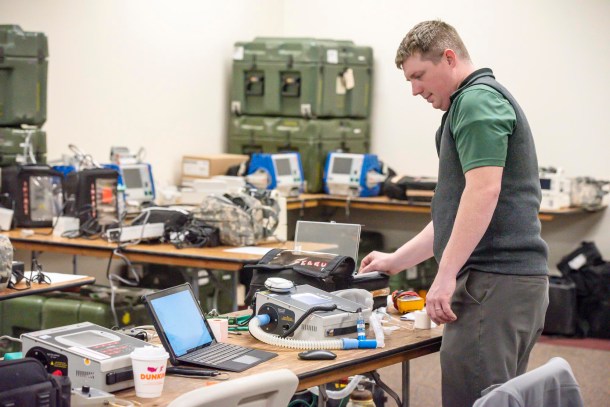
Life-saving ventilators are in short supply nationwide, and the federal government is only releasing them on an as-needed basis, within 72 hours of a request from states.
Hospitals in Vermont now have 208 ventilators available, based on data from the State Emergency Operations Center released Sunday. Michael Pieciak, the commissioner of the Department of Financial Regulation, estimates that about 245 cumulative ventilators would be needed through June 3, under the data modeling predictions released last week.
Adam Silverman, the spokesperson for the Department of Public Safety, said in a statement Sunday that the state has 600 ventilators on order from the Federal Emergency Management Agency. States must let FEMA know when “they see 72-hour critical need that will outstrip state capacity.
“State planners are monitoring that daily to model if/when the 72-hour critical period comes into view,” Silverman said. “No deliveries have occurred or been promised.”
The state has also “initiated” purchase of 452 ventilators through eight different suppliers. About 50 are in transit, but state officials say “due to global supply chain challenges, for most orders, shipping and arrival dates are not yet known.”
FEMA is sending other personal protective equipment on a rolling basis, and so far has shipped three out of four orders for face shields, N95 respirator masks, surgical masks, coveralls, gowns and gloves.

A chart from the state (pictured above) shows that 116,000 N95 respirator masks for front-line health workers have been received from FEMA.
Silverman said the state and hospitals have also privately placed orders for 3.7 million PPE items, predominantly masks, from 10 suppliers as of April 4.
“PPE is available primarily in hospital stock, which is receiving orders through supply chains, supplemented by the state’s Strategic National Stockpile (SNS) warehouse and ongoing state procurement,” Silverman wrote. PPE is distributed from the warehouse, “based on the prioritization set by the Health Department. Since March 18, the state has fulfilled 708 orders for PPE, 49 are pending, and eight were unable to be fulfilled because they were for items not stocked by the SNS warehouse.”
Vermont hospitals are also preparing to sterilize N95s for reuse, using health department and U.S. Food and Drug Administration guidelines, Silverman wrote.
So far, state expenditures for PPE have exceeded $20 million.

EMS crews anticipate reusing masks
When it comes to allocating the gear, Stetson said the state prioritizes hospitals, nursing homes, and emergency response services. That has left the leaders of some rescue services out of fresh supplies, forcing them to reuse PPE and tapping other sources rather than simply relying on the state to bolster their supplies.
Finger, of the Regional Ambulance Service in Rutland that has staff of more than 50 people, said state and federal guidance has been constantly changing in recent weeks, including calling for the reuse of certain PPE, particularly N95 masks.
He said the state recently put out guidelines stating that crew members would need to don PPE if they come within 3 feet of a patient.
“Well that’s every patient,” Finger said. “I wrote back and said, ‘OK then I’ll need 3,000 for the next 60 days,’ and they went, ‘Well you might have to look at the guidelines for reuse.’ So I’m not sure what I’m going to get.”
On Thursday, Finger said he heard from other rescue squad leaders that they have enough PPE. But, “will they in the future? Nobody knows,” he said. “It depends on how bad it gets.”
Dan Batsie, the chief of emergency medical service at the Vermont Department of Health, said with more precautions over Covid-19 and rising cases, the need for protective gear among EMS services in the state has also been increasing.
There are about 180 ambulance services and rescue squads in the state. About 2,800 Vemonters staff those agencies, the vast majority of them volunteers or part-time employees. Across the state, nine agencies are entirely staffed by full-time employees.
Batsie said he didn’t have a specific breakdown of requests to the state stockpile by EMS agencies in Vermont. In addition to making requests to the federal government for assistance, the state has tapped other sources, including businesses around Vermont for PPE supplies, he said.
Chiefs across the state said they’re sending fewer staff on calls and reusing masks to conserve resources.
Shelburne Rescue Chief Jacob Leopold said his service had struggled with maintaining a stock of personal protective equipment, such as N95 masks about two weeks ago, but the state has stepped in in recent days to help resupply.
“I do feel well-positioned right now,” Leopold said. “We will see what the next two weeks will bring. We are not at the surge for the state of Vermont yet, I cannot tell you what it will look like in the future.”
But he’s reusing gear just to be safe. Leopold said crew members responding to a call are wearing N95 masks covered by surgical masks as well as face shields. After the call the face shields are disinfected and the surgical masks are thrown away and the N95 masks are then reused, for up to a total of five calls.
“That is stretching the serviceable lives,” he said of the N95 masks.
Tom Leeman, operations coordinator of the Vergennes Area Rescue Squad, said his department is taking similar steps, including the reusing of N95 masks up to five times and reducing the size of crews responding to calls from as many as four people in the past down to two members.
“We’re pretty stable at this rate with our estimation,” he said of his rescue service which has two full-time members, six per diem members, and about two dozen volunteers.
On the open market
Hospital administrators said they had received supplies from the state, but were also scrambling to get back-up equipment from other sources. Gobeille, from the UVM Health Network, said the group of five affiliate hospitals in Vermont and New York state, is working with Dartmouth-Hitchcock Medical Center and the state of Vermont to jointly purchase more PPE.
On April 1, the group submitted about $8 million worth of orders to various companies, including suppliers in Canada, China, and Turkey, Gobeille said. The University of Vermont Medical Center shared its wares with affiliate hospitals in Vermont and New York when they ran low.
At the current “burn rate,” the hospital stash of N95 masks will last 60 days, he said. In most of the longer-term projections, “we’re relying on resupply,” Gobeille said.
Josh White, the chief medical officer at Gifford Medical Center, said he was having staff wear a mask a day. Other hospitals had taken a similar approach — though the guidance from the CDC is changing rapidly, Gobeille said.
Vermont officials are not relying on any hospital beds or ventilators at Dartmouth, which is just over the state border, saying New Hampshire is already accounting for those and they don’t want to “double count” them.
The city of Burlington is making its own effort to resupply. It has gotten protective gear from the state and from the airport. City officials bought hand sanitizer from distilleries and took mask donations from contractors.
The city has spent about $13,000 on masks and roughly the same amount on thermometers to test city employees and to donate to senior centers, according to Mayor Miro Weinberger.
Now, Weinberger said he’s confident the city has enough — for now. “I think we had some decent stockpiling and preparation,” he said. “But the biggest thing,” he added, is that Vermont hasn’t seen the influx of patients that flooded hospitals in New York City, China and Italy experienced.
Schirling, from the Department of Public Safety echoed that warning. He expressed confidence in the state’s models, but Vermont isn’t in the clear yet. “If folks begin congregating and not paying attention to the guidance that’s been given by the CDC and the executive orders, the burn rates will go up, the number of cases will go up, and we will be at risk of out stripping our supply of PPE, ventilators, and bed,” he said.
Editor’s note: This story was updated with information about Covid-19 transmission and data about health workers testing positive for the virus. Editor Anne Galloway contributed to this report.

