


A multi-year effort to expand the charge of the statewide energy efficiency utility from electric to “all-fuels” conservation got a boost from lawmakers this month.
The Senate Natural Resources and Energy Committee unanimously approved a bill that would allow the state’s electric efficiency utilities — Efficiency Vermont and Burlington Electric Department — to spend up to $2 million over the next three years on heating and transportation efficiency projects. Historically, the EV’s conservation efforts have been limited to electric savings work. The money to fund the “utility” comes from an efficiency charge on electric bills.
However, as transportation and heating now account for 80% of Vermonters’ energy costs and contribute to climate change pollution, lawmakers and others have grappled for years with how to have Efficiency Vermont do more work in those sectors.
Since its start two decades ago, the statewide efficiency utility has reduced greenhouse gas emissions by 11 million tons, said Rebecca Foster, Efficiency Vermont’s director. Vermonters will see long-term savings of $2.4 billion from projects done from 2000-2018. The budget during that time period has been $658 million.
Last session, lawmakers passed Act 62, which allowed the utility to put $2.25 million in savings toward moderate-income weatherization incentives. That law also directed the state Public Utility Commission to look into creating a so-called “all-fuels” efficiency program to better coordinate the state’s heating, electricity and transportation efficiency efforts.
Sen. Chris Bray, D-Addison, chair of Senate Natural Resources, said the most recent bill would allow Efficiency Vermont to be “free to innovate.” Any proposals from Efficiency Vermont and Burlington Electric to redirect money require PUC regulatory approval. And the bill only allows the utilities to redirect funds if their budgets do not go up.
Next week, Senate Finance will take its first look at the bill.
Foster said Efficiency Vermont feels the bill was “an important step forward” for the utility to shift its approach to work “more on those high cost, high emissions areas.” (The utility already does some weatherization work with money from other sources outside the electric efficiency charge.)
Transportation and heating climate change goals lag behind
The Department of Public Service notes in its annual energy report Vermont has made “limited progress” in meeting transportation-related climate goals. For example, while vehicle efficiency is improving, miles driven per capita in the state is also going up. The state would need 50,000 to 60,000 electric vehicles on the road by 2025 to meet goals laid out in the state’s Comprehensive Energy Plan; as of last July, there were 3,288 electric vehicles registered in Vermont.
Vermont’s renewable energy requirements have a unique provision that electric utilities have to reduce customers’ fossil fuel use through so-called “energy transformation” projects. Utilities are doing this in a variety of ways, from incentives for electric vehicles and cold climate heat pumps to switching maple syrup producers to more efficient evaporators.
Although Vermonters can now access incentives to make e-vehicles more affordable, electric vehicles are not widely available, the PUC notes in an initial report on the all fuels effort. Both the Department of Public Service and electric utilities want the efficiency utilities to work “upstream” with dealers and manufacturers to increase availability.
“We’ve heard from the auto dealers … that they have trouble sending two guys to a week-long training and spending $40,000 on (charging) equipment,” said TJ Poor, director of the efficiency and energy services division for the department, in an interview. For smaller auto dealers, “that creates a barrier” to them being able to sell e-vehicles, he said.
Lawmakers set a goal to weatherize 80,000 homes by 2020 — as of 2018, only 27,186 homes had been weatherized, according to a 2020 energy report from the state Department of Public Service. In addition to long-term savings, weatherization can also improve indoor air quality and reduce mold; the state health department estimated an $8,500 investment — the average cost for a state-funded low income weatherization project — would yield three times that amount in energy and health savings over a decade.
But the “up-front costs associated with weatherization” are high, and low heating prices make the payback period for those investments lengthy, the annual energy report notes.

Barre-based Capstone Community Action is one of five organizations that receive state money for low-income weatherization projects. Executive Director Sue Minter said for Vermonters struggling to afford necessities like food and health care, energy efficiency is not usually their “most pressing” concern.
She highlighted, however, that weatherization projects can have a big impact, with savings every month.
“To imagine a heating bill cut in half in the winter literally means more food on the table,” Minter added.
Matt Cota, executive director of the Vermont Fuel Dealers Association, said that his members have long supported efficiency efforts and need to have a role in the move to including “all-fuels.”
While there is a growing push to move off fossil fuels for heating and transportation, Cota said “that transition period is perhaps longer than some want it to be.”
“We’re in this with eyes wide open and understand that over the next 20 years, we’re going to need trucks that deliver fuel and we’re going to need techs in the basement to fix boilers and burners and furnaces,” he said.
Long-term funding still an unknown
In its initial all-fuels efficiency report last month, the Public Utility Commission states that the “evidence is clear and unrebutted” that Vermont “will fall short of its goals and commitments” to reduce emissions without more money and a unified heating and transportation efficiency effort. Previous reports estimated an additional $30 million-$60 million a year would be needed to significantly reduce emissions in those areas, the commissioners note.
Electric utility heads, the Department of Public Service and lawmakers broadly agree that they do not want the electric efficiency charge to go up to fund any expanded efforts. Andrea Cohen, government affairs manager for Vermont Electric Co-op, testified to lawmakers last month that “electric ratepayers, who have already been paying for efficiency, for cleaner energy … should not be the ones burdened with the next step in this.”
Coming up with additional money for heating and transportation conservation remains a challenge. House and Senate leadership have expressed support for the regional Transportation and Climate Initiative (TCI) over measures like a state carbon tax. Last session, senators deemed a House proposal to double the fuel tax to increase weatherization funding too regressive.
TCI would set a regional carbon dioxide emissions cap at current emissions levels and have them decline over time. Regional fuel importers would buy emissions allowances at auction based on the amount of on-road gasoline and diesel they sell in each state. States would use the auction proceeds on pollution reducing measures like public transit, making downtowns more walkable and electric vehicle incentives.
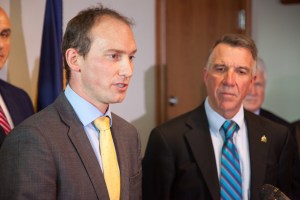
Signing on to TCI could provide Vermont with an estimated $18 million-$66 million in the first year of the program, said Peter Walke, deputy secretary of the Vermont Agency of Natural Resources.
But the proposal would likely raise gas prices, which Gov. Phil Scott opposes. The administration highlighted the governor’s proposed budget that includes more than $240 million in climate spending for Efficiency Vermont, park and rides, weatherization and other efforts.
Anthony Roisman, chair of the PUC, said he feels what’s often missing in the funding discussions is how climate change “has a huge cost” for Vermont.
“We’ll see when the current storm is over or the next time we have some major flooding,” he said. “You’ll get reports from the utilities and from municipalities and from the state itself as to how much it cost to deal with the problem that was created.”

