


Vermont’s goals for cutting greenhouse gas emissions were ambitious from the start.
In 2007, the Legislature passed a law that called for a 25% reduction in emissions below 1990 levels by 2012, 50% below by 2028 and 75% below by 2050.
Just over a decade later, Democratic lawmakers and one of the governor’s top environmental officials concede the near-term goal will not be met.
“We’re going to not meet that 50% by 2028,” Peter Walke, the deputy secretary of the state Agency of Natural Resources, put it flatly in a recent interview.
Emissions have increased in recent years, with the most recent data from 2015 showing emissions 16% higher than 1990 levels. And there are indications that emissions have only continued to rise since then.
House Speaker Mitzi Johnson, D-South Hero, and Rep. Sarah Copeland Hanzas, D-Bradford, vice chair of the climate solutions caucus, also said Vermont could not realistically halve its emissions in the next decade.
“In order to have met that goal, we needed to have been keeping closer track of it all along the way,” said Johnson.

This article is the last in a series covering the impact of climate change on Vermont. Read about hotter, wilder weather, the potential impact of ‘climigration,’ and the new pest problems farmers are facing.
VTDigger joined 250 media outlets for Covering Climate Now, a global journalism initiative. For more info, and stories from around the world, click here.
Support VTDigger’s ongoing coverage of the environment by donating here.
What happened?
Initially, the state focused on greening up the electric sector through energy efficiency and renewability standards for utilities. Vermont also participates in RGGI, a regional cap and trade program to reduce emissions from electricity.
Those efforts have been successful, to some degree. Greenhouse gas emissions from electricity are slightly below what they were in 1990, according to the state’s latest inventory.
But similar progress has not been made in transportation or heating, which now account for almost 70% of the state’s greenhouse gas emissions. In fact, emissions from transportation, the single biggest contributor, are now 28% higher than they were in 1990.
In a rural state with long winters, lowering emissions from heating and transportation has proven difficult. While some Vermonters have switched over to electric vehicles, 97% of vehicles are still gasoline and diesel powered, according to the state’s 2017 Vermont Transportation Energy Profile. And overall vehicle miles traveled in Vermont, which is above the national average, has been rising in recent years.
Vermont has among the oldest housing stock in the nation. While progress has been made in weatherizing homes to lower heating costs, the state is falling far below its goal of improving 80,000 homes by 2020. The state Department of Public Service said in its 2019 annual energy report that it would take an “immediate and unprecedented ramp up” to meet that target.
“We have not sustained effort and resources into it and until we do that … we’re not going to even be making progress, we’ll continue to fall behind,” Copeland Hanzas said of the state’s emissions goals.
Leaders in the Senate and House say their strategy is changing.
“We’re in the process of making a pretty serious conceptual shift to focus much more on transportation and the emissions from buildings,” said Senate President Tim Ashe, D/P-Chittenden, who placed himself on the Senate Transportation Committee this session.
“And so we might think about things differently today than we did when those particular goals were made in terms of timing and strategies,” he added.
While the 2028 goals may be out of reach, state leaders, including Gov. Phil Scott, are optimistic that Vermont can drastically reduce emissions by mid-century, citing technological advances and existing policies that will reap future reductions.
“I believe we can attain our goal by 2050 but it’s not linear,” Scott said in a recent interview.

Now what?
Next year, the climate solutions caucus will push for a bill known as the “Global Warming Solutions Act,” which would align Vermont’s goals with those of the Paris Agreement and require state agencies to adopt rules to reduce emissions. The long-term goal for Vermont would be net-zero emissions by 2050.
Connecticut, Maine, Massachusetts and New York have enacted similar laws.
“Both of these are pretty aggressive, pretty ambitious targets given that we’ve been falling behind,” Copeland-Hanzas said. “But we need something to demand that the Scott administration put more than just a handful of resources toward meeting these goals.”
Right now, the state tracks its past emissions mostly by aggregating federal and state environmental data. However, it does not track overall emissions reductions expected from public investments, new policies or actions from other players, like utilities or weatherization companies.
Walke said he thinks tracking expected progress is “important,” but said the state’s resources are better spent on policy development and action, such as home weatherization and promoting electric vehicles.

Even meeting the emissions reductions goals in the Paris Agreement would require drastic actions. Vermont would need 90,000 electric vehicles on the road by 2025, according to an Energy Action Network analysis; the state had 2,985 registered as of last January.
A version of the Global Warming Solutions Act introduced in the House last year did not make it to the floor. It’s likely that bill will see more play next year as Johnson said she is willing to support it in 2020. She said Rep. Tim Briglin, D-Thetford, chair of the House energy committee, has been looking at “ways to hold us and the governor accountable to those emissions goals.”
Johnson added that she wants lawmakers to focus their energy on emissions-reducing actions, not “quibbling over the specifics of the target.”
Ashe, however, said the other states that have passed the Global Warming Solutions Act have yet to see whether it has had the intended effect of reducing emissions — or simply set in motion “multi-year bureaucratic processes.”
“I’m open-minded to it,” he added of the proposal, but “it is less important to me than actually coming up with strategies that we know will work now.”
The governor also expressed concerns with that approach, saying he prefers carrots over sticks. “Trying to use a regulatory method and punishment as a means to drive change typically doesn’t work that well,” he said.

Walke said he feels the focus should be on how the state could help people transition off fossil fuels, not on regulations that could lead to additional burdens for low-income Vermonters. He added that while it seems that a similar approach has effectively spurred lake cleanup, there were years of litigation and other challenges to get there.
“So to assume that you can create that same jump in the climate change world just by saying ‘go regulate climate change out of existence,’ which essentially is what it says, is going to lead to us going fast to go slow because we’re going to have litigation all over the place,” he said of the Global Warming Solutions Act.
Both Johnson and the governor declined to cite specific policy proposals they would endorse next year beyond continuing work from last session to promote weatherization, electric vehicles and charging stations.
“I’m not looking to reinvent the wheel, I’m not looking to come out with something dramatic,” Scott said.
He added that the administration’s focus on promoting downtown development over sprawl should cut down on Vermonters’ driving.
Johnson also highlighted other work lawmakers had done to lower transportation emissions, such as increasing park and rides and greening up the state vehicle fleet.
Environmental advocates and Progressive lawmakers, however, expressed frustration last session with both the governor and Democratic Statehouse leaders for taking a piecemeal approach instead of supporting more sweeping climate change legislation, such as banning new fossil fuel infrastructure or taxing carbon emissions.
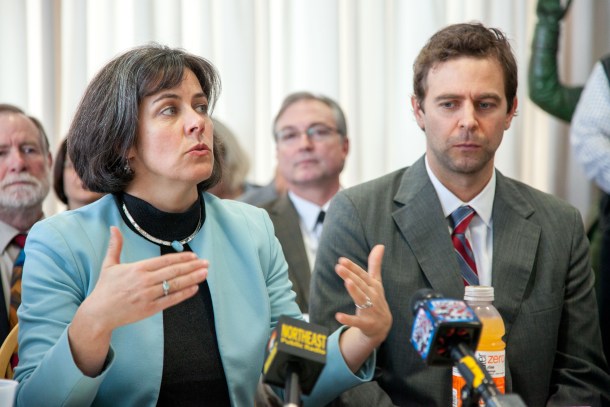
Ashe and Johnson both said that they would like to see the Legislature move forward with the Transportation Climate Initiative, a multi-state effort to reduce greenhouse gas emissions through a regional cap and invest program for onroad gasoline and diesel. TCI officials put out a draft outline of the plan this week.
“I think it’s powerful because not only does it mean taking some significant steps locally but it means that we’ve come to an agreement that has some very large states also agreeing to curb their emissions,” Ashe said. The TCI group includes 12 Northeast and Mid-Atlantic states and Washington, D.C.
The governor is withholding his endorsement of TCI until he sees the final agreement.
“I understand the enthusiasm but until you know what it is, I don’t see how you can commit to want to blindly adopting whatever it is this commission comes to in the end,” he said.
Another climate policy priority Ashe cited for next year is expanding Efficiency Vermont’s mission from electric efficiency to all home energy use, which is the subject of an ongoing Public Utility Commission proceeding. Johnson also expressed optimism for that approach.
Although he formed a climate action commission at the end of 2017, Scott has taken heat from environmentalists and some Democratic lawmakers for not pursuing more of their recommendations.

“Under this administration, we need to encourage, yell, scream, demand that they make this a priority and put more resources toward it,” said Copeland Hanzas.
Although Scott said he agreed with his climate commission’s view that addressing climate change could provide economic opportunities, he has so far been unwilling to recommend the scale of investments needed to achieve the climate goals.
Scott, who talks frequently of the need to keep the state “affordable,” sees moving the state toward greater energy independence as a “balancing act.” He noted that surpluses in recent years that some lawmakers would have liked to use for climate efforts have had to go to paying down the state’s pensions and other underfunded liabilities.
“I think a lot of it is behavior,” he said of reducing emissions. “And we have to prove to ourselves that this can work and show that there’s a path forward that we can afford.”
Key lawmakers have echoed Scott’s reluctance to raise new revenue for emissions reductions measures with “regressive” fees. For example, a House proposal to increase funding for weatherization with a tax on heating fuels was ultimately shot down last session.
Ashe said he does not have a target number for much the state needs to invest to reverse the emissions trend as he feels it depends on technological innovations and other policies.
“On the one extreme, we could buy every single person an electric car, on the other extreme, the auto industry could say we’re only going to produce electric vehicles from here on out,” he said. “The level of state investment needed will be determined in some ways by the sweet spot between those two extremes.”
