

Lawmakers are reluctant to significantly boost Medicaid spending to prop up local hospitals — despite urgent calls from health care regulators to do just that.
Kevin Mullin, chair of the Green Mountain Care Board and a former Republican state senator, sent a letter to Republican Gov. Phil Scott last month urging the state to increase state Medicaid expenditures by $70 million to relieve pressure on commercial health insurance rates and prevent the state’s small hospitals from bleeding more red ink.
Mullin wants the governor, who will present a budget in January, to boost state Medicaid spending to the federal spending cap.
Vermont Senate Pro Tem Tim Ashe and the House budget chair, Kitty Toll, both Democrats, say they haven’t hit the federal limit because it would put stress on the state’s already tight budget. Ashe also questions whether Mullin’s reason for the hike is fully justified.
Mullin says the money is needed to help hospitals transition to the state’s unique all-payer system, and to help address the Medicaid “cost shift,” which occurs when hospitals increase expenses for patients with private insurance to offset insufficient Medicaid reimbursements. Nearly one-third of Vermonters use Medicaid.
Hospital care makes up about half of all Medicaid spending. Mullin says low reimbursement rates are making it more difficult for small rural hospitals to afford the transition to the all-payer system run by OneCare Vermont, which pools Medicaid, Medicare and commercial insurance monies and distributes payments to providers on a flat per patient basis.
Mullin says increasing Medicaid revenue for rural hospitals could make it easier for them to take on the risk — and costs — associated with participation in the all-payer model.
To reach the Medicaid cap of $1.46 billion, the state would need to spend an additional $148 million in federal and state taxpayer dollars. Until the state hits the cap, the federal government pays for 54% of Vermont’s Medicaid funding, while Vermont contributes 46%.
Ashe, D/P-Chittenden, said he is interested in finding ways to provide financial assistance to struggling small hospitals, but bumping up against the Medicaid cap would strain the state budget.
“We’ve been discouraged by several administrations from getting all the way up to that cap for fear of the unknown happening: something happens that suddenly requires an infusion of Medicaid spending and having no ability to draw federal match as a result,” he said.

Ashe said he was surprised to hear the care board single out the cost shift as a major threat to health care reform. He said the issue hasn’t come up in “a single previous conversation with state officials.”
“The issue of the cost shift to suddenly emerge as the single thing that is 100 percent going to determine whether the all-payer model succeeds, to me, it’s quite sudden to hear that,” Ashe said.
Toll, D-Danville, the top budget writer in the House, also said she avoids funding Medicaid up to the cap. “Because it’s not always predictable, you have to be prepared for fluctuation in either direction,” Toll said. “So I don’t like to commit right to the line, I like a little buffer.”
About 14 percent of Vermont’s Medicaid funding is managed by OneCare Vermont, a private LLC that has refused to open its books despite the fact that the company manages federal and state funds from Medicare and Medicaid.
OneCare pays hospitals and providers a flat fee per patient, instead of making fee for service reimbursements for patient treatments.
As the state transitions to a flat annual rate per patient, more Medicare and Medicaid patients have been included in OneCare Vermont program over the past two years. About 58% of the Medicaid population, for example, is now part of OneCare. Twelve of Vermont’s 14 hospitals participate in the Medicaid portion of the OneCare program.
In addition to seeking an increase reimbursement rates for hospitals, Mullin hopes to draw down $56 million of a separate pool of federal Medicaid dollars to help hospitals transition into the all-payer-health care system.
The Scott administration, which has pushed fiscal restraint even as the economy has rebounded, is still “reviewing” the Mullin letter and has not yet issued a statement about whether the governor will support additional Medicaid spending.
Toll said she is waiting for an analysis from the Scott administration before she decides whether to boost Medicaid funding. And should there be more money available, she’s not committed to funneling it to hospitals, as Mullin suggests.
“In order for me to prioritize now, I need a lot more information — whether it should go into rates, or go into developing more community services or investing more in the payment reform end,” Toll said. “Where is the money going to make the biggest difference?”
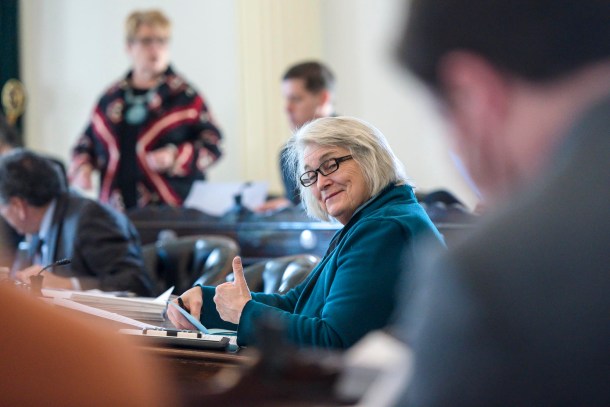
Sen. Ginny Lyons, D-Chittenden, the chair of the Senate Health and Welfare Committee, said she was in favor of increasing Medicaid dollars, but questioned how the state would fund them.
“I’d put more money into Medicaid, but you can’t just say we’re going to put more money from the general fund or increase the money that we have available to it without figuring out where it’s coming from,” she said. “I would challenge the administration to do that. I think it should happen.”
There is little indication that the Scott administration would have the appetite to raise the cap in order to bail out the all-payer system. The governor has previously put a lid on efforts by Democrats in the Legislature to raise taxes and fees.
Saving hospitals, or OneCare?
The overarching need for more Medicaid funding, in Mullin’s view, is driven by the “cost shift.” Last month, the Green Mountain Care Board approved a 12.4% hike for Blue Cross Blue Shield of Vermont and a 10.1% hike for MVP Health Care.
But when health insurance companies asked the Green Mountain Care Board for rate increases, they didn’t point to the Medicaid cost shift as the culprit. Blue Cross Blue Shield of Vermont said that drug costs, particularly specialty prescriptions, accounted for 50 percent of the rate hike.
Nevertheless, Mullin blames insurance hikes on low Medicaid reimbursement rates — even though under OneCare, Medicaid money is not used to reimburse for treatments, it is instead used to pay a flat annual fee to hospitals for Medicaid patients, 58% of whom are in the OneCare system.
“When I was in the Legislature, every year, it would be $20 million more that Medicaid needed,” Mullin said in a recent interview. “And for the last few years they’ve had the luxury of not having those increased millions being sought for in Medicaid. What I’m saying is you’ve got to pony up something if you expect that the all-payer model is going to work.”

Mullin says hospitals, particularly smaller, rural medical centers that serve more low-income patients, have had a hard time expanding participation in the OneCare program. That’s in part because he says they have larger pools of Medicaid patients and don’t see as much revenue as hospitals with more commercial payers.
Deb Richter, a Montpelier-based physician, said Mullin doesn’t address where the money would come from.
Even if Vermonters pay less in insurance premiums, they will still have to pay more in taxes to fund the additional Medicaid dollars, she said.
“Either way let’s not pretend this isn’t coming out of Vermonters’ pockets,” Richter said.
Richter, a critic of Vermont’s all-payer health care reform, also said she doesn’t believe the state should boost Medicaid spending when it’s unclear how hospitals participating in OneCare will benefit.
“That to me is the fundamental problem. We really don’t get to know who’s going to benefit the most,” she said. “If I were the Legislature, I would be incredibly careful about increasing Medicaid payments when this is not publicly accountable.”

