

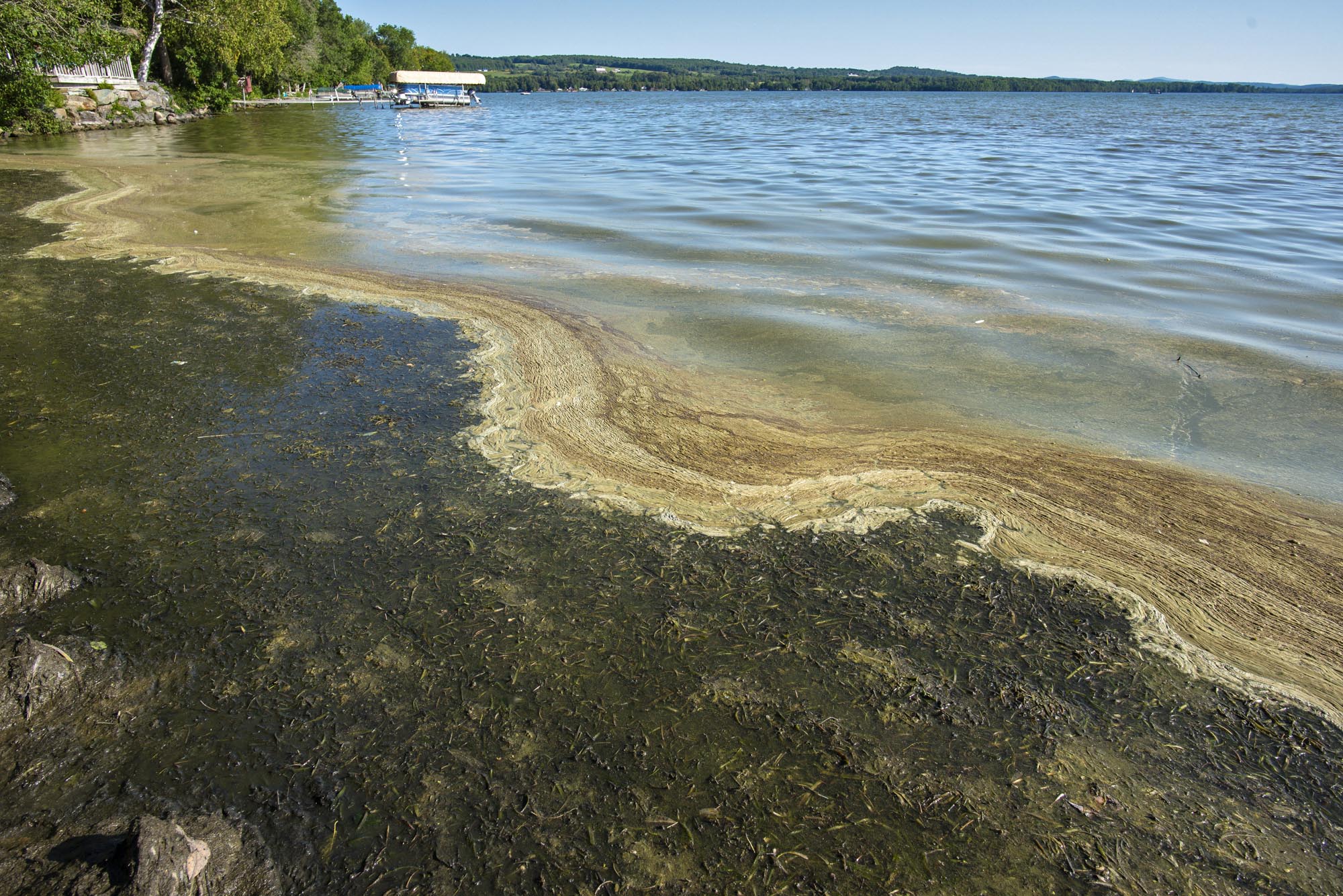
Residents who live near Lake Carmi and a polluted section of Lake Champlain pressed public officials Thursday on whether the state’s water clean-up plan will be effective.
They questioned regulations that still allow farms to spread manure near waterways at a public hearing on Vermont’s proposed plan for $32.9 million in clean water funding for next year.
Vermont is under federal mandates to reduce phosphorus going into Lake Champlain, Lake Memphremagog and Lake Carmi. Excess phosphorus can trigger outbreaks of potentially toxic cyanobacteria.
A lawsuit from the Conservation Law Foundation prompted the EPA in 2011 to reject Vermont’s earlier Lake Champlain pollution reduction plan, called a “TMDL.” Although runoff from New York, Quebec and Vermont enters the lake, Vermont contributes around two-thirds of the phosphorus pollution. The state passed a landmark water quality law, Act 64, in 2015, to provide new regulations and funding for water cleanup.
The draft budget for fiscal year 2021, which starts next July, tees up $8,550,000 for agriculture; $5,015,497 for wastewater; $6,600,000 for roads; $5,034,503 for natural resources; and $4,600,000 for stormwater. The budget is up $6 million from this year, with the biggest increases going to work to reduce runoff from dirt roads and for stormwater projects.
“In addition to all these water quality benefits, these projects also provide co-benefits like public health and safety and flood resiliency,” said Emily Bird, program manager for the state’s clean water investment report.
Agriculture contributes 41% of phosphorus runoff to Lake Champlain, according to the 2016 TMDL, and has to reduce phosphorus loading to the lake by 55%. But according to the Lake Champlain Basin Program, developed land actually contributes twice as much phosphorus per square mile as agriculture.
During the public forum, roughly a dozen people expressed concerns that conventional dairy practices, like manure spreading, were at odds with clean water.
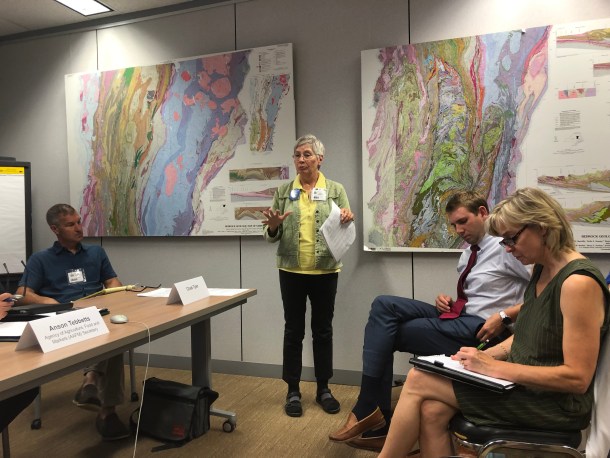
James Maroney, a former organic dairy farmer from Leicester, asked Anson Tebbetts, secretary of the Agency of Agriculture, Food and Markets, if he believed the required phosphorus reduction in Lake Champlain could still be met with the “conventional paradigm” of dairy farming.
“I would suggest that we’re going to have all forms of farming,” Tebbetts responded. “We’re going to have conventional, we’re going to have organic, we’re going to lose farmers. And all those factors have to play a role in meeting our goals — it can’t be one sector.”
Robert Wright, who has lived near Lake Champlain for over 70 years, said he was “irate” at what he has seen happen to the lake.
“Where is the money to help farmers transition away from practices that damage the lake?” he asked.
Last winter, the Agency of Agriculture granted over 60 exemptions to farmers to spread manure on snow in the fall when early snow cause storage problems for many farms. Farmers were still prohibited from letting any manure runoff and enter waterways.
Eben Markowski, a sculptor from Panton whose video of manure running off a field near his home prompted a state investigation, said he flukes in Vermont weather do not justify granting exemptions to the spreading on snow ban.
Markowski said he viewed the agency’s move as an indication that “you are OK with 100,000 gallons of manure going into the lake because if you’re putting it on snow, if you’re putting it on frozen ground, it’s going to make its way into the lake.”
Andrea Englehardt, who lives by Lake Carmi, said she appreciates the progress made to clean-up Carmi, from cover cropping at farms to fixing the septic system at the state park. And the state put in an in-lake aeration system this year to prevent algal blooms.
But Englehardt feels it “doesn’t make sense” for farmers to still be allowed to spread manure near the lake.
“Thanks for your efforts but it’s still blooming,” she said of the cyanobacteria.
Laura DiPietro, director of water quality at the Agency of Agriculture, said in an email after the hearing that water quality standards can still be met with application of manure, provided farmers follow required agricultural practices.
Those rules require farmers to inject manure on frequently flooded fields and prohibit manure from being spread on steep fields and near water supplies, among other restrictions. No farmers in the Carmi watershed were given permission to spread on snow this winter, said DiPietro.
Jane Clifford, co-owner of the Clifford Farm in Starksboro, expressed frustration with finger-pointing, saying that most farmers work hard to comply with the state’s water quality regulations. The Cliffords worked with the Vermont Land Trust and the state to put a river corridor easement on their farm that prevents 33 acres from being developed and requires a buffer strip along the Lewis Creek.
Clifford said that Lake Iroquois, where her family owns property, has water pollution problems and a Eurasian milfoil infestation. While there are no farms nearby spreading manure, there are dirt roads and camps around the lake with outdated septic systems, she said.
“I’m disappointed that you think it’s OK to always point the finger at me and my farm and say ‘you have to stop it,’” said Clifford. “You want us to stop producing a high quality product that we take pride in — my livelihood.”

Agricultural water quality projects led to a 1,301 kilogram phosphorus reduction in fiscal year 2018 — or 82% of the total pollutant reduction the state was able to calculate for that year.
The state auditor released a report earlier this summer looking at phosphorus reductions by sector for the first three years of ramped up state clean water spending. Geoffrey Battista, special investigator for the auditor, said that while agricultural water quality projects yield the most bang for the buck, more than half of clean water spending had gone toward expensive stormwater and wastewater reductions.
Multiple people at the meeting questioned state officials about how those findings were guiding the budget, with roughly one-third of spending slated for stormwater and wastewater.
Julie Moore, Secretary of the Agency of Natural Resources, said the budget does increase funding for agriculture from the previous year, but added that state and federal law requires improvements across all areas.
“So it’s not perhaps as straightforward as you may have read in the auditor’s report in that we want to make sure we’re making the most cost-effective investments, but…there’s also a minimum required investment in each of the core sectors,” she said.
The state is accepting comments on the draft budget until Sept. 6.
Correction: An earlier version of this story incorrectly stated the amount of the budget increase on clean water projects.

