


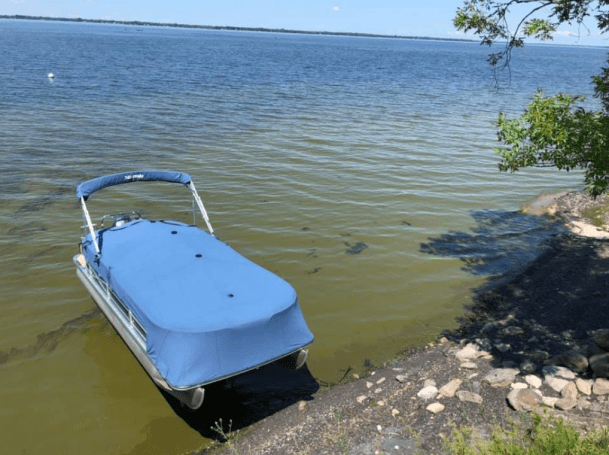
Jack Bliss saw the water on Lake Champlain two weeks ago turn the dirtiest he’s ever seen in 50 years of living on Maquam Shore in St. Albans.
“It was a thick pea green, thick like paint covering on the water for the first 300 yards from the shore,” he said.
The blue-green algae bloom was carried out of Missisquoi Bay by strong winds and it extended all the way to Butler Island, where Bliss has a camp. The water was so murky, Bliss said, fellow boaters were having trouble locating their moorings.
“The biggest difference this year is it’s a lot earlier,” he said. “Any of this green stuff is usually not until mid-August but this year it’s a month earlier.”
Bliss’s observations line up with reports made with the state’s cyanobacteria monitoring program. The percentage of early season reports this year classified as both high and low alerts for cyanobacteria, commonly known as blue-green algae, is the highest it’s been since data was recorded.
Vermont has had a cyanobacteria tracking program for the past 16 years to monitor beaches and lake accesses for the potentially toxic blooms.
The state tracker is a collaboration between the Department of Health, the Department of Environmental Conservation, the non-profit Lake Champlain Committee and the Lake Champlain Basin Program. Around 180 trained volunteers submit monitoring reports, mostly from sites along Lake Champlain in New York and Vermont, with photos and written descriptions on a weekly basis.
Monitors originally took water samples to test for cyanobacteria toxins, but in 2012 the state and LCC switched to visual inspections in order to monitor at more sites. Reports are classified as “generally safe” if little to no cyanobacteria are present, “low alert” if small amounts of cyanobacteria are present, and “high alert” if high amounts are present — forming dense blooms or colored water.
“Our approach with the visual monitoring is to engage the lake users,” said Lori Fisher, executive director of the Lake Champlain Committee. “People are deeply concerned about this issue understandably, and it’s a way to tap into the population with scientifically based training so we can reach a larger area more frequently.”
Fisher said while it’s too early to say if this year will be worse overall for cyanobacteria in Vermont, there have been more blooms earlier in the season than in years past.
VTDigger analyzed early season (June and July) monitoring data from 2012, the earliest year data was available, through 2019 to see what percentage of reports were classified as high and low alerts for algal blooms.
Early season Vermont algae bloom alerts
Percent share of cyanobacteria alert severity in May through July, 2012-2019
So far in 2019, 7.72% of reports were classified as “high alert,” while 8.64% were classified as “low alert.” That’s roughly twice as many during the same time period as the year before, when 4.18% of reports were high alert and 3.64% were low alert. High alerts and low alerts for June and July in 2019 were both higher than in any other year that data was available for.
Angela Shambaugh, the Agency of Natural Resources’ acting program manager for lakes and ponds, said weather conditions this year have come together to create the “perfect conditions” for cyanobacteria to form. Significant runoff from snowmelt, high water levels and warmer temperatures are prompting bacteria to be pushed downstream and form blooms.
“What we’re seeing now isn’t something necessarily new — it’s just, we haven’t seen these conditions in a long time,” she said.
Missisquoi Bay in St. Albans has been a hotspot this year, and small amounts have been detected on some smaller bodies of water, including Joe’s Pond in Danville.
“The goal of this program is really all about recreational safety at the moment,” Shambaugh said. “We want to provide a tool so people swimming on Lake Champlain know if they are safe or not.”
Shambaugh cautioned that there are many variables in the data — and overall trends about cyanobacteria blooms in Lake Champlain over time can’t be determined from the tracker. For instance, the number of submitted reports in the system, including clear water, increased from 767 in 2013 to 1,855 in 2018.
While cyanobacteria are native to Vermont, nutrient-laden runoff — as well as phosphorus-rich lake sediment — combined with warm waters can lead to explosive algal blooms.
Lake Champlain, Lake Carmi, and Lake Memphremagog are all under federal orders to reduce incoming phosphorus pollution, in large part to help prevent cyanobacterial blooms.
Natalie Flores, a PhD student at UVM, said that scientists are still looking into what triggers the algae to produce toxins.
“The tricky thing is they can only make toxins if they have the specific genes to produce toxins, and even if they have those genes, they’re not necessarily producing toxins all the time,” she said.
Bridget O’Brien, a toxicological analyst with the Vermont Department of Health, said the best strategy for cyanobacteria protection is to learn to recognize and avoid blooms.
Exposure to Cyanobacteria can lead to rashes or skin irritation, diarrhea, vomiting, liver damage and numb limbs. Children and pets are at greater risk of being exposed to cyanobacteria because they’re more likely to swallow water or play near the shoreline, where blooms are densest. Two dogs died last month from cyanotoxin poisoning at a private pond.
Climate change is creating the right growing conditions for cyanobacteria blooms.
Temperatures in Vermont have gone up more than 2 degrees Fahrenheit since the start of the 20th century, while average annual precipitation has increased by almost 6 inches since the 1960s, according to NOAA’s National Centers for Environmental Information.
Scientists predict that Vermont is expected to continue to see higher temperatures, increased precipitation (especially in the winter and spring), and more severe storms and floods.

Flores said the general scientific consensus is that climate change will lead to more cyanobacteria blooms.
“It’s really hard to say whether or not they’re going to increase or decrease in a particular area,” she added, as blooms are challenging to predict from year-to-year.
Vermont has a health advisory for three cyanobacteria toxins — anatoxin, microcystin, and cylindospermopsin. The state Department of Environmental Conservation’s drinking water program encourages public drinking water supply managers to conduct daily visual inspections for cyanobacteria during the summer and fall, and to reach out to the state to see if cyanotoxin testing is needed.
Jon Groveman, water and policy program director for the Vermont Natural Resources Council, said blooms should be taken seriously.
“Cyanobacteria outbreaks are extremely serious,” Groveman said. “We need stringent, clear standards for drinking water and beach closures.”
But managers of drinking water supplies are not required to monitor for the blooms or test drinking water for the toxins.
“Our stance is that people should be testing for cyanotoxins in their drinking water,” said O’Brien.
The Health Department has worked with DEC to obtain funding for weekly cyanotoxin testing at the 22 drinking water supplies in Vermont that draw water from Lake Champlain.
“This year we’re happy to have all 22 programs participating,” said O’Brien. She added that there is no long-term funding source for the testing.
Department of Health, DEC and LCC staff review incoming reports from the cyanobacteria monitoring tracker, reaching out to beach managers as soon as possible if incoming reports show there might be a bloom present. At some town beaches, like in Burlington, staff also [conduct daily visual inspections] for cyanobacteria.
“Working through the volunteer monitors using the visual observation system has been really good because we get a lot of information from them,” said O’Brien.
The Health Department has guidelines for advising beach managers to close beaches if blooms are present. O’Brien said the department recommends managers either test for cyanotoxins or wait 24 hours to reopen if they are not going to test.


