


Editor’s note: Mark Bushnell is a Vermont journalist and historian. He is the author of “Hidden History of Vermont” and “It Happened in Vermont.”
[G]eorge Fox had been worried about torpedoes for days before one slammed into the side of his ship.
The concern was understandable. The shipping lane he was traveling through – running from the North American mainland to Greenland – was infested with German submarines in 1943. He knew that his ship, the U.S. Army transport ship S.S. Dorchester, stood no chance of outrunning a U-boat if it encountered one.
A rumor had flashed through the ship that Fox and the other three chaplains were afraid of an attack. A soldier said he’d overheard two of them whispering their concerns to one another. The rumor, however, was in contrast to what the men had seen during the last few days. The chaplains had been their usual, cheerful selves. Smiling and joking, they had tried to visit each of the 900 men on board to give them encouragement and hope.
If Fox cursed himself for getting into this situation – traveling aboard an endangered ship – it would have been only human. After all, Fox had already done his time in the military.

Fox grew up in Altoona, Pennsylvania. His mother is remembered as cold and strict; his father as having an explosive temper that he unleashed on his children. In 1917, when Fox was 17 years old, the U.S. entered the World War, as it was then called. Though he was underage, Fox was eager to join the Army. His fervor was fueled by his abhorrence of German aggression and his desire to leave home.
Fox lied about his age to enlist. He served in the ambulance corps in northern France, saw heavy action and suffered a spinal injury during a bombing in early November 1918. When he awoke, he learned the war was over. For his service and sacrifice, Fox earned the Purple Heart, the Silver Star and a French medal for meritorious conduct.
Fox’s back injury continued to bother him and the Army declared him 10 percent disabled, for which he received $8 a month from the Veterans’ Bureau, or $8 a day once a month, as he liked to joke.
Returning to civilian life, Fox found his calling in the ministry. He entered the Moody Bible Institute in Chicago, where he met and began dating Isadore Hurlbut, the daughter of prosperous farmers from Hyde Park, Vermont.
The couple eventually married and moved to Vermont in 1925, settling in West Berkshire. Fox worked as a circuit rider for the Methodist Church, serving the communities of West Berkshire, Franklin and East Franklin. After two years, the couple returned to Illinois, where Fox continued his studies, this time to Illinois Wesleyan to earn his college degree. Soon he was studying at Boston University’s School of Theology.
As Fox’s education advanced so to did his position in the Methodist Church. After being ordained an elder during a ceremony in Barre in 1934, he took the first of a series of jobs as pastor in Vermont communities. First, he served Waits River, East Orange and West Topsham, then East Thetford and Union Village, which is in both Thetford and Norwich.
Fox seems to have particularly enjoyed his final position as pastor in Vermont. Moving to the community of Gilman, an incorporated section of Lunenburg, Fox found the people more talkative and more willing to joke than the ones he had met in other Vermont communities. He felt at ease among them. When women from his church held a tea for themselves, Fox walked a mock picket line, like the real ones he sometimes saw outside the local mills. He carried a sign that read “Unfair to Men of the Parish.”
In truth, Fox noticed that the church’s women did most of the work for the congregation and he was determined to get the men more involved. He decided to join the local American Legion post to get to know the men and soon made himself indispensable. Fox visited the sick and pulled strings to have men admitted to the Veterans’ Hospital; he also pressured the Veterans’ Bureau in Montpelier to get pensions paid and, in some cases, increased. His work got him noticed and he was named the Legion’s state chaplain.
In the late 1930s, Germany again ignited a world war. When America declared war on Japan and Germany in December 1941, he debated whether to enlist again. At the age of 42, and with a wife and two children at home, he could easily have opted out. Besides, his back injury had only gotten worse. After a medical check-up two years earlier, the Army had reclassified Fox as 29 percent disabled.
But Fox decided he was needed. He and his son, Wyatt, enlisted the same day. Fox planned to serve as a chaplain, but he was told he would first have to pass a physical at Fort Ethan Allen in Colchester. He was worried he wouldn’t pass right up to the moment the doctor said, “You’re in, Padre.”
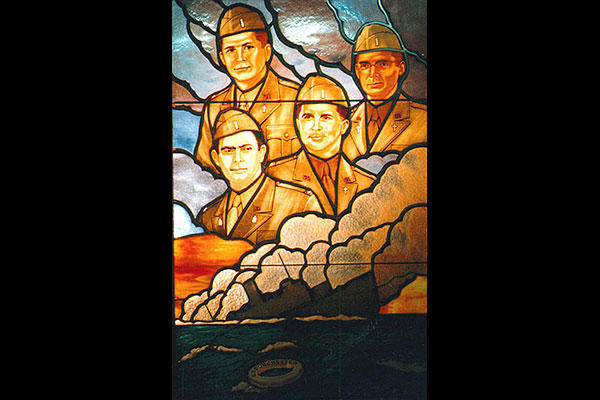
The torpedo struck the S.S. Dorchester in the early morning hours of Feb. 3, 1943.
Aboard the Dorchester with Fox were three friends he had made at the Chaplain’s School at Harvard: lieutenants Clark Poling, a Dutch Reform Church pastor; Alexander Goode, a Jewish rabbi; and John Washington, a Roman Catholic priest.
As water poured into the ship’s hold, hundreds of men flooded up onto the deck, many forgetting their life vests in their panic. Of those who fought their way back down the stairs to retrieve their vests, many died from the smoke and heat billowing up from the engine room.
The Dorchester began to list badly to port and soldiers struggled to lower lifeboats. Some boats, still empty, drifted away from the ship. Men started jumping overboard into the frigid water rather than remain on the sinking ship. The chaplains urged men to wait on board, perhaps knowing they would be lucky to survive half an hour in that water. Staying aboard for a few extra minutes might save their lives.
One survivor recalled seeing the oily water littered with bodies. “I could hear men crying, pleading, praying,” said Pvt. William Bednar. “I could also hear the chaplains preaching courage. Their voices were the only thing that kept me going.”
Working together, the chaplains distributed the extra life jackets stored in lockers on deck, but they soon ran out. A stunned soldier turned to one of the chaplains (no one seems clear which one) and said, “I’ve lost my life jacket. I can’t swim. I’ll …” The chaplain immediately took off his own life jacket and helped the young man into it. “Take this,” he said. “I’m staying. I won’t need it.” The other chaplains followed suit, giving their life jackets to others.
The chaplains spent their final moments standing together, arms locked, in prayer. Two recited their prayers in English, one in Latin and one in Hebrew.
The four chaplains were among the more than 670 men who died in the sinking of the Dorchester. Two hundred and thirty men survived, having been picked up by other boats in the convoy.
In death, Fox and his colleagues became national heroes. Each of the “Immortal Chaplains,” as they became known, was posthumously awarded a Congressional Special Medal for Heroism. Congress created this medal for the chaplains, since they were technically ineligible for Congressional Medals of Honor because their heroism hadn’t been while they were under fire.
The public was so moved by the story of the chaplains that their selfless courage was commemorated with a 1948 U.S. postage stamp and in stained glass windows at the Pentagon and West Point, among other places.
George Fox was also honored in his adopted home of Vermont, where his portrait hangs in the Statehouse.

