

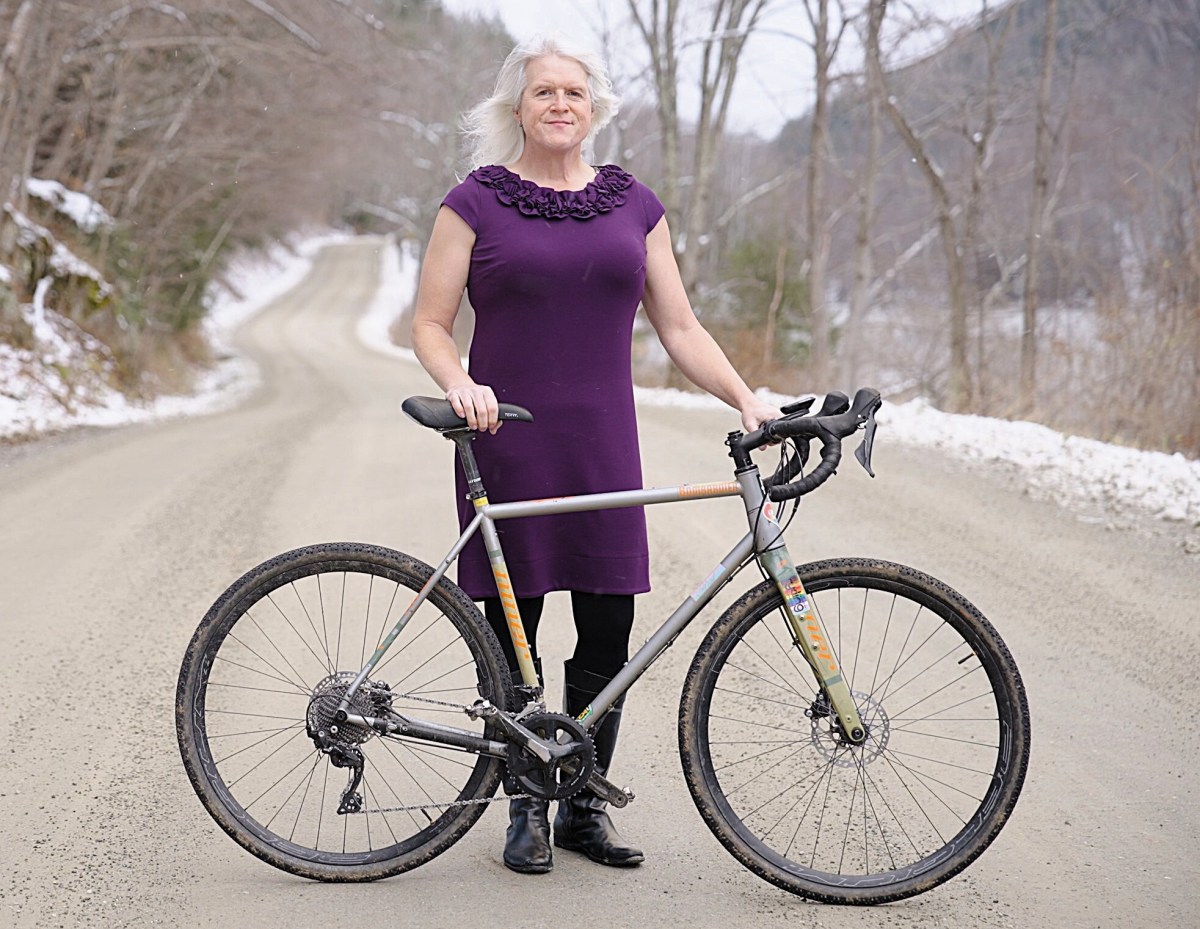
Filmmaker Jesse Huffman remembers when he first met fellow Vermonter Roxy Bombardier, an Iraq veteran turned dirt-road bike racer transitioning in her 50s.
“The concept of a transgender gravel cyclist was interesting to me,” he recently recalled.
Huffman then learned that was only the start of the story.
The video director, writer and producer was seeking a documentary subject when Bombardier revealed her challenges juggling gender-affirming surgeries, past traumas of war and present tensions with family.
“As I got to know Roxy,” Huffman said, “I realized there’s something deeper going on here.”
The resulting feature, “Claim the Lane: Becoming Roxy,” is set to shed light on Bombardier’s journey upon its state festival debut this week.
“When we started, we thought tackling this topic would be a big deal,” said Huffman, who began filming midway through the Biden administration. “The atmosphere for trans people has not improved. And that, to me, makes people seeing this all the more important.”
The documentary isn’t about the current debate on whether trans athletes should compete in women’s sports. Instead, it spotlights the humanity behind the headlines.
“I have known that I’m a woman since I was age 11 or so,” Bombardier, now 58, says in the film. “I knew it was a risk all along, but I really wanted to become the woman that I envisioned for myself while I still had time.”
“The goal was to make it so you could relate to Roxy as a person,” Huffman added in an interview. “This is about a human being and what they’re going through in order to try to evolve. That’s much different than, ‘I need to win the race.’”
Huffman has produced short-form content for outlets ranging from ESPN to the New York Times. Without a resume of longer work, he borrowed a camera from a local public access station, crowdfunded $30,000 in small contributions and enrolled in an online how-to documentary course.
“I knew we didn’t have a commercial hit,” he said, “but I wasn’t going to let that stop me.”
Huffman filmed Bombardier gravel cycling (a pedal-powered dirt-road exercise not to be confused with mountain or motor biking) from 2022 to 2024, starting with April’s Muddy Onion ride in Montpelier and finishing with August’s Vermont Overland race in West Windsor. The documentary’s climbing scenes reflect Bombardier’s internal uphill struggle.
Childhood snapshots are soon overshadowed by images of darker years. Bombardier’s brother died tragically in 1987. Then the biker deployed to Iraq in 2005, only to battle post-traumatic stress disorder in subsequent decades.
Bombardier started her transition in 2018 and has since had three gender-affirming surgeries.
“I just want to be my true self,” she says in the film.
Not everyone has understood. Huffman said Bombardier’s former partner declined to appear in the documentary, while her father agreed to address his child’s metamorphosis only after the recent death of her mother.
The patriarch needed time to move from seeing a son to the woman Roxy has become — yet required only three sentences in the film to sum up his own transformation.
“I told him that I was not real happy about it but I would accept it because I loved him,” the father says to the camera. “I had to get used to the fact that trans was becoming a lot more common. I had more problem accepting it with my own daughter than I would have in the general community.”
Huffman boiled down countless hours of footage into a 69-minute film.
“It’s a lot like making maple syrup,” he said of the sap-to-end product ratio.
The documentary, part of the currently touring No Man’s Land Film Festival, is set to open Burlington’s Made Here Film Festival on Thursday, April 23, at 12:30 p.m.
“It was a learning experience in every possible way,” the filmmaker said of the content and creative process. “If you’re someone who doesn’t know a trans person, you might have some assumptions in your head. The hope is this is an entry point for people to be able to understand each other and hopefully have some empathy.”
