


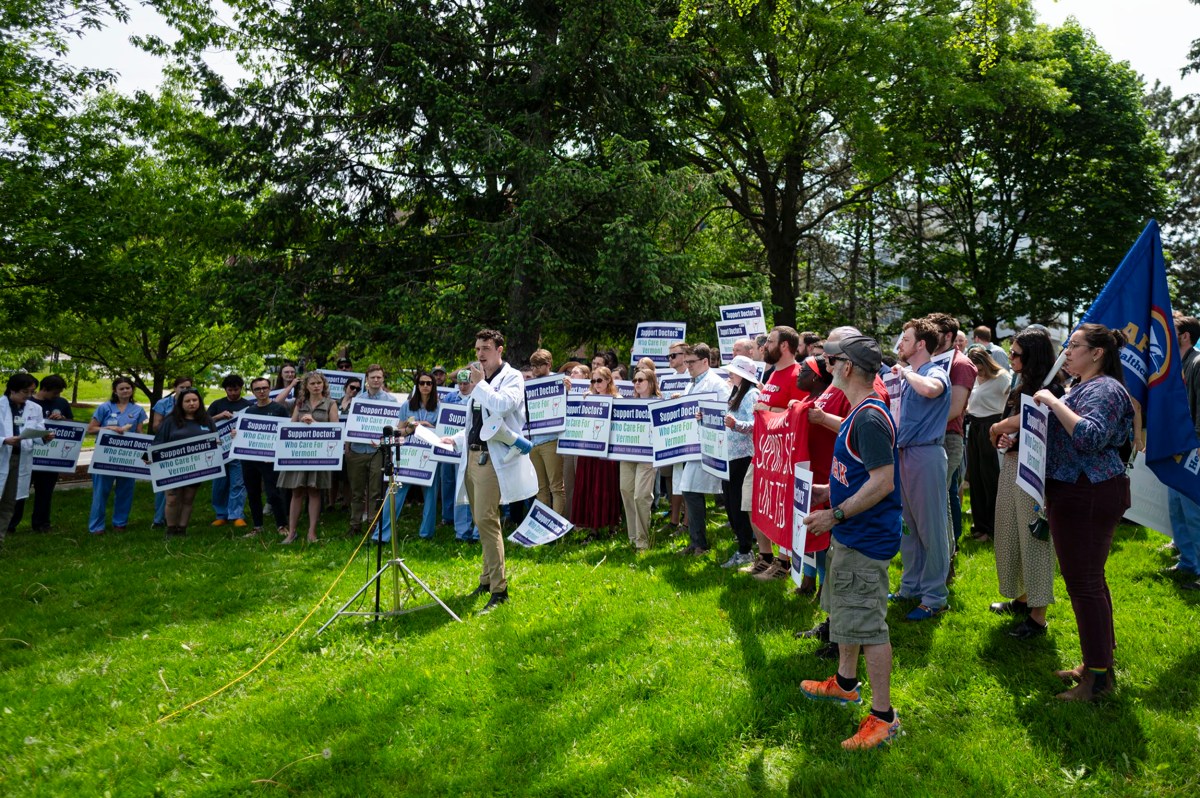
Nearly 70 early-career doctors rallied outside UVM Medical Center in Burlington on Thursday to put pressure on the hospital’s administration to agree to a contract that’s been in negotiations since January.
Many doctors and union activists marched, chanted and waved signs as part of the demonstration.
The 400 resident doctors and fellows in the union are seeking higher compensation, caps on shift length and better benefits, including childcare support, meal allowances and education stipends. They say these asks are essential for recruiting new doctors in a healthcare system desperate for new workers. It comes as the hospital also begins negotiations with two of its other staff unions and faces increased pressure to keep its costs low.
In the negotiations for a second contract since the union’s 2022 founding, residents have included a collection of “common good provisions” surrounding limitations on how immigration enforcement officials can interact with people in the hospital and creating a patient care fund for social services such as emergency housing that could reduce unnecessary emergency room visits.
Doctors said they routinely work 80-hour weeks, including 24-hour shifts. All the while, they maintain that their compensation does not meet the basic cost of living. Additionally, many residents are carrying hundreds of thousands of dollars of debt from medical school.
Residents’ work is capped at 80 hours a week, per accreditation guidelines for graduate medical education. But that cap is based on an average over a four-week period.
Dr. Caitlin Marassi, a general surgery intern, said that in some of her longest weeks, she’s tallied more than 93 hours. Her shortest still tallied over 60 hours. She works 28-hour shifts every four or five days, she said. By tracking the hours she works, she has realized that her earnings average out to about $19 an hour.

“Our hourly rate does not reflect the work we are doing,” she told VTDigger.
The hospital management initially proposed no wage increase, union organizers said, and subsequent offers did not keep pace with the rate of inflation.
Phillip Rau, a spokesperson for the medical center, said that the hospital’s current proposal includes 2-2.5% increases to salaries over the span of the three-year contract, in addition to resident’s existing 4.75% annual wage increases. He said he was unable to comment on further details of the ongoing negotiation but said the medical center “is committed to a culture where our people feel heard, respected and supported.”
“Since negotiations began in December 2025, UVM Medical Center has remained committed to working in partnership with our employees and the (union) bargaining team to address many areas of priority and develop sustainable solutions that support our dedicated residents and fellows in their work caring for communities across our region,” Rau wrote in a statement.
He added that hospital operations remain uninterrupted.
Medicare pays a significant portion of hospitals’ resident training costs, which go toward resident stipends and supervising physician salaries. Medicare’s payments are not meant to cover the full cost of resident training, however. UVMMC’s program is “significantly larger” than the federal funds, Rau said.
“What most people don’t know is residency is federally funded, so the hospital is paid to take residents on in training,” Dr. Rhys Niedecker, a resident and an elected delegate on the union’s bargaining team, told VTDigger in an interview. “Everything that we’re asking for doesn’t drive up the cost of healthcare.”
Vermont faces challenges attracting and retaining primary care physicians and specialist doctors. Attracting a class of residents to the Green Mountain State requires competitive residency salaries, many of the doctors argued.
Niedecker, who is a family medicine resident, said he intends to stay in Vermont to practice after his residency ends, as he said about half of UVM’s family residents do.
Unionized labor is still relatively uncommon for medical residents, a role known in the medical community for its grueling hours, low pay and difficult quality of life. When UVMMC’s resident doctors unionized in 2022, they were among an early wave of doctors to do so. A 2025 survey in the journal JAMA Network found that out of 1,235 resident doctors, 20% reported working in unionized hospitals.
“Residency is an interesting proposition. We all understand that we’re in this training phase of our lives, and we all kind of accept that it’s not forever, but at the same time, the working conditions can be a little bit crazy,” Niedecker said.
Thursday’s rally marks the second time Vermont’s unionized doctors have taken public action.
Simultaneously, the medical center is facing a separate round of contract negotiations with its support staff and technical staff unions, which have joint efforts to bargain together, in a 3,300-employee bargaining unit.
Niedecker said he sees the doctors’ efforts as a “benchmark” to set the bargaining stage for their fellow workers whose bargaining follows theirs. The support staff union has been in negotiations with UVMMC’s management since April for a contract that expires at the end of July.
“Collaboration is the only way to get things done in this country and in this state,” said Jacob Berkowitz, the president of UVMMC Support Staff United, who attended the rally.
He is optimistic about the relative leverage the combined efforts give workers to ask for broader goals: “You get to work on bigger picture items that go past a single institution or a single employer. You can make actual differences in the lives of not just patients but working people everywhere.”
Correction: This story was updated to reflect Massari’s correct hours and wages, which differed from what was originally shared with VTDigger.
