

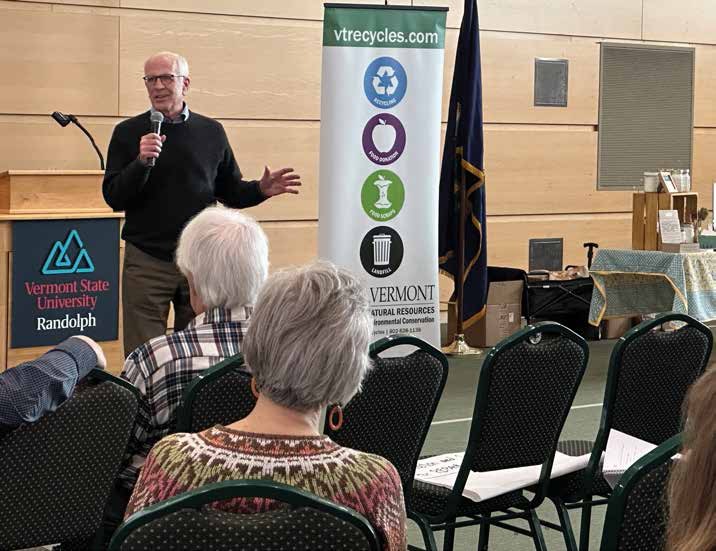
This story by Maryellen Apelquist was first published in the White River Valley Herald on April 16, 2026.
After talking about his love of buying used clothes online — “I’m not kidding, you get good deals” — U.S. Sen. Peter Welch, D-Vt., told a roomful of like-minded people at Vermont State University last Thursday about proposed legislation that would save money for another group of people: farmers.
The senator was on hand in Randolph Center for ReuseVT’s inaugural ReuseApalooza conference, which included an on-site repair fair, “drop and swap” event to rehome (and pick up) used items, and workshops on reusing and reducing waste.
Welch’s remarks centered on the Freedom for Agricultural Repair and Maintenance (FARM) Act that he introduced last October. The proposed federal legislation, he said, would give farmers the “right to repair” broken equipment themselves, rather than having to wait on and pay a dealer to send someone out to do the job.
The FARM Act would require manufacturers to share software, parts, and documentation with farmers and independent repair technicians.
Welch’s remarks at VTSU came just a few days after it was widely reported that national giant Deere & Co., doing business as John Deere, agreed to pay $99 million to farms and farmers as part of a settlement to resolve a class action lawsuit accusing Deere of monopolizing repair services. Another lawsuit, brought by the Federal Trade Commission in 2025, alleges Deere forces farmers to use its dealers and drives up costs for parts and repair services.
As it stands now, after a farmer purchases a tractor for a few hundred thousand dollars, Welch said, if something goes wrong, “they can’t fix it.”
“They have to call the dealer. They have to wait till the repair [person] comes out, and they have to have it repaired on site, and that costs some time. It could be a harvest season, and honestly cost a lot of money.”
The senator also noted that, “among other things,” farmers are “really good” at “fixing things.”
Such right-to-repair legislation is not a new idea. At the state level, a similar bill, H.81, had nearly unanimous support in the House a few years ago before it died in the Senate in 2024. It’s been resurrected with H.161, the Vermont Fair Repair Act, introduced last year and co-sponsored by state Rep. Monique Priestley, D-Bradford.
Priestley told The Herald earlier this week that “Vermonters shouldn’t have to ask a corporation’s permission to fix what they own.”
Medical equipment, too
That goes for any piece of equipment, she said, “whether it’s a tractor or a hospital diagnostic device,” the latter a reference to another bill Priestley is sponsoring: H.160, an act relating to creating a right to repair for medical devices.
“My first year in the legislature, I led our agricultural and forestry right-to-repair bill in committee. The biggest equipment providers fought it, it died, and we brought it back. We’re seeing the same pattern with medical devices. The goal is to expand right-to-repair across industries, starting where Vermonters are most affected.”
The legislator explained that, if passed, the law would give hospitals the right to access what they need to maintain their own equipment.
“Manufacturers would have to provide documentation at no charge, tools without requiring manufacturer authorization, and parts at fair prices. That means a hospital’s own biomedical staff can do their jobs, or bring in a qualified independent servicer, instead of waiting days or weeks for a manufacturer technician.”
In terms of a company’s proprietary information, she said trade secrets would be protected. The bill is “not anti-manufacturer. It’s pro-patient.”
Such legislation would yield faster care, lower costs, and create more resilient hospitals, Priestley asserts, noting that “over 80% of biomedical professionals nationally say repair restrictions cause equipment downtime frequently or most of the time, and rural providers are hit hardest. That’s most of Vermont.
“When manufacturers control the repair market, they set the prices, and we’ve seen rates of $600 to $800 an hour. Those costs flow through to what Vermonters pay for care. Fair competition brings them down.”
Officials at Gifford Medical Center did not have a comment on the proposed legislation, but pointed to House testimony in support of H.160 provided by Devon Green of the Vermont Association of Hospitals and Health Systems.
“From our perspective, if this bill provides a cost-effective path to fix hospital equipment, and we are convinced it does, then we support it and urge you to move forward,” testified Green. “Right now, our hospitals are doing everything they can to drive unnecessary costs out of the health care system, and H.160 could help.”
Priestley anticipates a long game on both the medical and farm equipment fronts, and said neither state right-to-repair bill is expected to pass this session.
“Large corporations came forward to oppose this bill, just like they fought our agricultural right-to-repair bill.”
She also noted that consumer protection is rarely a partisan issue.
“The right to fix what you own resonates with Vermonters across the political spectrum, and we’ve seen that in the statehouse.”
