

[T]he destination of toxic firefighting foam collected by the state is unclear after an environmental group raised concerns that the facility where it was going to be shipped was sued by the EPA for 17 violations of the Clean Air Act.
EPA inspectors found that the hazardous waste incinerator, Heritage Thermal Services Inc. in East Liverpool, Ohio, had “significant violations” of federal environmental laws during its last 12 quarterly inspections. The U.S. attorney general sued Heritage on Oct. 10 on behalf of the EPA for failing to meet emissions standards, prevent hazardous pollutant leaks and maintain adequate temperatures in a combustion chamber.
Earlier this fall, the state Department of Environmental Conservation and Department of Public Safety’s Division of Fire Safety joined forces to collect an outdated, and toxic, firefighting foam for free from fire departments around the state.
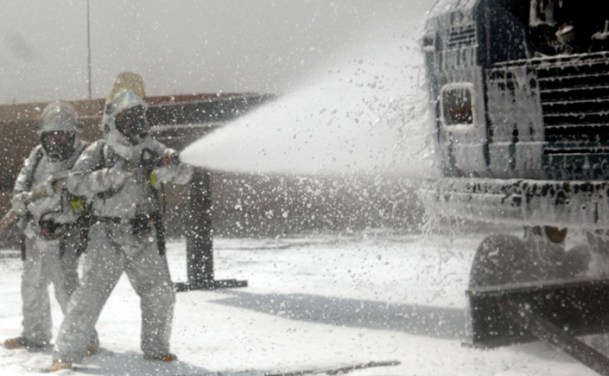
The specialized foam, Type B Aqueous Film Forming Foam or “AFFF,” is highly effective at quickly stopping petroleum and natural gas fires as it blankets flammable liquids, preventing the spread of oxygen, and smothering the fire.
But the same compounds — PFOA and PFOS — that made AFFF such an effective fire suppressant are now known to be toxic. PFAS, the class of man-made chemicals that PFOA and PFOS belong to do not break down over time and can accumulate in soil and water. Exposure to PFAS through drinking water can lead to certain kinds of cancer, thyroid disease, immune system damages, developmental problems in children and low birth weight.
Because of the health impacts, manufacturing firefighting foam with PFOA and PFOS became illegal in the early 2000s, leaving departments with stockpiles of legacy foams. While PFOA and PFOS based fire fighting foams are not illegal to use in Vermont, any fire department that uses the legacy foams would have to report the use to the state as a hazardous material release.
The state collected 2,500 gallons of the hazardous foam this fall from 38 fire departments, said Chuck Schwer, director of the DEC’s Waste Management Division. After researching options for disposal, like putting the foam in a landfill or sending it to a facility that injects the foam into a deep well, DEC determined that incineration was the safest method of disposal, said Schwer.

Schwer said in an interview Friday afternoon that DEC remains confident that incineration was the best method of disposal, but that, due to concerns raised about the Ohio facility, the state was delaying shipment and evaluating alternate disposal locations.
He added that during the collection effort, state employees had found that some of the foam was unsafely stored in degrading containers, which could have led to a release of the toxic foam.
“From (a stance of) protecting Vermont’s precious groundwater, I think it’s been a phenomenal success,” said Schwer. “So I’d hate for this small piece to influence the overall outcome of this action.”
Jen Duggan, Vermont director of Conservation Law Foundation, raised concerns with the DEC about violations at the Ohio incinerator. She said that there have not been thorough studies on how to completely break down PFAS so that the dangerous compounds would not be present in incinerator emissions.
“We know that the carbon fluorine bond is one of the strongest bonds on earth,” said Duggan. “That’s why (PFAS) are so resistant to degradation and that’s why they’re used in incredibly high temperatures for firefighting.”
Duggan said that CLF still has “significant concerns” about burning the foam at a hazardous waste incinerator.
“We need to make sure that we are not solving a Vermont problem by creating a public health risk for communities that live near incinerators,” she added.

