

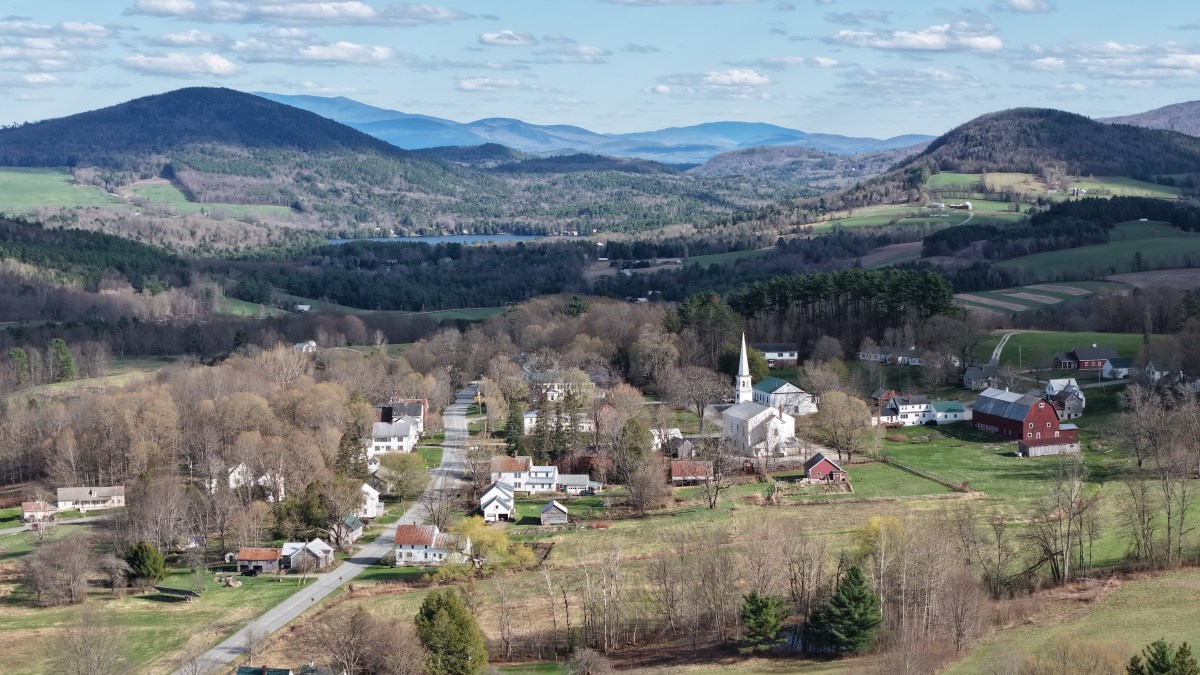
One Northeast Kingdom town took an unusual step to retain some control over its school’s fate just as the state Legislature finalized passage of this year’s landmark education reform bill on Friday evening.
Around 40 Peacham voters unanimously approved an article authorizing the selectboard to purchase the town’s elementary school building for the nominal amount of $1. The pre-K-6 school of around 60 students continues to operate, but the town will now retain the facility and grounds for community use in the event that its school district merges with another, which is likely because of the district’s small size.
Andra Hibbert, chair of the Peacham school board, said Monday that the idea of the property transfer surfaced about a year ago, when there was uncertainty about whether the Legislature would imminently force district mergers.
“It just felt like the only move we could make to sort of future-proof the school as a community asset,” Hibbert said.
“We all want the school to stay open. We all love our school,” she said, adding that the board and townspeople want to ensure the town is in charge of what the building is used for should a merger occur.
“We continue to believe that small, efficiently run, community schools are vital,” the school board wrote in the Peacham town report. “It is critical for children that they be educated close to home in a context that knows and understands them well while meeting their needs.”
The building will be leased back to the district with the school assuming responsibility for all operating costs. The building itself is in good shape, according to last year’s school meeting minutes, and its ventilation system, heating system and windows are all new. It is the only building that could work as an emergency shelter, Hibbert said, and abuts the town soccer field and pump track.
Rep. Peter Conlon, D-Cornwall, chair of the House Education Committee, said in an email last week that he couldn’t think of a situation where a school district does not own its building, aside from Burlington School District renting the former Macy’s department store during construction of the city’s new high school.
“There is at least one situation — Ripton — where the school closed and the building was given back to the town in the past year,” he said. “Most districts have that in their agreements that if the district closes a school, it must offer it back to the town.”
That was the case for Roxbury Village School, whose board voted to sell the school building to the town for $1 in November 2024. The school had been shuttered following a 2024 vote by the merged Montpelier Roxbury school board, in which five Montpelier board members voted to close the school with four votes against.
Per the Montpelier Roxbury merger agreement, the school district could have kept the building if it found a financially feasible use for it, such as hosting central office employees or operating a specific magnet-type school. If it could not find such a use, it had to offer the building to the town of Roxbury for $1.
Hibbert said that worries about any future district retaining the Peacham School building and grounds for its own use spurred the town’s decision.
Morgan Gold, a Peacham farmer well-known for sharing his life on YouTube, weighed in on the issue in a 12-minute video recapping Peacham’s vote that he posted this weekend. By Monday afternoon, it had gained 23,000 views. Gold also shared the video in a Facebook group for Rural Vermont Rising, an advocacy organization representing rural landowners and farmers that coalesced earlier this year in opposition to Act 181, a 2024 land-use law.
“We see this as a very active and vibrant community,” Gold says in the video. “And a big part of that is our elementary school. That elementary school is the lifeblood of our town.”
Although the education reform bill that passed Friday evening does not mandate mergers, it does create a fast-moving process for facilitating voluntary district consolidation. Lawmakers hope future districts will have at least 2,000 students.
Peacham School currently has its own district controlled by its own school board, which is overseen by the larger Caledonia Central Supervisory Union. The supervisory union oversees five districts operating seven schools: Barnet, Danville, Waterford, Walden, Cabot and Peacham, as well as Twinfield Union School serving Plainfield and Marshfield. According to the state’s “School District Builder,” the entire supervisory union currently has 1,461 students.
The bill that passed Friday also will penalize more districts whose spending exceeds a certain threshold, with that mark lowering year after year. Last year, Peacham moved $10,000 in funds for the elementary school’s after-school program to the town budget to avoid the excess spending threshold penalty already in place.
Critics of the bill, which passed with broad support from legislators, say it will unfairly target small rural schools.
“We would not have so many young families moving to town if we didn’t have an elementary school,” Gold says in his video. “If we didn’t have an elementary school, this would become a town just consigned to second-home owners and retirees. And, when I think about the future of this town, where I really do hope to spend the rest of my life in, it’s kind of depressing.”
