

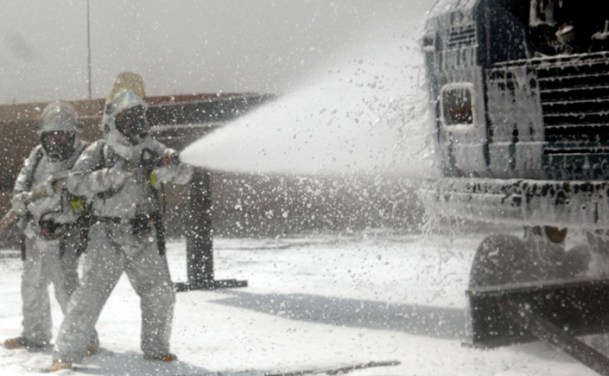
As part of a broader effort to address PFAS contamination around Vermont, the state is collecting an outdated, and toxic, firefighting foam from local fire departments for free until early October.
The Department of Environmental Conservation and the Department of Public Safety’s Division of Fire Safety teamed up to dispose of Type B Aqueous Film Forming Foam, known as “AFFF,” produced before 2003.
“As the issues with PFOAs have become more well known throughout the state, fire chiefs have continually asked more questions about what foam is safe and what they should do with the foam that was no longer of any use to them,” said Peter Lynch, chief of training at the Vermont Fire Academy.
Lynch said that while AFFF is not commonly used by fire departments, the specialized foam is crucial for quickly stopping gas fires. AFFF, first produced in the 1960s, blankets flammable liquids like petroleum and natural gas, preventing the spread of oxygen and smothering the fire.
But the same compounds — PFOA and PFOS — that made AFFF such an effective fire suppressant are now also known to be toxic. PFAS, the class of man-made chemicals that PFOA and PFOS belong to, do not break down over time and accumulate in soil, water and the human body.
Exposure to PFAS through drinking water can lead to certain kinds of cancer, thyroid disease, immune system damages, developmental problems in children and low birth weight. Because of the human health impacts, manufacturing AFFF with PFOA or PFOS became illegal in the U.S. in the early 2000s, leaving fire departments around Vermont with stockpiles of the “legacy foams,” said Michael Nahmias, a hazardous site manager for the DEC.
Late last winter, DEC and the Division of Fire Safety surveyed fire departments around the state about their foam inventories. Of the 89 departments that responded, 29 said that they had had legacy foam in storage, ranging from several 5-gallon containers to over 100 gallons.
Lynch summed up the departments’ responses as, “we know we don’t want to use this, but we don’t really have the money or know how to properly dispose of it.” The two departments pooled funds to set up disposal of pre-2003 or undated AFFF at five solid waste districts around the state, said Nahmias. Once collected, the foam will be incinerated to break down the toxic compounds.

“The cost of disposing of it pales in comparison to what it would cost to remediate an aquifer,” he added, referring to the process of cleaning up a contaminated drinking water source.
While PFOA and PFOS based fire fighting foams are not illegal to use in Vermont, any fire department that uses the legacy foams would have to report the use to the state as a hazardous material release, said Nahmias. Lynch said that fire departments in Vermont use alternatives to AFFF during training exercises.
Following the 2016 discovery of PFAS in drinking water in Bennington, the DEC has taken water samples at industrial and waste disposal sites around the state that may be sources of PFAS contamination.
The sampling included six sites where AFFF was used for training or for putting out chemical fires. Nahmias said the DEC decided where to sample based on past hazardous spill reports filed with his department. Two of the sites sampled showed levels of PFAS above the state’s 20 ppt health advisory in nearby public water wells.
Area next to the Southern Vermont Airport in Clarendon, two public wells for the Rutland Business Park and three private wells were found to have elevated levels of PFAS. Carbon filtration systems have been installed at the contaminated wells, according to the sampling report from the DEC. A filtration system was also installed at an agricultural well near the Vermont Air National Guard South Burlington base that had PFAS contamination.
AFFF has been used at military bases around the country since the 1970s to put out emergency fires and to douse purposefully set training fires, according to an investigation by The Intercept.
The Vermont Air National Guard has primarily used AFFF to fight jet fuel fires, said Nathan Rivard, public affairs deputy for the guard. He noted that the PFOA and PFOS based foams are no longer used by the guard. The last use of AFFF at the South Burlington base occurred in 2014, he said.
Although Vermont’s firefighters now use AFFF foams that are PFAS-free or are made from shorter chain PFAS molecules that break down more easily, the state is not encouraging the use of one particular kind of AFFF, said Nahmias. “That’s because we don’t know (exactly) what’s in these foams – it’s all trade secrets.”
PFAS, considered “emerging contaminants” by the Environmental Protection Agency, are a broad swath of chemicals used in everything from cookware to food packaging to stain protectant. The EPA says that “there is a substantial body of knowledge available about managing risk for PFOS and PFOA, but much less knowledge about the replacement PFAS.”
Some governments, military organizations and businesses have banned the use of firefighting foams with any form of PFAS. The Norwegian and Danish air forces, the state of South Australia, as well as 3M, ExxonMobil and ConocoPhillips have all banned PFAS foams.
Earlier this year, Washington became the first state to ban PFAS foam, following the discovery of contaminated wells near multiple military bases in the state.
Vermont fire departments with less than 220 pounds, or five, 5-gallon pails, of pre-2003 and undated AFFF can make a drop-off appointment with certain solid waste districts before Oct. 8. Departments with more foam than that should call the DEC’s waste management and prevention division at 802-828-1138.

