

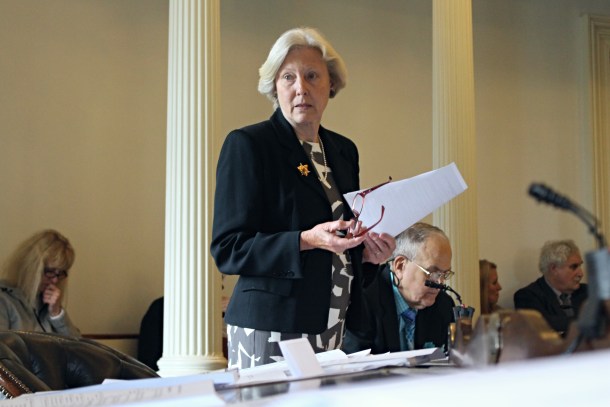
[R]efusing to capitulate to demands from the governor and eliminate the possibility of a nonresidential property tax hike next year, the Senate passed a budget bill Thursday that would prevent a government shutdown, but which now faces an almost certain veto.
As lawmakers and Gov. Phil Scott remain gridlocked over this year’s spending package, the House introduced the new budget bill, H.13, in an effort to ensure that the government stays open, even if parties can’t resolve all parts of an impasse by the end of the month.
If the governor kills the bill, which he has promised to do because it leaves a default tax hike in play, lawmakers and the administration will have less than three weeks to come to the table and hammer out a deal to avert a government shutdown.
Without an appropriation from the Legislature by June 30, the state will have extremely limited latitude in providing funds to state agencies, public services and schools. Democrats say they are still hopeful that Scott will sign the bill.
“I think this is a very important bill to keep government open,” Senate President Pro Tem Tim Ashe, D/P Chittenden, said on the floor Thursday afternoon. “It hopefully keeps the lights on so the public services people count on will continue.”
Even with the squeeze of a possible shutdown, both sides have made little progress in reaching a deal since Scott summoned lawmakers back to Montpelier for a special session three weeks ago.
By putting the new budget bill, H.13, on the table, legislators hoped they could get the bulk of the budget in place for the next fiscal year while leaving contentious tax and education finance provisions to be dealt with in future negotiations.
Lawmakers have promised to seek an agreement on these outstanding issues with the administration in a second piece of legislation, after addressing the shutdown threat.
But Scott says lawmakers are being disingenuous, as they have structured the bill to leave in a default tax rate that will kick in if they can’t make a deal, meaning his leverage in negotiations would evaporate as soon as it’s passed.

Not setting the rate leaves the possibility of a default nonresidential property tax rate of $1.59 if there’s no deal, which would mean a 5.5 cent rate increase.
Sen. Randy Brock, R-Franklin, said failing to set a lower rate in the budget bill would amount to a “backdoor tax increase.” He proposed an amendment that would set the default rate at last year’s level of $1.53, but it was shot down by his Democratic colleagues.
“It would be yielding to the governor’s position,” Sen. Ann Cummings, D-Washington and chair of the committee, said of Brock’s proposal during a brief meeting on the bill. Fellow Democrats said the amendment would be the end of negotiations with Scott.
Democrats insist they’ll address the tax provisions soon and try to come to a deal before the default rate kicks in, arguing that if they didn’t allow the statutory default the state would be facing a $20 million hole in the education fund next year.
But Democrats are also opposed to giving the governor ground by allowing their starting point in budget negotiations to involve using one-time money to artificially buy down the tax rates.
Scott hopes to use an additional $34.5 million in surplus money to buy down education property tax rates next year and put in place a slew of education finance policy changes he says could generate $300 million in savings.
Democrats say using one-time money to buy down taxes is bad fiscal policy and only creates a bigger tax gap in the next year, when the apparent tax increase will be even greater after another year of artificially low rates.
They also argue that their budget bill is already built on compromise with the administration. It puts about $10 million of one-time money into the education fund to fill reserves and sets the default property tax yield at this year’s level.

Sen. Dick Sears, D-Bennington, said the only way he can see H.13 skirting a veto is if lawmakers make progress on the second bill, which will include the tax rates, in the time between when Scott receives the legislation and decides whether to veto it.
“He’s been pretty clear, but I’m also not sure how long this game can go on and the sooner we settle our differences, the better for everybody,” he said.
The House Ways and Means Committee is scheduled to resume working on the tax bill, H.4, on Friday.
Lawmakers gave a grim forecast of what Vermont could look like if a budget didn’t pass by July 1. Jails may not have funding to continue operations and state parks could be forced to close over the summer, dealing a blow to tourism profits.
“If we do not have a budget, under the constitution, no money can be spent,” Sen. Jane Kitchel, D-Caledonia, who chairs the Senate Appropriations Committee, told senators on Thursday.
It’s also important to have a budget with default tax rates in place to assure schools are up and running in the fall, said Cummings.
“Without some tax rate we could not collect the money that will be needed to open schools in September,” she said. “We’re trying to keep not just the functions of state government, but our schools functioning while we work out the details.”
With three weeks left before the budget deadline, the Scott administration believes the governor can veto the bill without risking a shutdown.
Brad Ferland, the deputy secretary of administration, said three weeks is ample time to hammer out a budget deal that won’t lead to property tax increases.
Finance Commissioner Adam Greshin said that while lawmakers are expressing strong concerns about the shutdown, they haven’t rushed to the table for negotiations with the administration.
“For all of this talk of a crisis, they’re certainly not acting like it’s a crisis,” he said.
“Both the Legislature and the governor are clearly willing to put a shutdown on the line, because we haven’t agreed,” he said.

