

BENNINGTON — Residents still waiting for a solution to PFOA in their wells should know within “a couple of months” whether Saint-Gobain Performance Plastics will negotiate a settlement to provide clean drinking water to those affected by the industrial pollution.
John Schmeltzer, a hazardous site manager with the Department of Environmental Conservation and one of several officials attending an area informational meeting Monday, said discussions with Saint-Gobain will begin soon and will continue if progress is being made regarding properties east of Route 7A.
Otherwise, he said, “If they don’t agree [to fund an acceptable solution], then we are going to look at our legal options.”
Agency of Natural Resources Deputy Secretary Peter Walke echoed past statements that the state sees a negotiated settlement as preferable — and a much quicker resolution than a lengthy court battle with a multinational corporation.
But Walke said the Scott administration remains committed to a viable, long-term solution, and state officials still believe the best outcome would be installation of municipal water lines to replace contaminated wells.
“Right now Saint-Gobain doesn’t agree with our position,” said Walke, adding that although “litigation would take longer, “we don’t intend to drag [the talks] out.”
According to Richard Spiese, of the waste management project division, “We’re pushing for water lines.”
Spiese said residents have made it clear they don’t want to rely indefinitely on perfluorooctanoic acid filtering systems in their homes, which require ongoing maintenance and monitoring and lower water pressure.
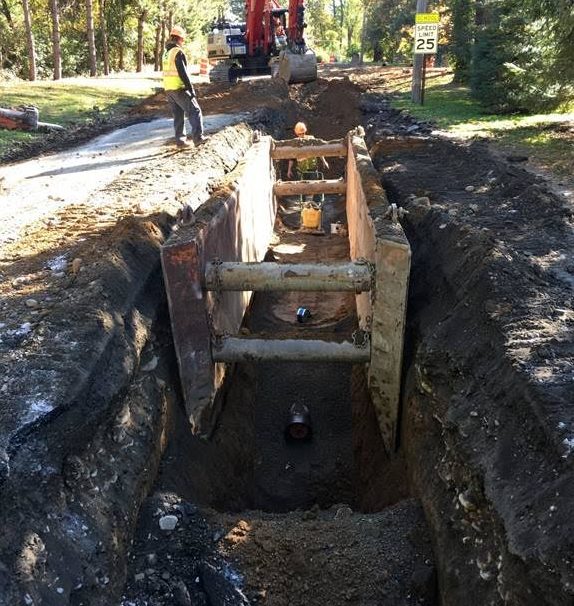
Walke and state Rep. Mary Morrissey, R-Bennington, who attended the session, also noted that $750,000 was inserted in the proposed next state budget to jump-start design of water-line projects, if necessary, to move the process along. The intent, Walke said, is to fold any state expenses for design work into an overall settlement with Saint-Gobain, as was the case with a previous consent agreement with the company.
Community update
The team of environmental officials traveled to the area to update property owners and residents on the pending talks to resolve differences between what the ANR believes caused widespread PFOA contamination in soil and groundwater and the differing conclusions in an engineering report prepared for the company.
The sought-after agreement would cover more than 150 properties in the eastern section of the state-identified PFOA contamination zone, which radiates out around two former ChemFab Corp. factories that once were owned by Saint-Gobain.
About 40 people attended the update session, and several pressed state officials on the likelihood of a settlement and when that might be concluded. Frustration has mounted among those residents — who live roughly east of Route 7A and a rail line — particularly as they’ve watched residents in the western sector being hooked up to new municipal water lines.

The ANR last year reached a settlement covering the western section, which called for Saint-Gobain to provide $20 million for water-line construction and other PFOA-related costs. But the company contends there are other sources of the chemical contributing to levels in eastern section wells found to be above the state’s 20 parts per trillion level for safe drinking water.
Asked why the water-line agreement was reached last year only for that sector, Walke said the firm’s engineers were simply willing to agree on the contamination source for properties to the west of the most significant ChemFab factory, in North Bennington.
They do not agree that is the case with the remaining properties, he said, and a 7,377-page company financed report submitted in March by Barr Engineering contends that other sources of PFOA contributed in the eastern sector.
The state currently is reviewing the massive report and other information, so that officials are versed in the data and conclusions before settlement talks begin.
“An amazing amount of material has been generated,” said Schmeltzer. “We want to go through this in good detail so we can make sure we have a good strong case.
Not buying company view
Schmeltzer also went over the state’s responses to conclusions in the Barr Engineering report that argue in favor of other potential contamination sources.
He said the report argues that “regional background” contamination, or PFOA from airborne sources from the region or beyond added to levels in the soil and to pollution of groundwater. But the air distribution models used in the report “are flawed” in the view of state officials, Schmeltzer said, and the calculations of the level of background PFOA contamination are incorrect.

Another argument, Schmeltzer said, is that “the worst is passed,” since the PFOA emanating from ChemFab factories ceased when Saint-Gobain moved the Teflon-coating operations to New Hampshire in 2002 and closed the last factory — on Route 67A in North Bennington. In other words, the Barr report contends that the levels in soil are now declining.
“We don’t think that,” he said. “The data doesn’t support that conclusion.”
The closed former Bennington landfill off Houghton Lane also is cited as a potential source of PFOA in groundwater, but Schmeltzer said the data in the state’s view shows that overwhelmingly the chemical traveled through the air from ChemFab stacks during the company’s high-temperature fiberglass fabric coating processes.
In addition, the officials said, records show that ChemFab deposited a significant amount of waste material at the former town landfill, which eventually became a federal Superfund cleanup site.
Asked whether arguments the company was only partially responsible could prove a strong bargaining chip for Saint-Gobain, Chuck Schwer, director of the Waste Management and Prevention Division, said the state could “go after them under the Superfund law,” which he said would only require evidence proving the ChemFab operation was a “major contributor” of the PFOA discovered here in early 2016.
Schwer said Saint-Gobain would then be responsible for pursuing other contributing entities if it wanted to force them to pay a share of the costs.
Walke said another update will be scheduled in a few months, when the state knows how the Saint-Gobain negotiations are likely to resolve.
The state’s goal, he said, is to begin final design work for water lines by the fall, with construction to begin in early 2019.

