

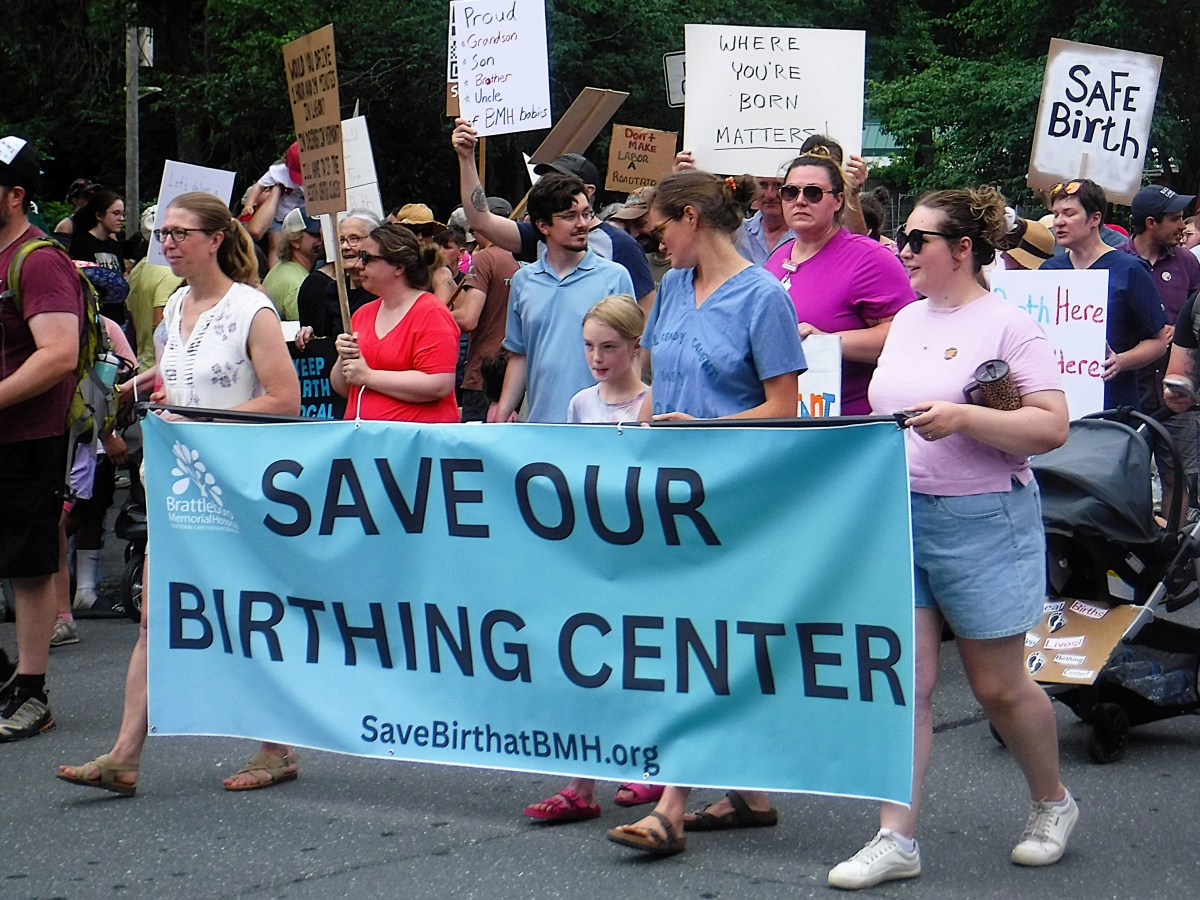
BRATTLEBORO — A week after proposing a municipal tax hike to help Brattleboro Memorial Hospital’s fiscally ailing birthing center stay open, the town selectboard dropped the plan Tuesday night upon the suggestion of leaders at the southeastern Vermont healthcare hub.
“I’m worried about this tax,” Dr. Tony Blofson, the hospital’s acting co-CEO, told the selectboard at a special meeting. “People say, ‘I can’t afford it,’ and this is going to be a divisive issue at a time when we really need to all be together.”
The not-for-profit facility, facing a multiyear, multimillion-dollar budget deficit after recent management upheaval, has announced it will close its obstetric services in the next six to nine months if it can’t find a way to cover estimated annual unit losses of $4.8 million.
At a meeting last week, the five-member selectboard introduced the idea of an unspecified one-time special tax above the town’s current $27 million annual budget, proposing it could raise somewhere between $100,000 and $1 million.
Municipal leaders said the tax would give the hospital more time to search for a long-term financial solution and save expectant mothers a potential half-hour drive to the nearest maternity care option in Keene, New Hampshire.
But observers ranging from local social media commenters to state government officials have questioned the idea, with Gov. Phil Scott noting at his most recent press conference, “That’s not going to fix the problems.”
Hospital leaders, meeting with town officials privately and publicly Tuesday, voiced appreciation for local interest while stressing their desire to find a state-level fix.
“This actually is an opportunity, I think, that we see for our state to tackle rural healthcare issues that one institution can’t do alone,” said Chloe Learey, chair of the hospital’s board of directors.
A recent letter by seven Vermont medical groups urged the state Agency of Human Services to help the hospital by raising Medicaid obstetric reimbursement rates to match those paid for other primary care services.
Medicaid pays for nearly half of Windham County births, the groups noted — a ratio higher than the state average of 36.9%.
Both Scott and Human Services Secretary Jenney Samuelson have spoken encouragingly about the idea, although the state has yet to decide anything.
State regulators, for their part, have said they’ll address the hospital’s financial situation at an Aug. 14 hearing of the Green Mountain Care Board, which assesses and approves hospital budgets.
The hospital has operated with acting administrators since former President Christopher Dougherty exited without explanation in November and former Chief Financial Officer Laura Bruno departed amid similar silence in December.
The hospital’s new leaders haven’t publicly addressed the reasons for the changes in administration and accounting but have acknowledged receipt of a $1 million state grant to study and help stabilize its finances.
They’ve also yet to confirm a total for their multiyear budget deficit, although tax filings show a fiscal year 2022 net income loss of $2.9 million, an FY23 net income loss of $1.5 million and an FY24 net income loss of $3.2 million.
Administrators recently reported a $16 million shortfall for FY25 — four times their initial loss estimate, or 13% of a $119 million budget. They’ve also projected a $14.5 million deficit for the current year’s $130 million budget, although Blofson said Tuesday without offering a figure, “It’s going to be considerably less.”
