

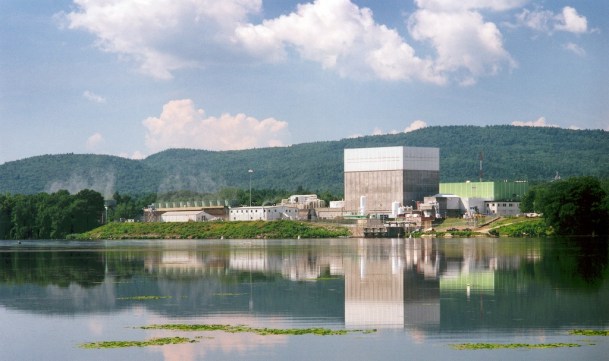
[V]ERNON – Will explosives be used to demolish radioactive structures at Vermont Yankee?
It depends on who you ask.
State officials have filed testimony claiming NorthStar Group Services, which wants to buy and decommission the idled nuclear plant, plans to use explosives on “at least one” contaminated building. The department is raising concerns about the spread of radioactivity.
But NorthStar’s chief executive officer says his company has no such plans. And there seem to be no public documents available to back up the state’s contention.
The federal Nuclear Regulatory Commission also has no record of any blasting plans at Vermont Yankee. Federal regulators keep a tight rein on the use of any explosives at nuclear plants, NRC spokesman Neil Sheehan said.
“We would not allow the use of explosives for buildings with significant radiological contamination,” Sheehan said. “Our concerns in this area would center on the ability to control any airborne radioactivity/contamination.”
NorthStar is seeking federal and state permission to buy Vermont Yankee by the end of next year. The demolition contractor says it can clean up most of the Vernon site as early as 2026, several decades sooner than current owner Entergy had planned.
That would make the property available for redevelopment much sooner than had been expected. But some are skeptical that NorthStar can follow through on its plans.
Vermont officials have not been shy about expressing their reservations about NorthStar’s financial wherewithal and planning. But the use of explosives is a new concern emerging in testimony submitted by the state Public Service Department.
In documents filed at the end of August, Gregory Maret – a former Vermont Yankee plant manager testifying as a consultant for the Public Service Department – mentioned the “use of explosives in demolition activities” as a risk in NorthStar’s plan.
Some of Maret’s testimony was redacted as part of ongoing confidentiality negotiations in the state Public Utility Commission’s review of the proposed Vermont Yankee sale. But on Sept. 11, the Public Service Department – after consulting with NorthStar’s attorney – released several new portions of the testimony offering more details.
“NorthStar proposes to use explosive demolition for at least one radiologically contaminated structure,” Maret testified in the new documents. “NorthStar has not demonstrated (including by providing analyses) that it could adequately control the spread of radioactive material during the proposed demolition.”
Maret also expressed concern about NorthStar’s planned use of fixatives – which he defined as products used to “lock contamination in place” – in conjunction with explosives. That would be “unprecedented” in commercial nuclear plant decommissioning, he said.
“NorthStar did not provide analysis to support the contention that such demolition could be accomplished without the spread of radioactive and nonradioactive contamination,” Maret testified.
A consultant’s report that Maret co-authored says the main concern is “explosives that lead to release of a large amount of dust.”
“This dust can travel a substantial distance from the structure being demolished, and when radiological contamination is contained in the structure, can result in significant concern with the spread of radioactive material,” the report says.
NorthStar CEO Scott State, however, flatly denied Maret’s contentions.
“NorthStar does not have any current plans to use explosives at the (Vermont Yankee) site,” State said. “If it was later determined that use of explosives was preferable for any structure, such use would require appropriate approvals and would only be carried out if it were determined that no contamination would be spread.”
Asked about the state’s contentions, Sheehan said the NRC has no information on blasting at Vermont Yankee. “NorthStar did not discuss the use of explosives in the draft revised Post-Shutdown Decommissioning Activities Report it submitted to us in April,” he said.
So at this point, it’s not clear where the Public Service Department’s information came from.
Maret did not return a phone call requesting clarification. And Stephanie Hoffman, special counsel for the Public Service Department, said officials “will not be in a position to discuss the substance of this case” until the utility commission issues a ruling on the NorthStar sale.
“This matter is actively being litigated, and the department is focused on presenting the case to the PUC,” Hoffman said. “The department has no further comment at this time.”
There are no references to “explosives” in NorthStar’s initial testimony filed with the Public Utility Commission or in discovery responses later submitted to state agencies. However, there are are many documents still unavailable to the public in the Vermont Yankee case because they’ve been labeled confidential.
While blasting radiologically contaminated structures does appear to be unprecedented, officials said there have been explosives used at decommissioning sites when radiation was not a concern.
Both Maret and Sheehan mentioned the demolition of a containment building at Maine Yankee and the implosion of a cooling tower at the former Trojan Nuclear Plant in Oregon.
“In both cases, explosives were used to demolish structures that were not radioactively contaminated,” Maret wrote.


