

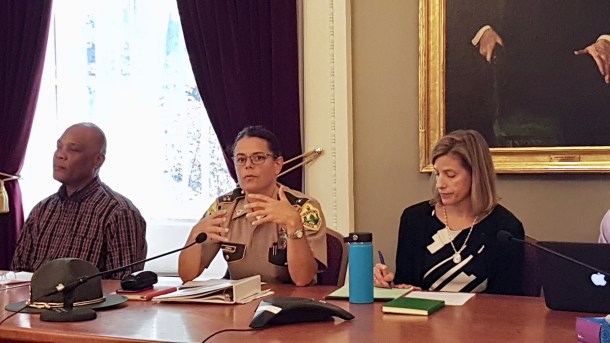
[A]n advisory panel on racial justice reform discussed Tuesday adding new information to the reports Vermont police officers file when they pull over drivers.
Established by the Legislature in May, the panel, which was holding its first meeting, has a hefty charge. The bill that created the panel instructs its members to assess current racial disparities in Vermont’s criminal and juvenile justice systems and provide recommendations to address them.
At present, people of color in Vermont — especially black people — are incarcerated at a substantially higher rate than whites. The Sentencing Project reported last year that black Vermonters are imprisoned at a rate 10 times greater than their white peers.
A state police report from last summer showed that Vermonters of color are also more likely to be pulled over and have their vehicles searched. The same report showed that police officers have been more likely to find contraband while searching the cars of white motorists in recent years.
The new 13-member panel will submit a report to the Legislature by January containing recommendations on implicit bias training for state employees.
Eight state officials from departments related to the criminal justice system sit on the panel. As charged by statute, Attorney General TJ Donovan filled the panel’s five remaining seats with citizens who “represent the interests of communities of color.”
At the meeting’s start, Donovan said he didn’t want the work of the panel to dictated from the top down.
“Although the attorney general’s office is the convener of this panel, we are certainly not in charge of this panel,” Donovan said.
On issues of race and discrimination, Donovan said “those in the position of power need to do more listening than talking. ”
Donovan added that the panel needed “to put political correctness to the side,” and said it wouldn’t be able to accomplish anything without “honest conversation.”
Much of the panel’s first meeting was devoted to wrangling with the issues at a high level, but the panel also discussed at some length its charge of reviewing traffic stop data.
The panel discussed ways to improve traffic stop data collection, both in terms of ensuring reports are consistently entered and in terms of tracking new categories of information.

Randee Eddins, of Chittenden, a member of the audience, agreed with Hughes’ recommendation.
Eddins said she wanted data to be gathered on “which officers are consistently using what would be considered excessive force.”
Hughes said the panel should “think long and hard about exactly what dataset we want to be looking at” before changing traffic stop data requirements. He said getting police forces around the state to adopt new policies is “like herding cats — herding cats, literally.”
Eddins also said that traffic stops don’t tell the whole story of racial discrimination in the criminal justice system. Many minority youths, she said, are stopped while they’re walking, not driving.
The panel agreed that it needed to address issues such as the point Eddins raised about non-traffic stop discrimination.
Geoffrey Jones, the first black trooper in the Vermont State Police and a board member of the Vermont ACLU, said he wanted to see “transparency with all government agencies, as quickly and as soon as possible.”
“I’d like to see us have the chutzpah to recommend increased budgets, specific running items, for all of these departments to get the data together,” Jones said.
Jones added that he thinks “the state has, with some exceptions, good intentions,” but “people’s attitudes are way ahead of their budgets.”
“In the end, it’s money,” Jones said. ”At the end, the state has to make the commitment to spend the money.”
Panel members said they want their meetings to be as accessible to the public as possible.
At the end of the meeting, Assistant Attorney General David Scherr said his department will work on creating a website for the panel and look into getting its sessions recorded and broadcast in some manner.

