

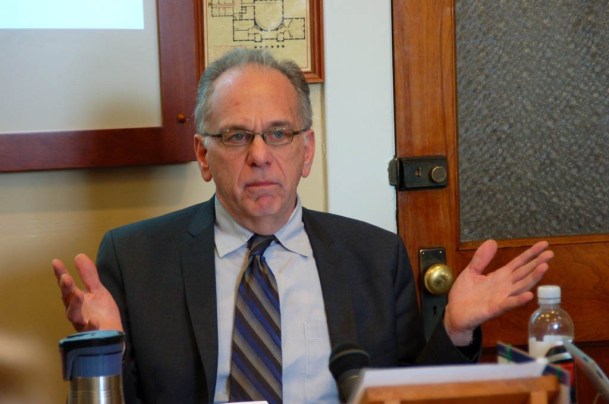
“If schools make the cuts the governor has asked for, Vermont homeowners won’t see lower taxes. Instead, school budget savings will be used to cover new obligations the governor wants to pay for out of the education funding pot,” wrote Paul Cillo, an education fund architect and founder of the Public Assets Institute think tank.
Scott framed his proposal last week in the context of Vermont’s “affordability crisis,” saying high property taxes are a reason people move out of the state.
He wants school boards to pull back the budgets they have prepared for town meeting in March and instead present level-funded spending plans to voters in May. He also wants school boards to negotiate contracts with teachers that force them to pay 20 percent of their health insurance premiums. But the envisioned health care savings — $15 million — while baked into his budget proposal, wouldn’t be available in fiscal year 2018.
The plan is to shift $89.7 million for higher education and part of the annual investment in teacher retirement — $35 million — from the general fund into the education fund. Scott also wants to add $9.6 million for early education and $1.6 million for innovation grants. Together these items total $135.9 million, but only $86 million in revenues will be transferred from the general fund — which analysts say leaves a $50 million hole that will be added to property taxes.
This plan would shift 6 cents to the average homestead property tax rate to cover what has traditionally been paid for out of the general fund, according to Cillo.
The governor’s office disagrees, pointing to a spreadsheet (see below) it says shows how increased investments in Scott’s priorities — early care and higher education — would keep property tax rates level.
Rep. David Sharpe, D-Bristol, chair of the House Education Committee, said the plan raises equity concerns. He said the budget “seems to allow local communities to raise funding and thereby property taxes on the local grand list as it was before Act 60. This seems like it would raise property taxes unequally across the state as communities saw the need to raise revenue to adequately fund their school budgets.”
Under Scott’s proposal, future spending is tied to fiscal year 2017, which was artificially low. School boards built their budgets under the threat of spending caps last year and emptied reserve funds to avoid tax penalties. Under Scott’s proposal, any district that did that is starting in the hole.
Scott’s plan would give each town money from the state based on their fiscal 2017 spending. If a town wants to spend more, it would need to raise the money locally.
Another aspect of the plan that concerns Cillo is a one-year 5 percent bump Scott is offering school districts. For fiscal 2018, school districts will be allowed to spend up to 5 percent more than they did in fiscal 2017, but in fiscal 2019 they would have to freeze spending at 2017 levels. Cillo called it a major setback.
“By giving the property-wealthy communities a special deal to get under the governor’s cuts while other school districts don’t have that ability undoubtedly violates constitutional equity outlines in Brigham,” he said, referring to the Vermont Supreme Court decision on education equity that led to Act 60.
Compliance with the Brigham decision drives all decisions around the education finance formula.
Scott’s treasurer told the House Ways and Means Committee last week that the 5 percent bump would probably be acceptable since it would be offered only for one year.
“All you are doing is giving property-wealthy communities a special deal for one year, and that doesn’t make any sense,” Cillo said.

