


[W]ith the initial implementation of Act 46 well underway, the governor and Legislature will likely turn their attention to enhancing workforce development. Gov. Phil Scott wants to make sure students are ready to take on 21st-century jobs, according to his spokesman.
The House Education Committee wanted to delve into career and technical education during the last session, but its work was stalled by changes that needed to be made to Act 46, a landmark law passed in 2015 that changes the way schools are governed.
Scott’s priority on education will be increasing access for students to career and technical education; trade training; and curricula focusing on science, technology, engineering and math, said spokesman Ethan Latour.
Rep. David Sharpe, D-Bristol, who was reappointed as chair of the Education Committee, said Vermont needs to do a better job creating pathways for students to get certificates that the business community can use.
For example, the Vermont Community Foundation’s annual report says the state will need 300 additional plumbers over the next decade and there aren’t enough people learning that trade to fill the slots.
“No one is shipping plumbing jobs to India,” said Sharpe. “Those are good-paying jobs, and they would be good staple Vermont jobs.”
Speaker of the House Mitzi Johnson changed up the Education Committee by appointing some new faces Wednesday, but she stayed true to her predecessor’s philosophy of anchoring education policy with funding.
Sharpe said the changes are positive. While he agreed that the mix is different from the last biennium, he doesn’t think it will affect the sorts of issues the panel looks into.
“Questions around education are always emotional and difficult,” Sharpe said. “It is important that we are able to think about the state as a whole rather than our individual towns. That is a difficult process for all of us in the Legislature. It will be a challenge, but education is always a challenge.”
Until the last biennium, the House Education Committee was a policy committee. But then-Speaker Shap Smith added some lawmakers who had been on spending committees, such as Appropriations, to marry the two issues.

Rep. Albert Pearce, R-Richford, formerly of the Appropriations Committee, will become vice chair. Rep. Adam Greshin, I-Warren, has moved over from Ways and Means.
The ranking member is also a new face on education, Rep. Kathryn Webb, D-Shelburne, who used to be a special education instructor before becoming a legislator. Other members new to the committee include Reps. Ben Joseph, D-North Hero, Dylan Giambatista, D-Essex Junction, and Peter Conlon, D-Cornwall. All three are new legislators.
Returning to the committee are Reps. Alice Miller, D-Shaftsbury, Scott Beck, R-St. Johnsbury, Larry Cupoli, R-Rutland, and Emily Long, D-Newfane.
Sharpe said his priorities for this session include fixing some lingering problems with Act 166, the universal pre-kindergarten law that rolled out last year. He would also like to get into issues of special education finance.
The new pre-K program gives parents vouchers that can be used at any private or public pre-kindergarten. The money comes out of the budget in the school district where the parents live. That makes superintendents responsible for making sure the new employees of the district pass a background check that includes fingerprinting. Act 166 is creating new relationships between school districts and private pre-K providers.
Superintendents use a third party for all their fingerprinting needs in the kindergarten-through-12 arena. But under Act 166, the Child Development Division of the Department for Children and Families, which has overseen the state’s child care system, took over the fingerprinting process for pre-K. State education law does not reflect the change in responsibility for fingerprinting. On top of that, federal law now requires fingerprinting, and the Child Development Division has to redo all previous background checks. These plus the new checks have created a backlog in the system as the first year of publicly funded pre-K is being offered across the state.
Sharpe said he has heard of a superintendent who has to deal with more than 40 preschools and ensure fingerprinting as part of making sure the kids are safe. “We need to solve this problem,” Sharpe said. “There is no reason we should be having two fingerprint-supported background checks for every preschool teacher or employee because of the way the law is structured.”
He said this is part of a broader problem with two entities — the Child Development Division and the Agency of Education — having concurrent responsibilities. “We have to hear what the problems on the ground are and what the possible solutions are,” he said.
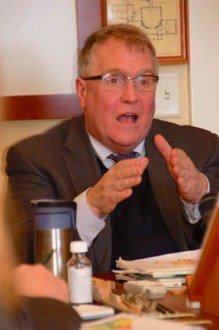
“Act 166 is an expansive piece of legislation that is extremely laudable in its intent, … but you need to pay very close attention to the delivery mechanism you are using to provide it,” Francis said, adding that he hopes lawmakers will undertake a comprehensive review of the law.
Last month, the Governor’s Blue Ribbon Commission on Financing High Quality Affordable Child Care recommended the Legislature make immediate, incremental investments in early care and learning and move toward a universal delivery system. The panel said there needs to be a new design and significant increases in funding.
Sharpe said the commission’s analysis would require an additional $350 million in taxpayer money. “That is a whopper. While many people value quality early childhood education, there are big hurdles to figure out how to deal with this going forward,” he said.
Sharpe is also concerned about conflicts between Head Start programs and public schools that have occurred since enacting Act 166. “Can we improve that in some way? We should encourage these collaborations rather than discourage them,” he said.
The House Education Committee wanted to move on special education funding last session after hearing the results of a report that found the state could have saved $164 million on pre-K-through-12 education during one school year. The lion’s share of that, $140 million, was spent on special education.
“The Picus report has indicated that there are savings to be made,” Sharpe said. “I suspect that the governor’s office and my own priorities might coincide in terms of trying to do a better job for less money in special education.”
Johnson, the new speaker, said she is open to adding some flexibility into Act 46. She said the Legislature was surprised at how many successful mergers came forward in the first year. But she said “a number of communities have hit a wall and said, ‘We don’t want it. It’s not working, we can’t find the right partner.’ … We need to dig into what those communities are thinking so we can look at how we can potentially amend the law to make it work.”
Latour said Scott will let the General Assembly handle any ongoing issues with Act 46.
“A lot of the work on Act 46 will come from members of the Legislature. Like I said, the (governor’s) priorities are in workforce development and STEM programs,” said Latour.
Expected education legislation includes:
- Proposals to add flexibility to Act 46. Rep. Janet Ancel, D-Calais, and Sens. Ann Cummings, D-Washington, and Anthony Pollina, P/D-Washington, want to see legislation that would help their area move forward on a merger that has been held up over school debt that would be shared by a common tax rate. They are also concerned with the State Board of Education’s expectations for districts that want to merge into an alternative structure.
- A move to strip the State Board of Education of its rulemaking ability and give the governor more leeway in choosing the education secretary (a Cabinet position). Sens. Brian Campion and Dick Sears, both Bennington County Democrats, have said they plan to propose such legislation. The issue arises from the private school approval rules that the state board has drafted. After Campion and Sears said they would introduce such legislation, the attorney general weighed in, saying the state board has the rulemaking authority on this issue. Sears and Campion said there is a Legislative Council legal analysis that is different, although both said they hadn’t read it yet. Sears said in an interview that they want the legislative process to sort it out.
