


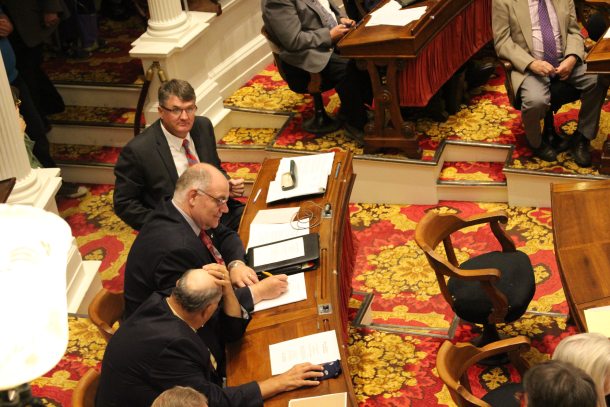
While almost all of Vermont’s top statewide political seats will be filled with new people come January, the makeup of the two bodies under the golden dome will not be all that different than it was last year.
Both chambers continue to have a Democratic majority, while Republican presence slightly diminished in each chamber.
Both Democrats and Republicans in the House lost one seat; Democrats slipped to 84 seats, while Republicans slipped by one seat to 52. Progressives and independents won seven seats each.
Republicans also lost two seats in the Senate and now hold a total of seven.
While lawmakers pledge to work with the new Republican governor, the new power dynamic sets up an inevitable culture clash over a host of issues from budget cuts to health care reform.
SENATE
The Senate leadership is poised for a significant shift left.
Lt. Gov.-elect David Zuckerman, a Progressive, is taking Scott’s place at the podium in the Senate. Meanwhile the pro tem’s office is likely to be taken over by Sen. Tim Ashe, D/P-Chittenden, who is more progressive than the former Senate leader, John Campbell, a moderate Windsor County Democrat.
Chris Pearson, a Chittenden County Progressive, is trading his House seat for a Senate one, which maintains the Progressive/Democrat ranks as Zuckerman ascends to the podium.
Sen. Dick Mazza, who has served in the Senate for more than three decades, said that the new leadership in the top two positions and the two-seat pickup by Democrats won’t change the dynamic that much.
“I don’t think there’ll be any major change that I see,” Mazza said.
Mazza, a blue dog Democrat from Grand Isle, openly backed Scott, a Republican, over the Democratic contender Sue Minter.
He is supporting Ashe’s bid for pro tem, and doesn’t believe he will shift the Senate left. Mazza is also optimistic about how the Senate will work with the new governor.
“We’ve all worked with Phil Scott as lieutenant governor,” Mazza said. “One of his abilities is to be able to work with everyone.”
Meanwhile, Republicans’ presence in the Senate slipped from nine seats to seven. Notably, Sen. Bill Doyle, 90, a Washington County Republican who has served in the Legislature since 1969, lost his re-election to Democrat Francis Brooks.
Senate Minority Leader Joe Benning, R-Caledonia, said Doyle’s loss came as a blow. Benning has known Doyle for decades, and remembers seeing him in the Statehouse working on weekends and holidays.
“He was one of those people who spent more time in the building trying to get his constituents answers than most of the other legislators I knew,” Benning said.
The party also lost one seat in Chittenden County, previously held by current Natural Resources Board Chair Diane Snelling.
Benning is “somewhat disappointed, although not totally surprised about my state Senate situation,” he said.
A strong Scott supporter, Benning anticipates Senate Republicans will have a good working relationship with the administration. Despite the GOP’s small presence in the upper chamber, he feels they’ll be able to pursue their priorities, backed by the Fifth Floor.
“Our agenda is not that complicated,” Benning said. “It’s getting the economy back on track, and Phil Scott’s the one leading that conversation.”
Zuckerman, Ashe and Pearson, and liberal Democrats in the Senate, however, have been proponents of a higher minimum wage, gun control measures, climate change initiatives and legalization of marijuana — all of which could run into conflict with Scott’s agenda, which he says will be entirely focused on the economy.
HOUSE
In the House, Democrats maintained their presence with 84 seats. Republicans dropped by one seat to a total of 52, a disappointment to party leadership that nonetheless allows the minority party the ability to sustain a veto.
“When we were going into this cycle, we had big hopes,” House Minority Leader Don Turner said.
The party was “shocked,” Turner said, that GOP Rep. Paul Dame lost his re-election bid in Essex. His absence will be “a big loss” to the caucus, he said.
Two Democrats took the seats in that area — Lori Houghton and Dylan Giambatista, outgoing House Speaker Shap Smith’s former aide.
Republican Brian Keefe in the Bennington-4 district won a seat with 26 percent of the vote. Democrat Cynthia Browning maintained her seat there, with 24 percent, but incumbent Democrat Steve Berry, who got 23 percent, lost his seat.
Republican candidates in three districts may seek recounts:
• A Windsor-Orange district where incumbent Democrat Sarah Buxton eked out a victory over Republican challenger David Ainsworth by just three votes;
• A Franklin County district where Prog/Dem Cindy Weed defeated incumbent Republican Larry Fiske by 15 votes;
• A Colchester-area district where incumbent Republican Joey Purvis lost re-election by 31 votes.
“We fully accept the voters have spoken,” Turner said. However, he said, the party wants to make sure the results are accurate.
The Lamoille-Washington district, home to the outgoing House speaker, has all new representation. Former head of the Department for Children and Families David Yacovone won a seat as a Democrat and Republican Gary Nolan clinched the second vacancy, ousting incumbent Democrat Avram Patt.
Though disappointed that his party didn’t pick up seats in the House, Turner is pleased about Scott’s victory in the governor’s race.
He expects the Republican administration will put muscle behind initiatives proposed by GOP members in recent years that have withered on committee walls. Still, Turner is wary that there could be some challenges.
“By far, the working conditions for our caucus I think are going to be greatly improved,” Turner said.
Progressives continue to hold seven seats in the House, according to Pearson.
Incumbent Progressive Rep. Susan Davis lost her seat by less than two dozen votes in Orange County to Robert Frenier, a Republican who won in the primary on a write-in campaign.
Selene Colburn and Brian Cina, both Progressive-Democrats, were elected to fill seats vacated by Pearson and Democrat Kesha Ram, who left the Legislature to run for lieutenant governor.
With Davis’ loss and Pearson’s move to the Senate, it is unclear who will take the lead in the Progressive House Caucus at this point.
House Majority Leader Sarah Copeland-Hanzas, who has already informed the Democratic caucus that she intends to seek the speaker’s office, said that both legislative chambers are “largely unchanged.”
She’s optimistic about the relationship a Democrat-led House will have with the Republican administration.
“I think there are places where we will come together with a Phil Scott administration,” Copeland-Hanzas said.
She has not yet sat down with Scott, but she has had a good working relationship with him in the past, she said. She could see the parties uniting on issues including rural economic development, and expanding broadband access and cellphone service in the state’s more remote areas.
As to whether House Democrats pursue some key initiatives that have been divisive along partisan lines, Copeland-Hanzas said that will become more clear after the caucus convenes in December.
Though she believes there is impetus among Vermonters to consider changes to gun policy, she was not certain whether the caucus will want to push universal background checks for gun sales under the current administration. Scott has said he does not see a need to change Vermont’s gun laws.
She could see Democrats trying to work with the administration on other party initiatives, like raising the minimum wage to $15 per hour and efforts to make college more affordable. Too many Vermonters can’t make ends meet despite working full time, she said.
“We need to have a conversation about how Vermont can make work work for people,” Copeland-Hanzas said.
Scott said in a press conference Wednesday that he would reject another increase in the minimum wage. He also reiterated that he would veto a carbon tax bill.
Copeland-Hanzas said she expects Democrats will need to encourage the administration’s party to find “proactive ways of solving some of the problems that we can identify.”
“They’re the party of ‘no.’ We don’t need to stop them. We need to make them say ‘yes,’” Copeland-Hanzas said.
Incumbent Democrat Patsy French lost her seat in the Orange-Washington-Addison district, which will be represented by two new faces next year — Independent Ben Jickling, who won 25 percent of the vote, and Democrat Jay Hooper, who won 22 percent.
Independent Rep. Adam Greshin, of Warren, is uncertain what the dynamic within the House will be come January. The new leadership, he said, will play a big role in determining that. Greshin expects the relationship between the House and the administration will be similar to when Gov. Jim Douglas was in office and Democrats were in control: “Cordial, but I would call it tense,” Greshin said.
The dynamic between the Democrat-led Legislature and the Scott administration could include a power struggle if Scott delivers a veto. Democrats would have to pick up support beyond their 84 members to complete an override; the Republicans have 52 seats in the 150-member House.
“It’s going to be very, very hard to override a veto in the House, and if they do every vote is going to count,” Greshin said.
This post was updated at 11:13 a.m. Thursday.
