

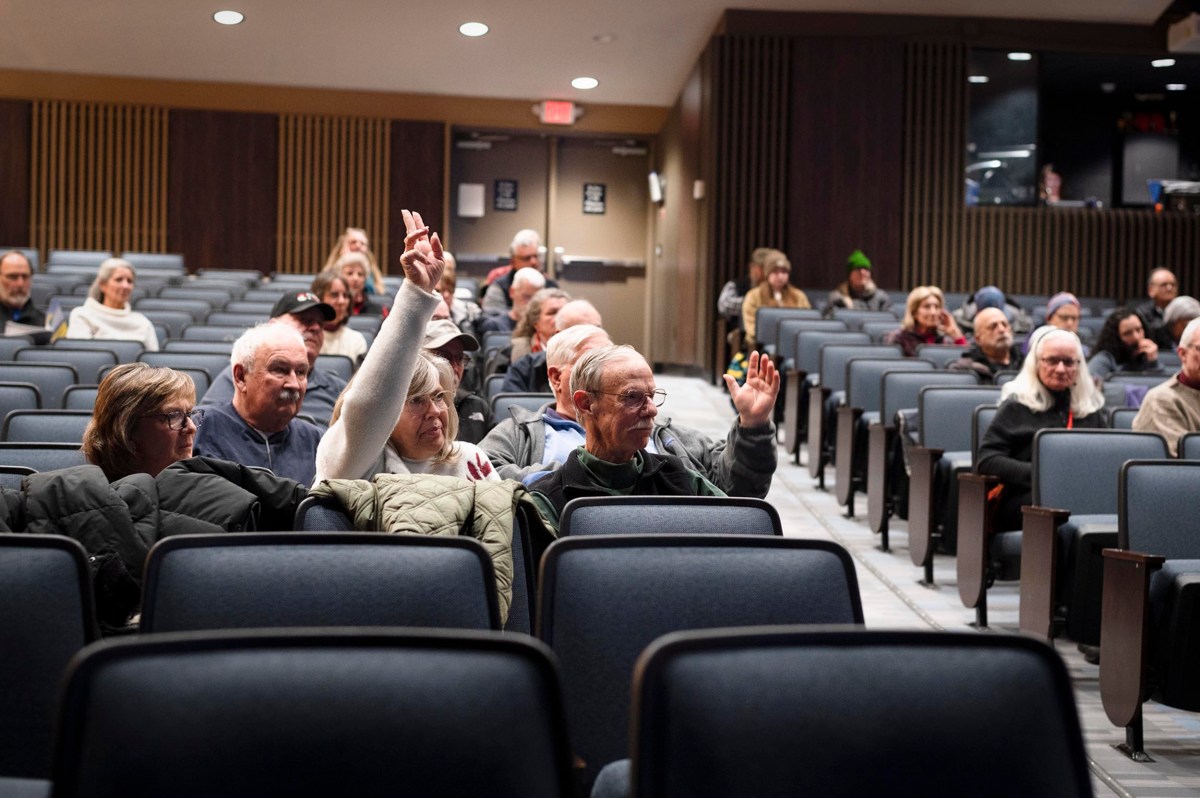
Voters approved the vast majority of school budgets on Town Meeting Day this year, the second year of relative calm in school budget voting following the historic rejection of school budgets in 2024.
According to preliminary results compiled by the Vermont Superintendents Association and the Vermont School Boards Association, 85 school budgets were approved, while a dozen will be voted on at later dates.
Nineteen school budgets failed to muster support on Tuesday, including from voters in the towns of Barre, Milton, Newport City, Alburgh and Wolcott, among others.

Voters in the state’s larger school districts in Burlington, Colchester and Winooski, for example, approved their budgets. But voters in the Barre Unified Union School district rejected their $57.8 million budget, according to reporting from the Times Argus.
The tally of defeated budgets is higher than last year, when nine budgets were voted down. But education leaders said the results from both years are more typical — at least, compared with 2024, when one-third of school budgets were voted down in a historic rout.
“We’ve seen for the past two years it go back to a much more normal approval rate,” Chelsea Myers, the Vermont Superintendents Association’s executive director, said during a Wednesday press briefing.
That news provides a sigh of relief for many school district officials, who have faced mounting increases in health insurance, special education and other costs out of districts’ control.
Health care costs have increased nearly 35% over the past three years, according to data from the Vermont School Boards Association and the Vermont Superintendents Association. More than 70% of most school districts’ budgets, meanwhile, are made up of faculty and staff salaries and benefits.
Amid those rising costs, and the intense political pressure to keep budgets level, school leaders say they’ve run out of financial runway to keep their district spending level without making cuts to staffing or programming.
Education property taxes have risen more than 40% in the last five years. This year, statewide projections have school spending increasing by 4.2% from the current year, less than the 5.8% projected rate of growth in the Tax Department’s annual “Dec. 1 letter.”
Public education has been a focal point of Vermont politics since the taxpayer revolt of 2024. Efforts to reform the public education system began the following legislative session.
Last year, Gov. Phil Scott signed Act 73, a law laying the groundwork for the consolidation of the state’s 119 school districts and a shift to a new education finance formula.
But there’s little consensus so far on how to achieve that reform. While the 2024 tax revolt was seen at the time as a mandate to reform the system, some are still weighing — during an election year, no less — whether there’s broad support for the type of consolidation envisioned by Act 73.
“I think Town Meeting Day is one of the clearest ways that Vermonters show what they value, and that even in these times, when there are economic pressures, communities are continuing to show their commitment to supporting our public schools in Vermont,” Sue Ceglowski, the Vermont School Boards Association executive director, said on Wednesday.
Scott, for his part, has continued to demand reform, warning lawmakers in his State of the State address in January that he expects a reform package by the end of this session.
He generated some controversy last month, when he said that the state’s annual assessment of student and school performance illustrates “why education transformation is not optional, it’s essential.”
And last week, he told reporters during a press conference he would be voting against his own community’s school budget. Scott, who lives in Berlin, said the Washington Central Unified Union School District budget would lead to “significant” property tax increases in several of the district’s five towns.
In both instances, education leaders accused Scott of politicizing public education.
A statement signed on by a number of public education leaders, as well as the board chair of the school district Scott voted in, called Scott’s statement “a political stunt.”
“There isn’t a single school board in Vermont that doesn’t carefully craft budgets that meet the needs of their communities’ children,” Don Tinney, the president of the Vermont-National Education Association, the statewide teachers’ union, said in a statement. “By very publicly denouncing the efforts of the school board in his own community, he is clearly hoping other voters go along with him.”
Myers, in a press release issued Wednesday, said the fact that communities often struggle to pass budgets “points to deeper structural challenges in the system.”
“If Vermont is going to move forward with education reform, these results suggest we might need a more precise tool than a sledgehammer,” she said.
Also on Tuesday, voters in the towns of Marlboro and Readsboro voted to shutter their small elementary schools, where enrollment has declined to unmanageable levels. Elsewhere, voters in Woodstock approved a more than $111 million bond to build a new high school and middle school for the region.
Clarification: This story was updated to reflect different votes in Barre Town and Barre City on the Barre Unified Union School District budget.
