

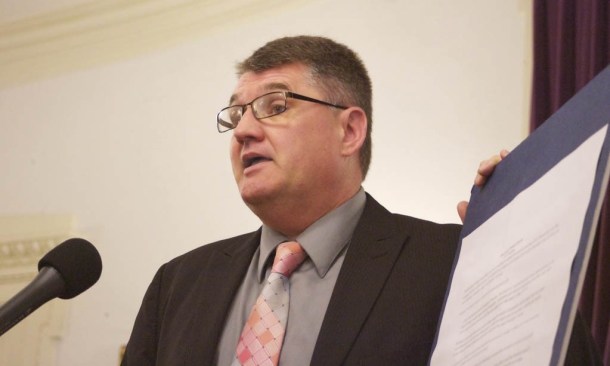
[M]ILTON — Chittenden County is a Democratic stronghold. As a result, it’s difficult to run a successful campaign in the state’s most populous county without running as a Democrat, said House Minority Leader Don Turner, R-Milton.
That’s true no matter what end of the political spectrum you’re running from, Turner said. Republicans struggle, as do Progressives, Vermont’s far left party.
All six Progressive candidates for legislative office in Chittenden County ran in the Democratic primary, and two senators, Tim Ashe and Phil Baruth, are Democrats first and Progressives second on the ballot.
There is perhaps no candidate more closely associated with the Progressives than Rep. Chris Pearson, P-Burlington, who in order to make the leap to the Senate ran in the Democratic primary, a step that he hadn’t taken in his past House campaigns.
“The bigger the jurisdiction in terms of number of seats, the more the two-party structure comes into play,” Pearson said in an interview just before the August primary.
Three Progressive candidates for Chittenden County House seats this cycle also opted to run in the Democratic primary, though like Pearson, they waged write-in campaigns or accepted the Progressive nomination and will appear on the November ballot as Progressive/Democratic candidates.

Turner said that, when it comes to the Senate, the Democratic dominance in Chittenden County is unfair and possibly illegal. That’s because the six-member senate delegation is elected at-large, and the result is that his constituents in Milton aren’t guaranteed representation, according to Turner.
Turner describes Milton and several neighboring towns, such as Westford, as a blue-collar conservative community. No Democrat is challenging him or his seatmate, fellow Republican Rep. Ron Hubert.
“We have six senators and I do not believe any of them represent the majority of people in this community,” Turner said.
Republican Diane Snelling retired earlier this year, and Shumlin appointed Republican Helen Riehle, a South Burlington City Councilor, to take her seat, but Riehle isn’t standing for re-election.

Turner credits Sen. Tim Ashe, D/P-Chittenden, for regularly coming to Milton to hear residents’ concerns, something he said other members of the delegation don’t do as often. Still, he said that he doesn’t believe Ashe’s voting record would jibe with the predominant political views of Milton residents.
“What I would propose is to break it up,” Turner said, adding that Chittenden County could be split into districts, with candidates running to represent a specific portion of the county.
Pearson, in a more recent interview, said he agrees that the district should be broken apart. “I think it’s highly important to break it up. I think six members is too big, and makes it very confusing for voters.”
Pearson, who ran successfully in the Democratic primary, was careful to say that the large district favors “the dominant party,” which just happens to currently be the Democratic Party.
The Vermont Democratic Party did not respond to a request for comment about the notion of breaking up the Chittenden County Senate delegation.
Secretary of State Jim Condos, a former Democratic Chittenden County senator, said dividing the six-member Senate delegation is not a new idea. For the past two decades, it’s been a bone of contention in every redistricting debate, Condos said.
Most recently, in 2012, proposals to divide the Chittenden County senate delegation into two three-member districts failed to gain traction.
Turner said the Republican Party has long considered taking the issue to court, but he says they don’t have the money.
“I wish someone would take up the case because I think it’s a winnable one,” Turner said.
It’s likely to become an issue during the next redistricting in 2022, but in the meantime, Turner said the best chance that John Gifford, the lone Republican on the November ballot, has of winning a senate seat is if Republicans only vote for him. Voters in Chittenden County are able to select as many as six candidates on their ballots.
Gifford, the Milton town treasurer whom Turner encouraged to run, appeared tepid about his prospects back in August, and has raised only $2,400 and spent just $1,800 as a first time candidate with little county-wide name recognition.
However, Turner said money isn’t going to get Republicans elected in Chittenden County, pointing to Joy Limoge’s 2014 bid in which she spent more than $33,000 and still came up short.
“I think the only way you can win is if people only vote for the Republican,” he said, “That’s what I’m advocating everywhere I go.”
An independent has also joined the senate contest. Burlington resident Tom Licata, a member of the conservative Ethan Allen Institute’s board, has been critical of Republicans, urging them to “grow a pair” in a recent op-ed.
Licata is running ads on CCTA buses, but his campaign finance filings could not be located on the Secretary of State’s website. Licata is listed on the site as a candidate for the November ballot.
House races
Chittenden County has 35 House seats, or nearly a quarter of the 150-member lower chamber. Currently, there are 25 Democrats, eight Republicans and two Progressives, counting Rep. Diana Gonzalez, P/D-Winooski.
There are 18 seats that Republicans aren’t contesting, and though they could, in theory, increase their representation in Chittenden County, that’s not the GOP’s focus, Turner said.
“My main focus is to protect the seats we have,” he said.
One race where Turner says Republicans could pick up a seat is in Chittenden 7-2, which includes much of South Burlington. There, incumbent Democrat Ann Pugh will face off with Sam Handy.
Handy is a businessman from a well-known family, which could boost his prospects, but he still faces a difficult contest, Turner said.
“He’s the kind of young Republican we need to get elected, but it’s a big challenge to beat a 20-plus-year incumbent,” Turner said. Pugh was first elected in 1993.
Katherine Levasseur, house campaign director for the Democrats, said she’s optimistic Democrats may pick up seats, noting that, in general, her party does well in presidential election years.
Levasseur declined to comment on any specific Chittenden County races where the party might focus its efforts, because she said that would not be strategic.
Selene Hofer-Shall, a consultant for the Democrats, said they do plan to spend money on House races in the weeks leading up to the election but did not provide greater detail.
In 2014, the Washington, D.C.-based Republican State Leadership Committee spent $370,000 on legislative races in Vermont. This year the group has scaled back its efforts, spending $65,000 as of the Oct. 1 filing.
Much of that money went toward a website that aims to tie Democratic incumbents, including several in Chittenden County, to Gov. Peter Shumlin and his legacy.
Levasseur decried what she called “DC-style tactics,” and said she’s confident Vermonters won’t be swayed by outside groups.
Turner said he attends Republican State Leadership Committee events, but has not coordinated with the group on its spending in Vermont. He said he was not sure if they plan to spend more in the last month of the election.
“In order to pick up seats and change the balance we need all the help we can get. Democrats have a strong hold up here,” Turner said.
The Vermont Democratic House Campaign used to be its own political action committee until it was dissolved in February and rolled into the Vermont Democratic Party. At that point it had spent $96,000 on the 2016 election.
The Vermont Democratic Party reported spending $63,000 on candidates in the 2016 election cycle, but less than $150 of that went to candidates for representative. In both instances the expense is listed as a returned contribution.
More information on the individual candidates can be found in VTDigger’s candidate guide. Channel 17 is hosting a series of public forums with the Chittenden County legislative candidates.
