

Even as Entergy continues to grapple with a groundwater-intrusion problem at Vermont Yankee’s turbine building, company administrators and state officials struck a conciliatory tone during a lengthy discussion of the issue Thursday night in Brattleboro.
There were apologies and admissions of miscommunication. And state officials now say the water incident may have been a “blessing in disguise” because it has spurred weekly, wide-ranging discussions about decommissioning issues with Vermont Yankee administrators.
“Initially, there was great disappointment that we had to learn about this essentially through the press,” said Bill Irwin, radiological and toxicological sciences chief with the Vermont Department of Health. “The end result, however, is that it has opened up a really important dialog that should have existed before we had to have an incident like this.”
Entergy administrators had expected some groundwater to seep into the lower level of the turbine building after the Vernon plant ceased producing power in December 2014. But they did not anticipate flows that periodically have reached thousands of gallons of water daily.
The water is radiologically contaminated with low levels of tritium. So Entergy had to scramble to come up with storage and disposal solutions for tens of thousands of gallons of tainted liquid.
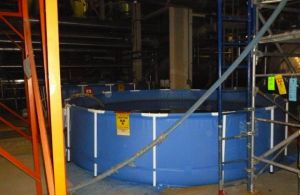
The issue first came to light in a January inspection report from the federal Nuclear Regulatory Commission. In February, VTDigger was provided with photos that showed some of the radiologically contaminated water was being stored in open swimming pools.
The NRC has said those pools, which have since been removed, were acceptable for short-term storage. At Thursday’s meeting of the Vermont Nuclear Decommissioning Citizens Advisory Panel, state Nuclear Engineer Tony Leshinskie said he believes that the pools were an effective – though not aesthetically pleasing – way of temporarily stashing excess water.
“What was done works. It works fairly well,” Leshinskie told the panel. “So from that perspective … there’s not any violation of rules.”
That doesn’t mean, however, that state officials were happy with how the incident played out. After seeing press reports that disclosed the extent of the water problem, “we did begin conversations with the company right away,” said Trey Martin, deputy secretary of the state Agency of Natural Resources.
Chris Wamser, Vermont Yankee site vice president, said the company had not been silent about water management and has made mention of such issues at past advisory panel meetings. But he admitted that there initially had been a lack of clear communication with the state.
“We were managing it, but clearly we should have done a better job communicating that,” Wamser said Thursday.
Leshinskie, who is often at Vermont Yankee, also issued a mea culpa. He said he knew as much as a year ago that there were groundwater incursions at the plant, but he didn’t think to ask a key question – “how much water are we talking about?”
Leshinskie said his primary focus has been on maintaining the integrity of the plant’s spent-fuel pool, not on groundwater issues. He also noted that the turbine building “is not an area that I normally go into.”
Nevertheless, he acknowledged that “examining the magnitude (of the groundwater issue) … was something that was missed on my part.”
State officials say there’s now a system in place that may keep them from missing any more such problems. Martin said there have been weekly discussions between state agencies and Yankee representatives over the past five or six weeks.
“We’ve addressed the water-management issues,” Martin said. “But they have also provided a forum to talk about other issues that are arising in the ongoing management of the plant or decommissioning … which has been a very good thing. It reflects a commitment on behalf of the company to be in dialog with the state on a routine basis so that, as things come up, we can address them right away.”
Those meetings will continue, both in person and via phone when necessary. “Any changes in our plans are communicated directly to the state agencies,” said Joe Lynch, Vermont Yankee’s government affairs manager.
Entergy’s current plan is to ship the water to a processing facility in Tennessee. Lynch said about 30,000 gallons have been shipped so far, and the company will continue shipping 5,000 to 10,000 gallons per week via tanker truck.
EnergySolutions, headquartered in Utah, is processing and disposing of that water. On Thursday, company spokesman Mark Walker detailed EnergySolutions’ experience in the nuclear industry and its safety regulations, since a subsidiary of the company also is trucking the Vermont Yankee water.
Walker emphasized that officials have not found high levels of contamination. “You’ve got waste that is so low in radioactivity – hardly any radioactivity – that it can be (tested) and then it can be disposed of in a municipal landfill,” Walker said.
Vermont Yankee’s water-management efforts come at a cost that has not yet been disclosed. On Thursday, Lynch mentioned that each 5,000-gallon water shipment costs about $22,000, but plant spokesman Marty Cohn said a more-detailed financial accounting is still to come.
Cohn also said that, in spite of the volume of water, Entergy is not breaking its decommissioning budget. “We had the money earmarked,” Cohn said. “We’re just spending it sooner.”
Entergy administrators are trying to curtail those expenditures by squelching the groundwater problem. Lynch said a team made up of plant personnel and “industry experts” – including a hydrogeologist who advised on previous tritium leaks at the plant – is working on the problem.
“Our long-term goal is to manage the intrusion, minimize it coming into the building and find the most economical options for disposing of the water,” Lynch said.

