


[P]ORT KENT, N.Y. — Environmentalists are pushing state and federal governments to stop the flow of crude oil along railways next to Lake Champlain.
The Canadian Pacific Railway has been transporting Bakken crude oil from North Dakota on rail that hugs the banks of Lake Champlain in upstate New York, and environmentalists say tar sand shipments could be next.
John Sheehan, communications director for the Adirondack Council, said companies could already be using the 130-mile railway along Lake Champlain to move tar sands, but the public would not know because federal regulations under the Department of Homeland Security keep the shipment of hazardous materials secret.
Sheehan and other representatives from Vermont and New York held a small news conference in Port Kent, New York, on Thursday to talk about a report that condemns the oil industry for using rail transport and calls federal regulations inadequate.
Jake Brown, communications director of the Vermont Natural Resources Council, said the risk of a spill from oil-by-rail would negate the water cleanup bill that the governor is days away from signing.
“This would be a major step backward if something happened,” Brown said. “This lake is the crown jewel of this region, and it’s owned by us all — Vermonters, New Yorkers, and Quebecers.”
The National Wildlife Federation’s report, “Tar Sands At Our Doorstep: The Threat to the Lake Champlain Region’s Waters, Wildlife, and Climate,” recommends a moratorium on all oil-by-rail transport, including along the Canadian Pacific Railway, until governments can enact stricter regulations.
“What’s happening is we have a rail infrastructure that hasn’t been repaired or upgraded in close to 100 years, so you’re pushing a very volatile substance on a very weak and decrepit infrastructure,” said Aaron Meir, national president of the Sierra Club.
Meir said community emergency services assume “all the risk” in the event that an oil company’s Bakken oil or tar sands fall off the tracks. In Port Kent, he said the substance would land in either the Wickham Marsh or Lake Champlain.
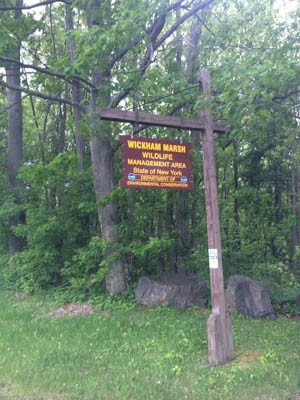
“If they’re going to make their profits from oil … then there should be billions of dollars of support for the infrastructure for communities that are along the transportation routes,” Meir said.
The report cites a July 2013 spill in Lac-Megantic, Quebec, from a derailed train that killed 42 people and is thought to have vaporized five. That was one of 117 oil-by-rail spills in 2013, according to the report.
The report also details a roughly 40-fold increase in oil-by-rail traffic nationwide between 2009 and 2013 — from 10,800 carloads to more than 400,000 carloads.
Crude oil travels in trains of up to 120 cars that resemble cans of soda, the report says. The New York Department of Transportation has already found and ordered fixed 740 rail defects, the report says.
A spokesperson for the rail company, which also does business in Canada and the Midwest, said it is a “common carrier” that has to move goods that meet federal standards.
“We don’t break down the details of our dangerous goods shipments for security reasons,” Andy Cummings, a spokesperson for Canadian Pacific Railway, said Friday.
Meir said organizations should push Gov. Andrew Cuomo, Gov. Peter Shumlin, President Barack Obama, and state legislators to keep tar sands away from Lake Champlain.

