H.361, which will be out in time for voters to consider when approving school budgets on Town Meeting Day, would save an estimated $25 million to $50 million annually, lawmakers were told.
Under the bill, school districts would be required to attempt to form “integrated education systems” of at least 1,100 pre-kindergarten-grade 12 students.
At 4:47 p.m. Thursday, after days hammering away at the final details, Rep. David Sharpe, D-Bristol, chair of the committee, asked, “Do we have a bill?”
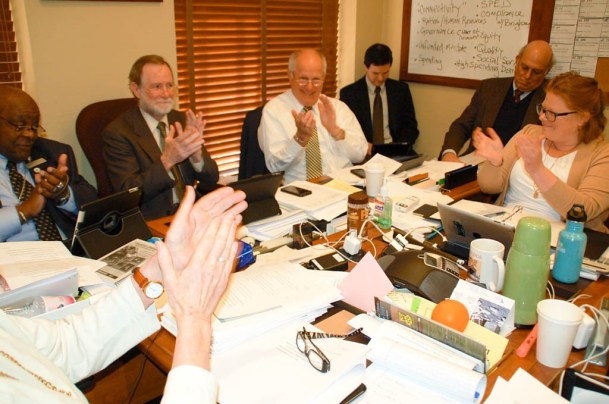
At about 5 p.m., they did, voting unanimously followed by general applause and then applause for Sharpe.
“I think we did the right thing; we moved the ball forward for kids and for taxpayers, and that was our goal,” Sharpe said to applause. “All right! Let’s go have a drink,” he proclaimed.
The size of the larger districts was reduced slightly from the 1,250 considered Wednesday.
The figure started at 1,000 and was suggested to go as high as 1,500 before settling at 1,100.
The committee was given a rough estimate of $25 million to $50 million in annual savings that are possible from the move to larger districts and other measures, by Mark Perrault, senior fiscal analyst from the Joint Legislative Office.
“This is the roughest kind of analysis, you need to take it with a grain of salt. I don’t doubt that there will be savings through consolidating,” but it’s hard to know what districts will do and how things will play out in the next few years if the bill becomes law, Perrault said. “I can feel comfortable putting that out,” he said of the range he put on the table.
The bill would require districts to reach out to neighboring school districts, form study committees and propose larger systems.
Districts that do not move in that direction by July 1, 2019, would need to receive permission from the State Board of Education to continue an alternate form of governance.
The committee has been pressing down for nearly eight weeks on the best ways to address complex issues confronting the Vermont public education system, where 21,000 pupils have been lost in the past two decades, while teacher and paraeducator staffing levels have remained constant.
There has been increasing outcry from taxpayers calling for property tax relief, along with the hope that larger districts will improve student educational opportunities.
Small schools and phantom students
The “big bill” voted out by the committee Thursday, 55 pages in length, calls for subsidies given to small schools being pulled back and the phase-out of the support built into the hold harmless provision, which has protected schools with high enrollment losses from the full financial sting.
That provision has created what are known as “phantom students.”
Small school grants will continue as they are through 2020, but after that only in a few circumstances will they continue, including whether they meeting state-set educational quality standards and whether they have high student-to-teacher and student-to-staff ratios.
Schools that merge into larger districts would keep their small schools grants as part of a merger incentive.
“If they merged, they would be able to keep that equivalent of money, even though they are no longer a small school district, that money would go to the new entity,” Perrault said.
There will also be tax incentives for merging, with incentives being higher for those who merge earlier.
“So, is the message here if you get on your horse and you merge early,” the savings will be higher? asked Sharpe.
That is how it will work, answered Perrault.
The State of Vermont spends about $20 million a year on the small schools grants and the hold harmless provisions.
Out-of-state tuition to stop, ratios part of bill
Donna Russo-Savage of the Legislative Council covered the changes made from Wednesday to Thursday’s draft legislation, including the piece of the bill that will stop the flow of Vermont public education dollars out-of-state except in certain circumstances — including border towns, and the grandfathering of students currently enrolled in schools that would not be covered in the new law, among others.
The bill calls on districts to increase staffing ratios, but does not set a target number, an issue that drew much debate over the final hours.
Rep. Kevin “Coach” Christie, D-Hartford, ranking member of the committee, who proposed a bill calling for ratios, said they would be hard to achieve in small districts, and suggested a goal rather than a hard number.
Christie said in the district he represents, and where he is a school board member, has upped ratios and found substantial savings. “It’s the right thing to do. It’s for the interest of the good of the whole,” he said.
Rep. Scott Beck, R-St. Johnsbury, said, “I like the idea of schools working on increasing the ratios on their own. The ultimate goal here is to reduce spending, so I think it fits in here.”
2 percent per-pupil spending cap added
Rep. Kurt Wright, R-Burlington, said he needed to see “concrete, measurable savings for taxpayers,” before he would vote for the bill.
Toward that end, a statewide cap of 2 percent in per-pupil spending, which would sunset on July 1, 2018, was agreed to Thursday.
That step is aimed at immediate property tax and spending controls.
So far this year, the average increase for school budgets across the state, the committee was told earlier in the week, is 2.95 percent above last year’s education spending.
Ed Fund outlook
Perrault also offered a quick look at recommended tax rates based on that average.
The base homestead property tax rate will be $1, up from 98 cents in FY 2 015. The average homestead property tax rate will go from $1.50 to $1.55, the figures shared Thursday showed.
Sharpe asked what the figures would look like with the 2 percent per-pupil spending cap proposed for the next three years’ budgets, not including those to be voted on next week.
“It would mean we would have to raise less on the property tax, assuming that spending only is going up by 2 percent, I would have to raise less in the property tax line. That’s how we would see property tax relief,” Perrault said.
“So, then is it fair to say that with a cap in place for three years at 2 percent and the expected merger savings of $25 to $50 million beyond three years we might actually see some property tax relief?” asked Sharpe.
“That difference in spending would go directly back to property taxpayers,” Perrault said.
Study hall
Eight different studies came up during the two-month journey toward producing the bill, and five remain.
They are: special education funding; the roles of superintendents and principals; and property tax adjustment lag; and a study on adequacy; and the establishment of a Joint Legislative Education Oversight Committee.
Sharpe said many of the nearly 100 proposals to the Legislature about education funding and governance asked about what constitutes adequacy, and he believes it’s a critical question as the state moves forward with how to best address public education.
Seeking a so-called “adequacy determination shall be based on the educational standards adopted under Vermont law, including adherence to Brigham v. Vermont (the suit that led to current education law in 1997) and the promotion of substantial equality of educational opportunity for all Vermont students,” the bill reads on the adequacy study. “The determination shall consider all sources of spending related to education, including capital expenditures.”
Up to $300,000 will be budgeted for the adequacy study, which was supported by a majority of the committee; the body is hoping for that report to be in hand by the next Legislative session, they discussed.
Health care added at 11th hour
The bill also addresses rising health care costs.
It proposes that a working group of state health and education leaders work to transition public school employees to Vermont Health Connect by 2018, a move Wright suggested earlier in the day, which could save up to $40 million annually, he estimated.
“We’ve taken testimony that it is the most steep, persistent increase that school boards have had to deal with, Sharpe said. “It eclipses all other growth in costs, even fuel oil costs.
Rep. Tim Jerman, D-Essex Junction, said, “This bill sends a strong message to voters that we heard them in the last election. We’re trying to move to a better system that has better outcomes for kids.”