

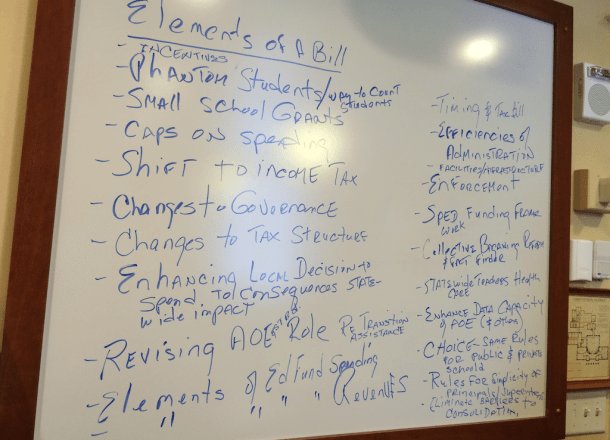
The House Education Committee has begun to put pen to paper — actually, dry erase marker to whiteboard.
After weeks of testimony, lawmakers began to brainstorm elements of an education reform bill on Friday. The much-anticipated legislation will likely include expanded, regional school districts, and may do away with contradictory incentives related to declining enrollment.
Rep. David Sharpe, D-Bristol, chairman of the committee, said on Monday that he hopes to “have a bill on the table by the end of the week.”
All eyes are on the work of both the House and Senate Education Committees this session as pressure across the state mounts to control education spending and improve equity and student outcomes in Vermont’s public schools.
On Friday, members of the House Education Committee had a brainstorming session on two white boards: one white board for problems, one for elements of a bill.
“Virtually everybody who chimed in said that school districts should be larger in one form or another,” Sharpe said, so “some form of enlarged governance structure” will be part of the bill taking shape this week.
Though the bill will be coming out of the House Education Committee, it is a collaborative effort with other branches of government, Sharpe emphasized.

“The Speaker had a bunch of suggestions and the committee had a bunch of suggestions, and I have some thoughts of my own, and the governor made some proposals,” Sharpe said. “I think we are going to put those together in a bill form that the committee can start chewing over.”
The committee has been hearing testimony from government officials and education experts for the past several weeks. What is likely to be included in the bill, Sharpe said, will be “a bunch of things that showed up fairly often.”
Contradictory incentives, such as small school grants and the hold harmless provision, responsible for the phantom student phenomenon, are on the chopping block.
Both those provisions subsidize schools that are losing enrollment, and in the case of the Small Schools Grants, give additional state funding to the state’s smallest schools. Higher per pupil costs in those districts are shouldered by taxpayers across the state.
Sharpe said that separate from the education reform bill expected out this week, the committee will continue to work on property tax reform. They will consider shifting from the property tax-based system to an income tax-based system for funding education.
Sharpe said that the committee will likely base its approach on the work by the Education Finance Working Group, organized by House Speaker Shap Smith, D-Morrisville, which put out a renovation plan on how to rework the present Act 60/68 system.
Ideas in the renovation plan include:
- an excess spending surcharge aimed at restraining per pupil expenditures;
- phasing out of the hold harmless provision which creates so-called phantom students, insulating schools from the financial losses that they would realize if their actual drops in student enrollment were felt;
- phasing out the Small Schools Grants;
- increased state incentives to encourage local districts to join larger Regional Education Districts;
- not applying new state mandates to the Education Fund and more.
Rep. Bernie Juskiewicz, R-Cambridge, vice chair of the House Education Committee, said that Friday’s brainstorming session was a first step toward drafting a bill.
“We’ve heard a lot of testimony to bring people up to speed on a lot of different aspects,” Juskiewicz said. “We’re just pushing on right now.”
“We just brainstormed on what we thought the problems were, from the transparency to accountability, the ratios, unfunded mandates…” said Juskiewicz. “And we put down what would be the elements of a bill – what would go into it? Caps on spending? A change in the tax structure? We just put all that stuff out there, and that would be our starting point moving forward.”

