

They’re going to need a bigger room.
House Education Committee Chairman David Sharpe, D-Bristol, several times Tuesday morning urged people to let House Speaker Shap Smith know that the committee is going to need larger quarters as its highly watched work gets underway this session.
It was standing room only Tuesday, with people in the hallway and seated on window sills and on top of the heater in the room. Witnesses, media and stakeholders are glued to the panel as it begins its work to address rising education costs and declining student enrollments.
Testifying before the committee Tuesday morning were: Joel Cook, director of the Vermont National Education Association; Jeffrey Francis, executive director of the Vermont Superintendents Association; and Stephen Dale, executive director of the Vermont School Boards Association.
Cook told lawmakers that Shumlin missed an opportunity to save money on health care for teachers, and there is no evidence that there is no such thing as an optimal class size. Francis says the state’s education system is “not in balance,” and there is growing inequity between schools. Meanwhile, Dale says a status quo approach to declining enrollments in areas of the state that have become depopulated is no longer acceptable.
Go slow on consolidation
Cook touched on highlights from an 11-page document the VT-NEA submitted to the speaker entitled, “Education Finance and System Reform.”

Cook noted early in his comments that role of schools is quite different now than it was 20 or 30 years ago. Schools are meeting a broad range of needs for children, including health and nutrition.
While Cook acknowledged that Vermonters are concerned about “what we spend on kids,” he said Gov. Peter Shumlin could have reduced health care costs for teachers by implementing a single payer health care system. According to a study conducted by KSE Partners last summer, the state stood to save $202 million in health care costs for teachers under a publicly financed single payer program.
“Vermont NEA produced a proposal that would have, in fact, under a publicly financed health care system, produced substantial savings” for school employees, Cook said.
Whether it comes back, “or we ignore it … the fact is that we were certain that we had unlocked a key in addressing the issue [that is dominating the Legislature] and that is: Are there ways to mitigate the costs that are facing our public schools?” Cook said.
Cook also said there is no such thing as an optimal class size and that there is no evidence that small schools provide lesser quality education.
Cook cautioned the committee not to mandate consolidation of local schools. He urged them to go slowly.
“My strong recommendation, based on years of dealing with this issue … you can spend a lot of time advancing the ball nowhere down the field by mandating school consolidation. If I’m wrong, I’m wrong, but I haven’t been wrong about that one,” Cook said.
High cost, mixed results
Next up was Jeffrey Francis of the Vermont Superintendents Association.
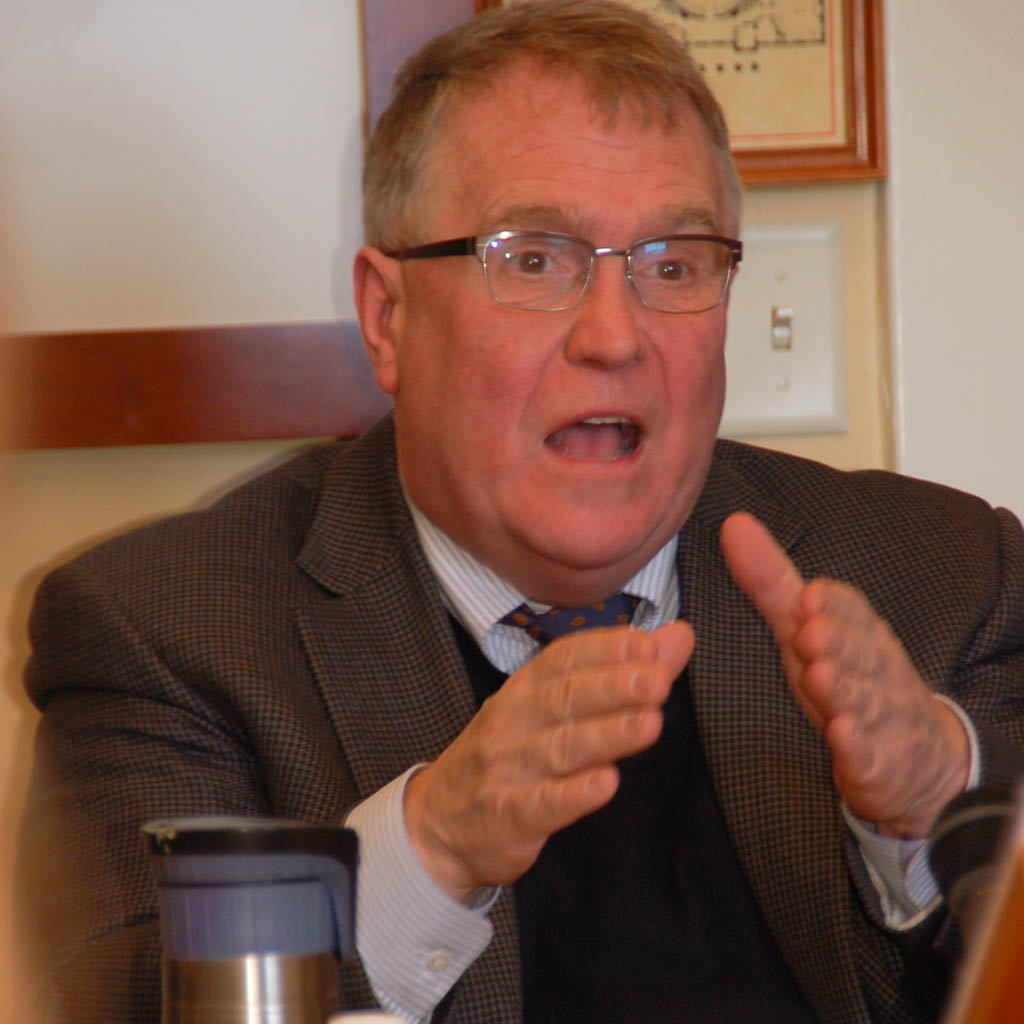
The first spring after Act 60 became law was Francis’ first year with the association, he began.
“We went out into the communities to talk to people about Act 60, and the point was driven home to me — you have to go a long way to find things that Vermonters care about more than education and their money.”
But Act 60 and 68, which created the statewide property tax as a way of ensuring that towns had roughly the same amount of money for educating children, is “not in balance,” Francis said. He credited Rebecca Holcombe, the Secretary of the Agency of Education, for producing data that shows how the educational opportunities offered by Vermont schools differs from one district to another.
Francis said, “We have a high level of investment, arguably the highest in the country per pupil,” he said. But the results are mixed. There are, he said “major and increasing discrepancies in the opportunities that we are able to provide our students.”
Referring to Joel Cook’s comment that he believes some “forced corrections” will need to be made by the Legislature, Francis said Cook, “is absolutely right … at the center of this needs to be the kids, and right there with him or her is the taxpayer … we need to think about what is the delivery system, the best opportunity to use taxpayer dollars” to deliver services in a way that is most affordable, most efficient, and most equitable for students.
Rep. Kurt Wright, R-Burlington, a new member of the House Education Committee agreed.
“I think you’ve stated that we need to have significant change in the system or we are not going to be improving education,” Wright said.
Fix property taxes
Stephen Dale, the executive director of the Vermont School Board Association, told the committee “the perspective of our membership is diverse,” and brings with it “a range of perspectives” on the big issues confronting education in Vermont today.

“Our association has clearly stated by the full group that the status quo is no longer acceptable; that we have challenges; we need to face the challenges; we need to come up with solutions,” Dale said. “The devil’s in the details, and the solutions are not clear or they would have been decided in the last two or three years.”
Dale said the association will work with the committee to “try to define the problem and identify solutions.”
“The first issue is rising property taxes,” he said.
“This can’t be a one-year fix, it can’t be a quick fix … we need to look at the overall structures that are contributing to the problem,” he said.
Dale stressed that he believed “there does need to be some movement toward property tax relief” this session or more school budgets might be shot down in March. Last year, 36 school budgets were rejected in larger communities across the state. The districts represented roughly 178,000 Vermont residents.
Many Vermonters don’t see a way other than voting down a school budget right now, to be heard on the issue of property taxes, Dale said.
The School Boards Association had several suggestions, including asking the state not to create unfunded mandates, to help at the local level and to establish a predictable split in funding for the Education Fund.
He said the Education Fund in 2005 paid 61 percent of the costs, and this year, it is 68 percent.
“If we don’t do anything about that split, within a few years, it may be 75 percent,” he said.
Dale also said the association was interested in learning more about shifting “more toward an income tax basis” to pay for public schools.
With 65 percent of the state’s citizens already paying based on income, Dale said, “It’s a discussion that ought to be happening.”
Committee Chairman Sharpe asked Dale to ask board members what would happen if the state allowed a completely voluntary consolidation process to start, noting that “would leave orphan towns and orphan districts,” across Vermont, potentially.
Dale said he would report back.

