


[I]n 2006, Colchester businessman Richard Tarrant garnered national attention when he sunk about $7 million of his own money into a failed U.S. Senate campaign against then-U.S. Rep. Bernie Sanders.
Tarrant, a Republican, invested roughly $64 of his cash for every vote he earned in that year’s primary and general elections.
A decade after Tarrant’s doomed spending spree, Republican gubernatorial candidate Bruce Lisman staged his own self-financing spectacle by raiding his coffers for $1.55 million – or about $86 for each of the 18,115 votes he earned in losing the Aug. 9 primary to Lt. Gov. Phil Scott.
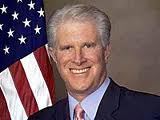
Lisman and Tarrant are extreme examples of a common theme in recent Vermont politics: Self-financing a major campaign seems to ward off victory. While not inherently a bad idea, it requires just the right set of circumstances to work, along with a dash of good timing, says longtime political analyst Eric Davis.
Regardless of his spending, “2016 was just not the year for Bruce Lisman – going up against a popular officeholder who many Republicans saw as ‘next in line’ for a chance to run for governor,” said Davis, a professor emeritus of political science at Middlebury College.
The 2016 gubernatorial primary was a showcase for multiple candidates spending their own money. While final campaign-financing reports are not yet in, state documents make clear which candidates opened their own wallets to a significant degree.
Lisman led the pack in that regard. When the retired businessman from Shelburne filed his last full campaign-finance report in mid-July, he reported $1.85 million in contributions – with $1.55 million of that coming from his pocket. Lisman invested heavily in advertising, including negative attacks on Scott.
In contrast, Scott last month reported only $975 in contributions from himself or immediate family and did not report any last-minute infusions of his own cash.
When Scott won the Republican nomination on Tuesday with about 60 percent of the vote, he declared that “this campaign settles an important debate: Negative campaigns don’t work in Vermont, no matter who you are or how much money you spend.”
In the race for the Democratic gubernatorial nomination, Townshend resident and former state senator Peter Galbraith reported last month that he had contributed $185,643 to his campaign – about 57 percent of the total amount he had raised.
On Aug. 4, Galbraith reported spending another $20,000 on his campaign, pushing his self-financing total over $200,000.
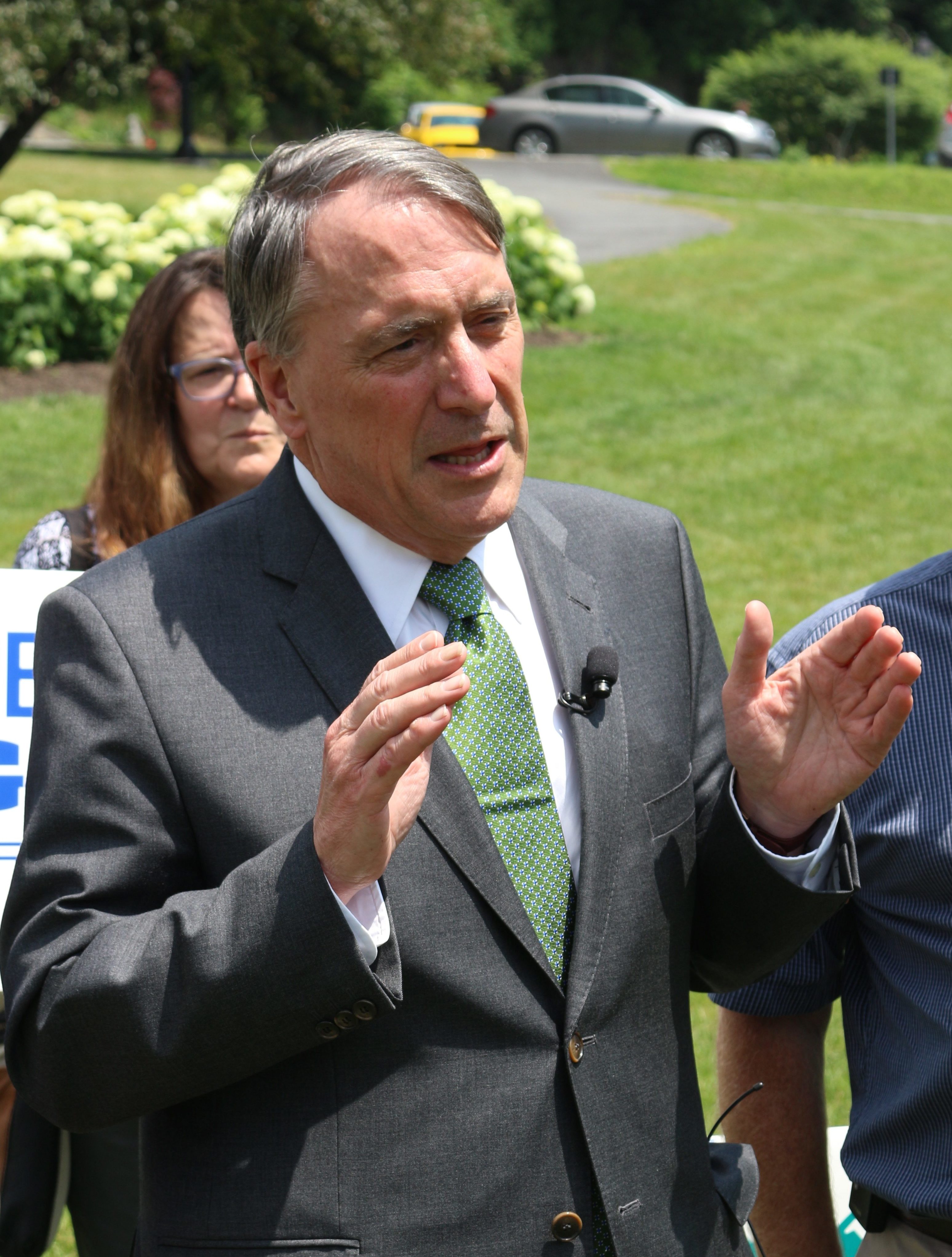
He wound up finishing in third place behind nominee Sue Minter and runner-up Matt Dunne. Galbraith garnered one vote for every $31 of his own money invested in the race.
As he reflected on his campaign late Tuesday night, Galbraith said his self-financing was minimal when compared with the money he could have spent from “substantial personal resources.” Galbraith also framed his spending as a rebellion against corporate campaign contributions and a political system that requires candidates to spend a lot of time fundraising.
“The modern campaign is spending 40 hours a week on the telephone, calling people for money. And I just wasn’t going to do that,” Galbraith said. “It’s become a terrible system, and it is not serving our democracy well.”
Self-financing was an issue for another candidate in the Democratic race for governor, but in a different way. Dunne put $95,000 of his own money into the campaign in the first few days of August, in apparent contradiction of his earlier pledge to adhere to the state’s $4,000 campaign-contribution limit on individuals.
Though Dunne’s campaign characterized the $95,000 as a bridge loan, the online election site Ballotpedia fact-checked the claim and reported that Dunne did, in fact, break his funding promise.
The common thread among Dunne, Galbraith and Lisman was a losing campaign.

There are a few other recent examples of futile self-funding in Vermont politics. While he came nowhere close to Tarrant’s or Lisman’s largesse, Republican Randy Brock invested heavily in his unsuccessful 2012 gubernatorial run.
Brock put $300,100 of his own money in the campaign, about 39 percent of his total contributions, according to a report filed at the end of that year. He lost the general election to Democratic incumbent Gov. Peter Shumlin.
Shumlin himself is an outlier in the self-financing saga. In winning his first term in 2010, he strategically infused $225,000 of his own money into the campaign in several disbursements before the primary and general elections.
Records from the end of 2010 show Shumlin spent a total of $285,555 on that campaign. But that was just 19 percent of the $1.49 million he raised.

From those examples, Davis takes a few lessons about self-financing. He believes it can help a candidate who already has strong grassroots support; who is in a “competitive, winnable” election; and who needs a little more cash – maybe a 10 percent to 20 percent boost – to pay for a “positive advertising campaign.”
Shumlin’s 2010 primary campaign fits that bill, Davis believes.
“Five experienced candidates in a close race,” he recalled. “Shumlin had good fundraising numbers without his own money, and his money went to pay for a summer advertising campaign that was focused on the issues – (such as ) single-payer health care.”
The problem with many other self-financing candidates from gubernatorial elections, Davis says, is that they simply weren’t spending their money in winnable races.
Davis puts Dunne in a slightly different category, seeing the candidate’s last-minute $95,000 investment as symptomatic of a troubled campaign. Dunne spent too much time worrying about Galbraith and attacking Minter in the campaign’s last few weeks, and not enough time focusing on his message, Davis said.

“His late self-funding fit into a developing narrative of a desperate candidate, especially when coupled with the large donations from out of state on behalf of his campaign in the final week,” Davis said.
No matter the reason for significant self-financing, Vermont Public Interest Research Group’s executive director Paul Burns is concerned about its impact on elections and public policy.
It could be argued that, in some ways, self-financing is the opposite of Vermont’s public-financing system, which is available to candidates who meet certain criteria. VPIRG is a champion for expanded public financing, with Burns saying it’s “a terrific way to reduce the corrupting influence of big money in politics.”
Burns would apply the term “big money” not only to corporate funding, but also to large amounts of cash flowing from a candidate’s own coffers. For example, a candidate who made his or her money in a certain industry may favor that industry, he says.

“I would not consider a self-financing candidate to be a clean-money candidate,” Burns said. “In the absence of a workable public financing system, I think a campaign that focuses its fundraising primarily on small-dollar gifts is the way to go to ensure that the voices of working families are not drowned out by the super rich.”
The 2010 Citizens United decision by the U.S. Supreme Court protected political spending as free speech. So Burns understands that – in the current legal environment – there’s no way to limit a candidate’s contributions to his or her own campaign.
In Burns’ ideal world, “It would be better if the court would allow limits to be placed on campaign spending, including limits on what an individual can spend on his or her own campaign,” he said. “But in order for that to happen, we need at least one new justice on the Supreme Court.”

