

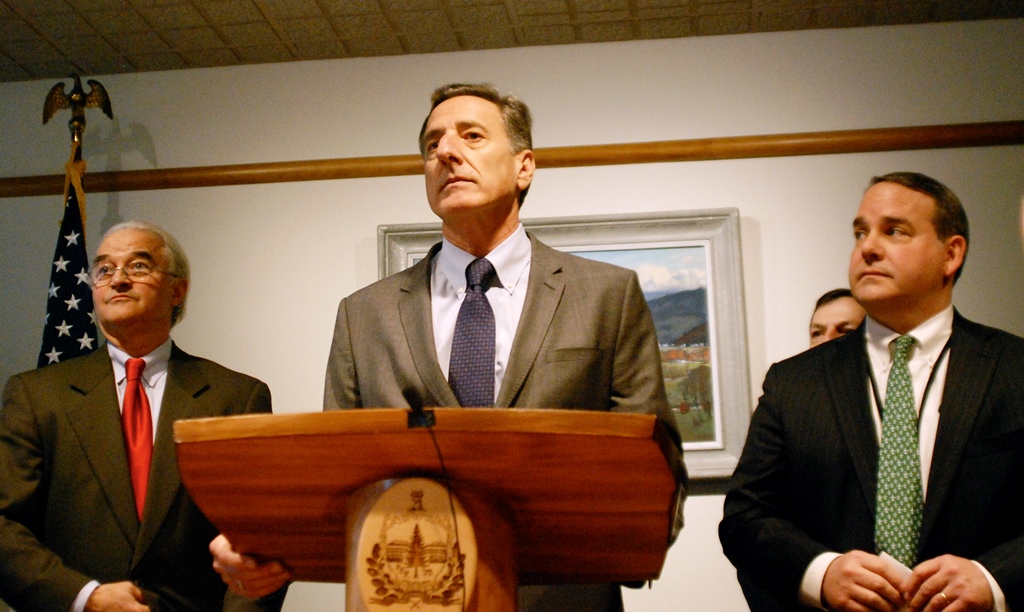
The Shumlin administration declared victory in December when Entergy agreed to dismantle the Vermont Yankee Nuclear Power Plant in as few as 15 years, but the settlement did not address the most pressing question at hand: How will the company pay to tear it down?
Five weeks after Gov. Peter Shumlin held a news conference announcing the deal, uncertainty over Entergy’s plans for the decommissioning fund has already surfaced.
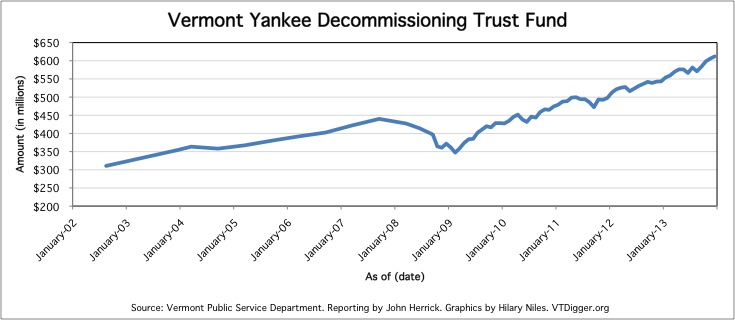
Entergy officials have asserted that the company can use the more than $600 million trust fund as it sees fit, and consequently it is unclear whether all of the funds would be available for dismantling the plant, which could cost $800 million to $1 billion.
The fund is critical to the timetable for decommissioning the plant. Under the tentative agreement, Entergy must begin to dismantle the plant once the fund reaches 100 percent of the projected cost. The fund, however, is already a far cry from the $800 million mark, and using some of the money for moving spent fuel into dry cask storage could slow plans for an accelerated timeline, state officials say. In 2009, Entergy asked the federal government for permission to use $219 million to move spent fuel rods into dry cask storage, for example.
Entergy wants to tap the fund to move some of the roughly 3,000 total fuel assemblies at the Vernon plant from its cooling pool and into dry cask storage, a process known as spent fuel management.
Meanwhile, the state wants the fund reserved to tear down the plant.
Ultimately, the state and Entergy “agreed to disagree” on the matter.
Vermont Attorney General Bill Sorrell, who helped to negotiate the agreement, said if Entergy taps the fund, the company could mothball the plant for 60 years, a process referred to as SAFSTOR — the worst-case scenario for Vermont officials.
If Entergy elects to remove money from the fund, Sorrell said the state will take legal action.
“The stakes are very significant,” Sorrell said in an interview. “Vermont is going to want a place — a legal opportunity to be heard on those requests in the future. So stay tuned.”
Entergy announced in August that it would close the plant in 2014 and abandon its pursuit of a 20-year license extension. The company has since asked the Vermont Public Service Board for a certificate of public good to produce power through the end of 2014. A decision must be reached by March 31 or Entergy can retract its offer.
The state negotiated conditions to be placed on the company’s state operating license. The pending memorandum of understanding between the state and Entergy set a nonbinding time frame for decommissioning, settled pending federal litigation and required that the company make payments to the state for renewable energy programs and economic development support for the region, which stands to lose about 600 jobs.

But after uneasy negotiations with high-level officials from Entergy Nuclear, a subsidiary of the parent company, the state was unable to put a lock on the fund reserved to clean up the plant. Now the two sides, which have demonstrated little mutual trust, are forced into something of a good-faith alliance.
Raiding the ‘cookie jar’
Some experts say the decommissioning fund is woefully insufficient, and state officials say if Entergy dips into the fund to move spent fuel there will not be enough money to pay for a swift dismantling of the plant.
Sorrell said Entergy could treat the fund as a “cookie jar” that could be used for “any number of things” — the cost of security at the plant, for example, or the cost of moving spent fuel from the reactor into the spent fuel pool or out of the pool into dry cask storage. None of these uses, in his view, are appropriate.
Before tapping the fund, Entergy will first need a waiver from the Nuclear Regulatory Commission in order to draw money from the fund before decommissioning, said Neil Sheehan, an NRC spokesman.

In 2009, Entergy filed with the NRC to draw $219 million from the fund to move and store the fuel in dry casks. The NRC approved the plan the following year. (Entergy plans to file a renewed request, officials say.)
Entergy has said it will then file suit against the Department of Energy to recover the cost of spent fuel management, a common practice, federal regulators say. Sorrell said there is no guarantee that any federal reimbursements would be returned to the decommissioning fund.
“The question is, is the decommissioning fund a big cookie jar that may be tapped for any number of purposes?” Sorrell said. “To the extent that that happens some of the expenses, like moving spent nuclear fuels, is ultimately a federal responsibility. If Entergy pays X million to handle spent fuels then the federal government has to reimburse Entergy for that. But the question is, how long does that take, and is there going to be a lawsuit between Entergy and the Department of Energy about reimbursements?”
Mike Twomey, vice president of external affairs for Entergy, insists the company has the authority to use the money to manage the plant’s spent fuel.
“Our belief is that we have that right,” Twomey said in an interview. “Once we do the site assessment and we determine a schedule for spent fuel management, we will evaluate our options for funding those activities and that includes the possibility of taking money out of the decommissioning trust fund because, quite frankly, that fund has, as always, been intended as a source of funds for spent fuel management and decommissioning.”
How the fund works
Entergy has more than $600 million in the decommissioning fund for Vermont Yankee; the cost of dismantling the plant could range from $800 million to $1 billion, according to Entergy’s most recent decommissioning cost analysis.
According to the memorandum of understanding with the state, Entergy will determine the cost to decommission the plant by the end of the year, two years sooner than required under federal regulations. The report will be similar to the company’s 2012 study.
The fund, which is invested in stock and bond markets, is similar to a 401(k) retirement account: Entergy makes small contributions to the fund, which grow and shrink with the market until the fund is used for the plant’s dismantling and radiological decontamination.
Before the decommissioning process begins, which the state wants to be as soon as possible, the fund must cover the entire cost of dismantling the plant as determined by Entergy’s own study.
Chris Recchia, commissioner of the state’s Department of Public Service, made an unsuccessful bid to reserve the fund exclusively for dismantlement and decontamination of the plant.
“Obviously, taking money out of the fund reduces the amount of money that will grow,” Recchia said.

Recchia said it is unclear what would be better for Vermont.
“At this stage, it is not clear whether it is better to do that work quickly and get reimbursement from DOE and put it back in the fund or elsewhere. And it’s a matter of figuring out what gets you to the decontamination and dismantlement quickest,” he said.
DOE officials would not speculate on whether the company would be reimbursed.
Arnie Gundersen, chief engineer with Fairewinds Energy Education and a longtime nuclear safety advocate, said it is unusual for a plant operator to tap the decommissioning fund for spent fuel management.
He added there is no guarantee that the money will come back to the fund even if it is reimbursed. “If they recover it, will they put it back into the fund, or will they put it back into the bottom line?” he said.
Gundersen has been working on a model of the fund’s growth. He says removing $200 million from the fund could delay the start of the decommissioning by five years.
Five nuclear plants announced shutdowns in 2013, including Vermont Yankee. All the other plants have opted to take the full 60 years to decommission because they did not have sufficient funds, an NRC official said.
“It’s clear that the amount of available decommissioning funding is a key factor in those other situations,” Sheehan said. “Those other sites simply do not have sufficient funding at this point to embark on immediate dismantlement.”
Costs related to decommissioning can escalate quickly.
Deb Katz of the Citizens’ Awareness Network (CAN), a nuclear watchdog group, led the charge to shut down Massachusetts’ Yankee Rowe, Connecticut Yankee and Millstone 1 in the 1990s. “One of the things that is clear with decommissioning is that the colossal failure of nuclear power becomes evident,” she said.
Massachusetts’ Yankee Rowe was shut down in 1992; it was built for $40 million and cost more than $600 million to tear down. Later, the 600-megawatt Connecticut Yankee Nuclear Power Plant, unable to compete with low cost fossil fuels, pulled the switch to shut down. Now, the cost to clean up the site is inching toward $1 billion.

A matter of trust
The administration has characterized the operator of Vermont Yankee as an untrustworthy partner. But as the plant prepares to shut down, Entergy is a necessary ally.
Last month, the Public Service Board heard hours of testimony on the state’s agreement with Entergy; now, the board will decide whether to approve the memorandum of understanding as a condition of granting Entergy a state permit to operate the plant until the end of the year.
“The way I look at it, the question really is are you better off with an MOU or not. You still have us to deal with, you still have the facility to be decommissioned, we still have prior board orders and MOUs that have to be complied with. This was a measure of our effort to change the perception of the company.”
Mike Twomey, Entergy
The board must approve the MOU by the end of March or the agreement will be canceled. Furthermore, if the board adds any conditions to the MOU that the Entergy finds unreasonable, the state could find itself either back at the bargaining table or back in court, state officials say.
“We’ll see what the future will hold,” Sorrell said.
During two days of cross-examination, citizens and lawyers questioned whether the state can be assured that the company will execute the terms of the agreement given Entergy’s rocky relationship with the state. As recently as August, the Department of Public Service scolded the company for deliberately misleading the board and filing false testimony.
“Entergy has not acted as a fair partner to the State of Vermont,” state officials said in a court filing.
In 2009, when the facility announced that a tritium leak was contaminating the compound, state officials questioned whether underground pipes could be fingered as the source of the leak. Entergy officials testified under oath that there were no underground pipes in the vicinity of the leak but later admitted that there were pipes located underground, leading state officials to say the company was untrustworthy.
PSB member David Coen, who has served on the board throughout Entergy’s querulous chronicle in Vermont, said Entergy’s previous statements before the board were like promises made by a child with their fingers crossed behind their back.
“So my question is, we have this MOU, you’re asking us to trust you again,” he asked company representatives during a technical hearing. “Considering some of this history, why should we?”
Twomey, the company’s vice president of external affairs, responded: “We could have simply said we are going to SAFSTOR for 60 years, that’s it. So the way I look at it, the question really is are you better off with an MOU or not. You still have us to deal with, you still have the facility to be decommissioned, we still have prior board orders and MOUs that have to be complied with. This was a measure of our effort to change the perception of the company.”
Twomey said the company has been a fair partner with the state — providing stable rates for Vermonters and investing hundreds of millions in the facility. Furthermore, despite attacks from the Shumlin administration, the company said it returned to the bargaining table to discuss the terms of continued operation and cleanup.
“I read the post-hearing briefs, too, including the parts about me. And I still sat down and negotiated with that team to try to find common ground,” he said, pointing to attorneys representing the state. “And I believe we have compiled a Settlement Agreement that is in the public interest, and that is a better alternative for Vermont than not having one.”
The state has few cards left to play. Entergy’s nuclear power plant on the west shore of the Connecticut River could sit for 60 years before the company would have to begin tearing it down, under current federal regulations.
That’s why Recchia defended the agreement as better than no agreement at all. “This is not about ‘trust and everything’s going to be OK, we are all best buddies anymore.’ It doesn’t need to go there. And it shouldn’t. It’s about does the agreement stand on its own, and is it a better situation than we would be without it,” Recchia told the board.
The decommissioning plan
The company has previously maintained that it would mothball the plant for 60 years and decommission the facility in 2074, and under federal regulations, Entergy has the right to do so. Entergy officials’ rationale was that it would take that long for the company to build up enough money in the trust fund to decommission the plant.
After weeks of negotiations, the Shumlin administration pressed the company for a much shorter decommissioning timeline of 10 to 15 years, which is not explicit in the agreement.
Under the terms of the agreement, Entergy VY will conduct a site assessment study to determine the cost of decommissioning by the end of the year. Once the company decides it has enough money to complete decommissioning, it will file with the Nuclear Regulatory Commission within 120 days before beginning the process, sooner than federal regulations require.
At the very least, the possibility for a hastened decommissioning, in Twomey’s words, is “more likely than if we did haven’t an agreement.”
Critics of the agreement say Entergy could net a profit from the decommissioning process if the company waits to begin the cleanup. Under its 2002 MOU with the state, Entergy is entitled to half of the remaining money in the fund after decommissioning; as a result, the company might be inclined to wait for the fund to accumulate interest in order to cash out on its leftovers, critics say.
James Dumont, an attorney representing the Vermont Public Interest Research Group before the board, said the longer the company waits to decommission the plant, the more money the company could net from the remainder of the fund.
“They don’t have a duty to Vermont residents that’s on the same level as the duty to their shareholders,” Dumont said.
VPIRG wants to give the state the authority to require Entergy to file for decommissioning when the state considers the fund to be adequate. But Entergy officials do not want the state to interfere with the current regulatory process.
“I don’t think it is consistent with that regulatory regime to have a separate arbitration panel that is not part of the NRC try to force the issue. So I would not think it would be in the public interest for there to be an arbitration on the issue,” Twomey said.
Sen. Bernie Sanders, I-Vt., has urged the NRC to provide a stronger role for states in the process of decommissioning nuclear power plants like Vermont Yankee.
At a January hearing in the Senate Environment Committee, Sanders said unless the NRC makes changes on its own, he would introduce legislation to give states a greater role in the process, according to a news release.
“The licensee has a long history of safety and disclosure problems, despite NRC oversight, including the collapse of a cooling tower and multiple leaks of radioactive material,” Sanders told the committee. “I hope you can appreciate why the prospect of letting a dangerous plant sit there for many decades makes Vermonters uncomfortable.”

Unanticipated costs
Even if the state does leverage the power it has to return the site to greenfields as soon as safely possible, questions linger over the true cost to decommission the plant.
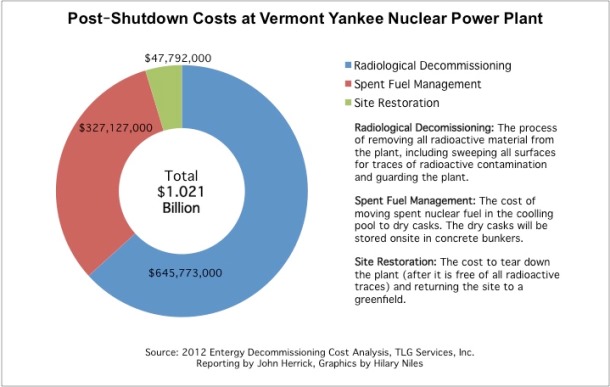
Entergy’s 2012 Decommissioning Cost Analysis report estimates the price of 60-year SAFSTOR decommissioning at more than $1 billion if the plant were to close in 2012.
Representatives of the Windham Regional Commission, the planning body for the area most affected by the plant’s closure, say the decommissioning estimates fall short.
“Our concern is that they haven’t provided a realistic estimate of what those costs would be,” said Chris Campany, executive director of the Windham Regional Commission.
The plant employs more than 600 employees in the Windham County region, fewer than half of whom are Vermont residents. The administration and regional planners want to keep current employees working in the plant after it closes. The company, which gave more than a year’s notice to employees, said it will keep the plant’s well-trained workers employed as long as possible.
Entergy has not committed to remove structures on the site beyond 3 feet below grade, as stated in 2012 decommissioning cost analysis report. The Windham Regional Commission estimates the cost of full removal of all structures, which was a condition placed on the 2002 MOU, at an additional $100 million.
The state has requested that Entergy create a separate trust fund dedicated to funding site restoration. Under the agreement, the Site Restoration Fund would reach $60 million with the assurance of a $20 million parental guarantee from Entergy Corp.
WRC, however, estimates the full cost of site restoration to be about $200 million. Entergy officials estimate site restoration costs at $50 million.
Additionally, the 2012 decommissioning cost analysis report assumes Entergy will pay property taxes on vacant lands, totaling an average of annual tax payments of $14,000 for a 33-year SAFSTOR process. This would total $460,000 for the entire decommissioning process, according to the company’s 2012 decommissioning report.
The Windham Regional Commission submitted a brief to the Public Service Board explaining its position.
“It is inconceivable that a developed 148-acre industrial site with access to road, water, rail, transmission level electricity, and employing close to 50 people on a permanent year-round basis, would be taxed as vacant land. It is unclear what the actual tax rate would be following cessation of operations, but taxing the site as ‘vacant land’ is clearly unrealistic,” WRC officials wrote.
Campany says there could be an additional $1.5 million in property taxes; this amount includes the installation of a new dry cask storage pad and the current unadjusted statewide property tax rate.
It is unclear whether the Public Service Board could order Entergy to put up any extra money for the plant’s decommissioning and site restoration. There is also little commitment from the parent company, Entergy Corp., to bail out its subsidiary.
Twomey warned that if the board requests too much of Entergy, the company could reject the MOU altogether.
“There is a lot of financial consideration in this MOU and in the Settlement Agreement. We have put up a lot of money for a lot of different items. And I would have to say that additional financial burdens on top of all of the commitments that we have undertaken would probably be material,” he said, suggesting the legal bind of the agreement could be undone.
“Obviously, it would depend on the amount,” Twomey continued. “But I would say that we believe that we have put forth a very strong financial package in consideration for the things that came out of the Settlement Agreement, and it is likely that any significant additional financial considerations would be considered a material change.”
State regulators will soon decide whether to approve the administration’s recommended conditions on the plant’s final year of operation and subsequent cleanup.
Critics of the agreement say the MOU does not go far enough to protect the state; Entergy’s message, meanwhile, is take it or leave it.
Either way, this uneasy alliance is destined to continue for decades.


