

This story, by Report for America corps member Carly Berlin, was produced through a partnership between VTDigger and Vermont Public.
In a victory for a rural coalition protesting the state’s controversial land-use law, a bill that would partially roll back Act 181 is now headed to Gov. Phil Scott’s desk.
The Vermont Senate approved the bill’s final iteration in a 28-2 vote on Wednesday afternoon.
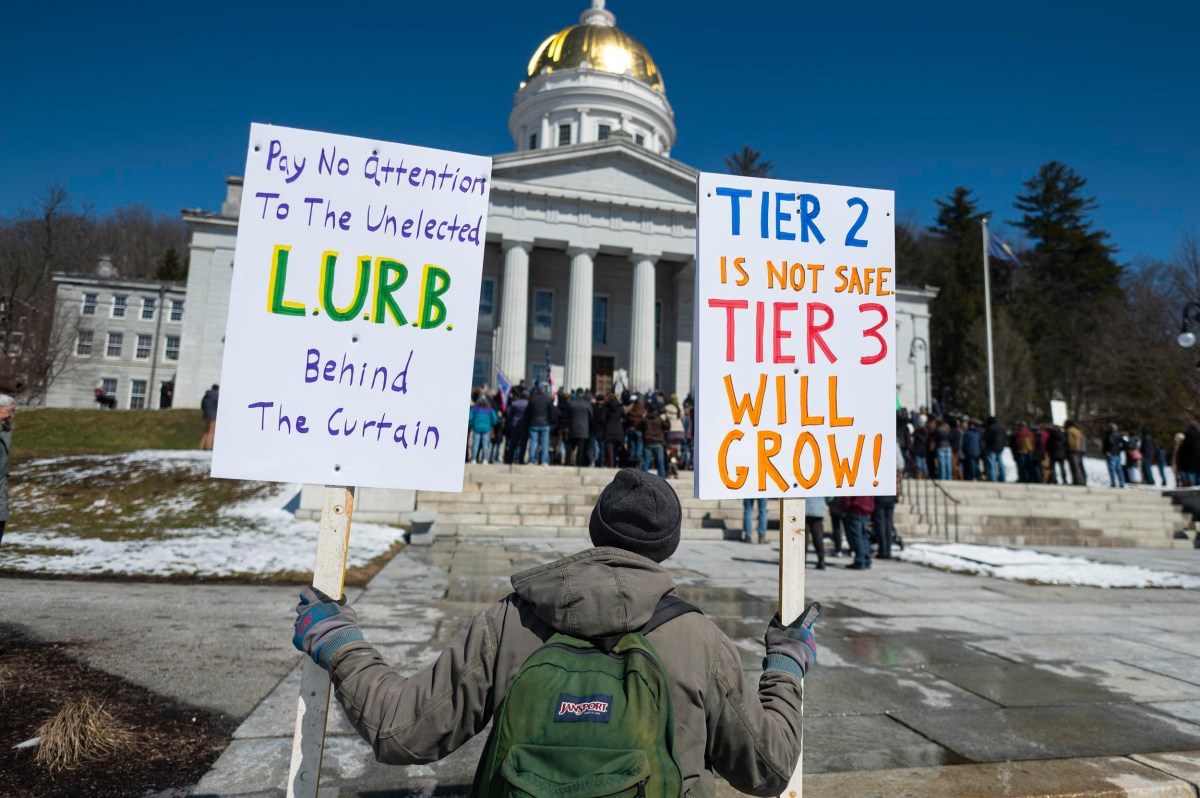
The bill, S.325, repeals portions of Act 181 that sought to beef up environmental protections around development in sensitive natural areas. The rollback marks a win for a vocal coalition of rural landowners that sprung up this spring to protest the law, arguing that its conservation measures amounted to an infringement on personal property rights.
Sen. Russ Ingalls, R-Essex, who helped organize a large anti-Act 181 demonstration in March, suggested the new movement galvanized by the land-use law will be ready for the upcoming election season.
“Rural Vermont has found their voice – has been reinvigorated into the political process, crossing party lines – and become ready to engage this August through November,” Ingalls said.
Scott, a fellow Republican, has long criticized the conservation rules in Act 181 that were targeted by protestors this spring. Yet instead of celebrating lawmakers’ repeal, Scott issued a rebuke, saying the Legislature has lacked a sense of urgency on housing reform.
“Rather than spending this session moving forward on impactful housing legislation to address the housing crisis, we’ve now spent much of the session undoing the harmful provisions of Act 181,” Scott’s press secretary, Amanda Wheeler, wrote in a statement.
Passed in 2024 over Scott’s objections, Act 181 set in motion a transformation of Vermont’s landmark development-review policy, Act 250. The law mandated a statewide mapping effort that would essentially dictate where future development would be subject to Act 250 scrutiny, and where it wouldn’t be.
In response to Vermont’s acute housing shortage, Act 181 aimed to loosen state reviews in already-developed areas. At the same time, in response to climate change and habitat loss, the legislation added environmental protections for building projects in sensitive areas.
Act 181 sought to ease development regulations in “Tier 1” zones to speed up construction. At the same time, the law put in place a new “road rule” in much of the state – “Tier 2” areas – that would require a permit for private road construction longer than 800 feet. This measure was meant to cut back on the fragmentation of forest blocks. Proposed “Tier 3” areas would bolster regulations over particularly sensitive ecosystems, like headwater streams and habitat connectors.
As state officials rolled out draft maps of these areas, the ire from rural landowners, local officials and housing boosters began to bubble up. The pushback mirrored protests against land use maps that Vermont saw back when state officials first passed Act 250 more than five decades ago.
This spring, property owners argued that Act 181’s increased environmental regulations would devalue their land, while municipal leaders and housing advocates argued the proposed conservation measures would impede future housing growth in smaller towns. The bitter tenor of the pushback online prompted a reprimand from leadership in the House last week.
The Democrat-controlled Senate voted in late March to delay much of Act 181’s implementation. A few weeks later – in a dramatic about-face that would have been difficult to predict at the outset of the legislative session – Democratic leadership in the House signaled it was willing to go further by repealing the road rule and Tier 3.
“It became apparent that it was time to step back and reconsider how to engage Vermonters in addressing the impacts of incremental fragmentation of our forests and farmlands,” Rep. Amy Sheldon, D-Middlebury, chair of the House Environment committee, told her colleagues on the House floor ahead of a vote to repeal the measures earlier this month.
House and Senate lawmakers met last week to hash out their differences on the bill and focused on relatively minor details.
Those meetings resulted in tweaks to Act 250 exemptions for some businesses on farms, stipulating that their events would need to meet a noise limit and must wrap up by 10 p.m. But those rules wouldn’t take effect until next summer, meaning lawmakers could revisit them during the 2027 legislative session. The joint panel also made small tweaks to a new public engagement plan and oversight committee meant to guide the future of land use policy.
Scott, a Republican, vetoed Act 181 two years ago, calling the legislation a “conservation bill” that would do little to fix Vermont’s housing woes. Democrats enjoyed a supermajority in the Legislature at the time and passed the bill despite Scott’s objections.
Scott has not indicated whether he plans to sign S.325. He will have five days to make a decision once he retains the bill, which usually takes a few days after the final vote in the Legislature.
