


Editor’s note: This piece is by Candace Page, a Burlington freelance writer. In This State is a syndicated weekly column about Vermont’s innovators, people, ideas and places. Details are at www.maplecornermedia.com.
ST. ALBANS – The 115-horsepower engine on Gould Susslin’s G3 power boat whined as he threw it into reverse. “Got to clear the weeds,” he said, as the boat bobbed on the olive-green water of St. Albans Bay.
Although water levels were at a record high for July, a thicket of Eurasian milfoil swayed a foot below the surface.
“Some places, the weeds are so thick you can’t take a boat in there,” Susslin said over the engine noise. The boat glided to another part of the shore where algae hazed the water column.
“The algae blooms are just getting started. They’ll be here by August,” he said.
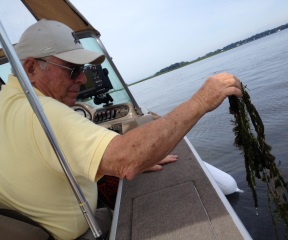
Susslin turned the boat toward deeper water, away from the floating evidence that — despite decades of promises and millions of dollars spent — water quality in this corner of Lake Champlain has not improved.
That’s true of other parts of Champlain as well, but St. Albans Bay is perhaps the lake’s most discouraging poster child.
Attempts to stem pollution – primarily phosphorus, the algae- and weed-feeding fertilizer found in sewage, farm runoff and stormwater — began here more than 40 years ago. Residents and government have tried out their best ideas to keep the bay swimmable all summer long.
It has not been enough.
Rain and snowmelt continue to wash excessive amounts of phosphorus into the bay. So much phosphorus has accumulated in sediments beneath the water that even if all land-based runoff were halted, noxious algae blooms would likely remain a regular part of summer life.
Later this year, the U.S. Environmental Protection Agency will issue new proposed targets for phosphorus reductions in St. Albans Bay and throughout the lake. An action plan designed to reach the targets will accompany them.
Promises, promises
Gould Susslin has heard it all before.
He is 85 now, retired from his dentistry practice. He speaks in a voice thinned by age and sports the bronze skin of a man who spends his sunshine hours in a boat or on a golf course.
He and his wife, Bev, bought their home on Hathaway Point Road as a summer cottage in the early 1960s before moving there year-round in the 1980s. Their four sons and three daughters spent their childhood summers here, playing in the water with the eight kids who lived next door.
“It was like running a summer camp,” Susslin recalled last week as his wife pulled out photographs of a gaggle of children diving from a raft.
Through all those years, 50 of them, he has been prominent among the campaigners for a cleaner bay.

He helped found the first St. Albans Bay Watershed Association and served as its president in the 1960s, when the bay’s most critical problem was pollution from the city sewage plant.
He lobbied for improvements to the sewage plant and saw them carried out. He helped arrange copper sulfate treatments in the 1970s that temporarily killed weeds and algae. He and the association supported a decade-long federal-state effort that installed manure pits and anti-pollution practices on 60 percent of the farms in the bay watershed.
“There was no significant improvement after all that work. A study confirmed it,” Susslin said.
Nevertheless, he still serves on the watershed association board, writes lobbying letters to Vermont’s congressmen and supports the bottle-and-can collection that helps fund the group’s work.
He understands there are no instant solutions to the problems of St. Albans Bay, a 2.6-mile-long inlet that drains a 50-square-mile watershed.
Stormwater runs off the streets of St. Albans City and from suburban development in St. Albans Town and Georgia. More than half the land in the watershed is devoted to agriculture. Nutrient-rich runoff from barnyards, tile drains and the exposed earth of cornfields pours into brooks feeding the bay.
Consultants have written a two-part prescription for cleaner water quality here: Make substantial progress in further limiting polluted runoff, then dredge (or seal off with alum treatments) some of the bay’s most phosphorus-rich sediments.
It’s an expensive plan, requiring tougher land use regulation and millions of dollars.
“Bottles and cans won’t do it,” Susslin said.

Tired of waiting
State officials urge lake advocates to avoid finger-pointing at any particular polluters. Their mantra is, “We’re all in this together,” and that city residents, suburbanites, farmers and shoreline homeowners all should share the cost of cleanup.
In his old age, and sixth decade of waiting for a cleaner bay, Susslin has dispensed with tact. He points the finger, at farmers, at government, at politicians who promise more than they can deliver.
“It’s dairy agriculture,” Susslin said, of St. Albans Bay’s pollution. “What happens on a dairy farm is their business. What comes off the farm into the lake is everybody’s business. … You’ve got to get agriculture to behave itself, and nobody wants to do that.”
He is irked that the state won’t allow weed harvesting until July 15, after fish have spawned. He’s critical of government for allowing some summer camps to be converted to year-round use without improved septic systems.
He’s unhappy that effective political organizing by advocates for polluted Missisquoi Bay has, in his view, led to less attention for St. Albans Bay in government circles. He’s impatient with Gov. Peter Shumlin, who has promised action on Lake Champlain, “but we haven’t seen very much.”
(Natural Resources Secretary Deb Markowitz said last week her agency has launched a St. Albans Bay initiative to work with local residents to set priorities for action. The new federal phosphorus targets for St. Albans Bay will likely require more storm water controls, further stripping of phosphorus from sewage effluent and tougher mandates for farmers, she said.)
Susslin was skeptical. “I wonder how far she is going to get with that,” he said. “it hasn’t happened in the past.”

As he sat on his porch, with its view of water through the trees, he was joined by his friend Steve Cushing, current president of the watershed association.
“One year Gould bottled up some of the algae in jars and sent it to the congressional delegation,” Cushing said over coffee. “He told them, “Open this up and take a whiff, then you’ll have sympathy with our cause.’”
“He’s nothing if not persistent,” Bev Susslin added.
Her husband pulled out a photo taken one summer of the water off their shore. The surface glowed a solid neon-green, looking more like the cloth on a billiard table than a place to swim – the sure sign of a blue-green algae bloom. It is not water in which one would allow one’s children or grandchildren to swim.
It explains why Susslin isn’t ready to retire from the fray.
“You’ve got to keep trying.,” he said. “St. Albans Bay is a nice place. It’s too bad to see it go.”
Candace Page is a Burlington free-lance writer.
